

9 Food Delivery Services, Ranked Worst To Best
In today's digital age, getting something delivered has never been more convenient. Food delivery was huge in America during the Coronavirus pandemic, as lockdowns swept the nation. Years later, food delivery is just as popular, as customers often incorporate it into their weekly routines. This has caused the restaurant industry to adjust its structure as well, with many restaurants succumbing to the demands of the delivery companies making the most money in order to remain in business.
Because of the explosion of the food delivery industry, a variety of apps have been created over the years to capitalize on this trend and fulfill consumer demands. While many of these apps are similar in concept, they vary in price, fees, in-app capabilities, and the range of food products available. To help customers make the best decision on which app to use for their next meal, I used my own personal experience, plus customer reviews, to round up nine of the most notable food delivery services and rank them from worst to best.
9. Caviar

Unlike many other food delivery services that are often used for everyday goods or fast food, Caviar aims to bring meals to the most discerning customers. As implied by the name, Caviar is a food delivery service that curates a selection of high-end, gourmet restaurants that might not otherwise offer delivery. First launched in 2012 and becoming a subsidiary of Square in 2014, Caviar was ahead of the curve and considered an early name in the budding industry. Later, in 2019, the app sold to DoorDash for a sizable $410 million, and its star power has dimmed since.
While looking through the options available for my local area on Caviar, I had a hard time seeing what makes this app so unique and exclusive. Almost every restaurant on Caviar is also available on another app, which defeats its intended goal of exclusivity. Customers claim the service has gone downhill since the DoorDash acquisition, with one saying on Reddit: "I order from Caviar frequently, and its emails to me say that orders are always direct delivery. But my driver today is now dropping off another order first, many miles out of the way..."
Because of their acquisition by DoorDash, customers who have DashPass — DoorDash's subscription program – can use those deals on the Caviar app as well. Without using DashPass, ordering a smoothie from my local Juice Generation would cost me $13.70, plus $3.49 for the delivery fee, and another $5.20 in fees and taxes, leading to a total price of $23.40. If I did choose to use my DashPass, the total would be $18.90.
8. Toast
Founded in 2011, Toast is a food pick-up and delivery service that caters to major cities across the country. When browsing through the local options, it's evident that this app has a smaller, more limited pool of local restaurants in its catalog. While delivery is available, it should be noted that Toast outsources its drivers to Uber and DoorDash.
I appreciate that Toast has a curated assortment of restaurants, but in my experience, ordering here has been inconsistent. When I placed an order here recently, I was given no tracking or updates, and my order arrived nearly 20 minutes later than expected with no explanation. While this may have been a restaurant specific issue, it does showcase the downside of this app, as Toast is not able to fully facilitate the handoff between the store and the customer.
However, a major perk to ordering on Toast is that — because it allows restaurants to pay a flat fee – many of its restaurant partners offer free delivery to customers as an incentive to boost sales. In the Toast app, ordering a matcha latte from a local chain — Isle of Us — would cost me $7.50 and $0.67 for tax, with no delivery fee for a total of $18.17. But be aware that delivery fees can sometimes apply, depending on the restaurant.
7. Seamless
After merging with competitor Grubhub in 2013, the once-popular Seamless app became somewhat neglected in favor of the larger delivery company. However, after both companies were absorbed by Wonder, new data from Restaurant Business Online suggested New Yorkers actually preferred Seamless to Grubhub. Seamless has since been relaunched, with Grubhub stating in a release: "In a time when the food delivery category has become more commoditized, there is clear value in the Seamless brand in New York City."
Even with this praise, some customers feel that clarity on fees, tips, and order status is confusing on the Seamless app. One customer review on Reddit explained: "They have various fees which can be inconsistent and confusing. There is a delivery fee and a service fee, but these fees are not charged on every order, and the amount and percentage is unpredictable."
A benefit of Seamless is that it allows restaurants to supply their own delivery drivers through its Turnkey service, which can sometimes make the process faster overall. When I ordered a smoothie from Juice Generation, it cost $13.70 with a $4.06 service fee, $1.56 tax, and no delivery fee. That brings the total to $19.05.
6. Gopuff
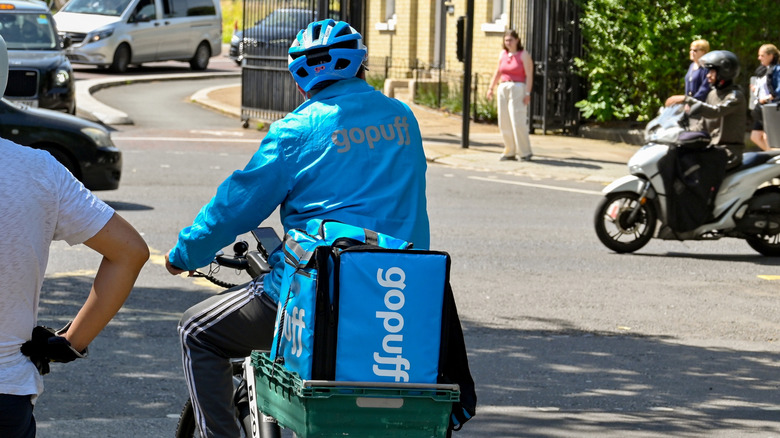
Of all the apps on this list, the one I use the most is Gopuff, a grocery delivery app known for bringing food, drinks, alcohol, and household goods to your door in as little as 15 minutes. Unlike many of its competitors, Gopuff skips restaurant delivery and has customers order directly from the Gopuff warehouse locations, allowing for a speedier process.
A typical order from Gopuff costs $3.95 in delivery fees, but that number can rise if you do not meet the minimum order price. Customers have the option to purchase a Gopuff FAM membership, which offers free delivery, weekly deals, and more for a $7.99 monthly plan. However, some customers complain that it's hard to cancel after signing up for the membership, with one customer reviewing: "I then went to cancel the subscription...and low and behold, there is not a single way to do so on the app... my only options were to switch payment methods or switch to an annual membership."
If I were ordering a specific bottle of white wine from Gopuff, the wine would cost me $16.07, with $4.95 in delivery costs, and $4.50 in fees, for a total of $25.52. With a Gopuff FAM membership, the wine would be discounted to $15.36 with $0.00 in delivery costs and only $1.55 in fees, for a total of $16.91. While Gopuff is limited by the fact that it does not offer restaurant food, the app's prices, membership deals, and speed make it a strong option overall.
5. Postmates
Founded in 2011, Postmates currently delivers in 40 major cities across the country. However, since being acquired by Uber, the app has become essentially a secondary version of Uber Eats. I used to love Postmates for its competitive prices and variety of deals, but since its acquisition, the app feels less unique.
Like Uber Eats, Postmates offers a variety of in-app deals on select restaurants, which is appealing. It also offers a large variety of restaurant options, including some upscale restaurants like Sugarfish and Luke's Lobster, that are exclusive to the Postmates and Uber Eats platforms. Those with Uber One can also use their $0 delivery deals with Postmates. However, some customers report that the app's customer service is inconsistent and confusing. One disgruntled customer on Reddit shared, "...at this point I can't even remember how long it's been since I've attempted asking Postmates for a refund for missing items...I've come to learn that I am unfortunately just wasting my time."
Without a membership, ordering a Juice Generation smoothie would cost me $13.70 on Postmates, with $0.49 for the delivery fee, and $4.07 for taxes and other fees, bringing the order total to $18.26. With an Uber One membership, the delivery fee would be waived, bringing the order down to $17.77. While the connection to Uber One is convenient, there is nothing in particular that Postmates is doing to stand out from their competitors as a delivery service.
4. Grubhub
Grubhub services over 4,000 cities across the country, making it one of the largest food delivery apps in the industry. The company — alongside Seamless — was acquired by Wonder, which aims to "...make great food more accessible." The app offers a wide variety of local restaurants and chains, and I've noticed that Grubhub is often used by restaurants for processing pickup orders. While I used to associate Grubhub with being affordable and consistent, several recurring issues with the app's interface and customer service have made it difficult to continue to support the brand. I am not the only user who has noticed issues with Grubhub's customer service, with one customer claiming that their food never arrived and the driver wouldn't respond to calls. When they tried to call Grubhub directly, the calls would consistently fail.
The company offers a Grubhub+ membership, which includes $0 delivery fees, reduced service fees, priority delivery, exclusive offers, and a 5% cash-back deal on pickup orders, all for a monthly fee of $9.99. On paper, this is one of the strongest membership deals, which contributes to the app's ranking on this list. If I were to buy the aforementioned green smoothie from Juice Generation on Grubhub, it would cost me $13.70 for the smoothie, $0 for delivery, $3.79 for a service fee, and $1.56 for tax, for a total of $19.05. With Grubhub+, this order would be discounted by $1.39 for a total of $17.69.
3. Instacart
Instacart is a food delivery app catered towards supplying groceries, alcohol, and household supplies to the approximately 600,000 users of the platform. Instacart works directly with over 1,500 grocery retailers to populate its app, allowing users to easily build their grocery delivery orders from whatever supermarket they prefer. Using this app is easy, and scheduling a preferred drop-off time is also convenient.
Each order on Instacart is subject to fees, which are based on distance, locations, order size, and the contents of an order. Instacart also offers a membership plan called Instacart+, which costs $9.99 a month and gives customers access to no delivery fees and membership perks. One customer reviewed the membership on Reddit: "I have an Instacart membership and almost never use it now because it ends up being so much more expensive than going to the grocery store... The fees, plus tipping the delivery person...often ends up being $20-plus more than I'd spend if I just paid the MTA fare."
If I were to buy a case of water from Aldi on Instacart, the item would cost $13.16, delivery would cost $7.99, service fees would cost $2.49, and taxes and additional fees would be $6.12, for a total of $31.76. With Instacart+, the item price would be reduced to $12.36, the delivery fee would be waived, the service fee would be $2.49, estimated taxes would be $6.12, for a total of $22.97. While Instacart is incredibly convenient, its inflated prices mean I would only recommend ordering with this app if you're in a pinch.
2. UberEats
When the ride-share app Uber launched their food delivery service Uber Eats, it was clear the idea was destined to be a success. With a large arsenal of delivery couriers already under their control, venturing into food was an incredible move for the company. While I do feel that this app is sometimes too expensive and has long wait times for items, I appreciate it for the great promotions it has on select restaurants.
You can order Costco groceries with Uber Eats, and the app also has access to some rare and exclusive stores and restaurants in my area of NYC. As an added bonus, UberEats offers great live-order tracking and options for splitting the costs of orders with friends and family. However, even with these positive aspects, the app also has some major issues. As one unhappy customer said on Reddit: "...Uber Eats is okay, but if your order is messed up, they generally do not care."
Perhaps the best aspect of this service is the Uber One membership, which offers $0 delivery fee on eligible food and groceries, up to 10% off of pickup orders, 6% cash back on Uber rides, and no cancellation fees for $9.99 a month. If I were to buy the smoothie from Juice Generation using Uber Eats, it would cost me $13.70 for the smoothie, $0.49 for the delivery fee, and $4.37 for the taxes and additional fees, for a total of $18.56. With Uber One, the total would be reduced to $17.52.
1. DoorDash
While no food delivery company is perfect, there is one that comes close. Since its founding in 2013, DoorDash has exploded in popularity, becoming a staple in over 40 countries around the world. Known for its timely customer service, large selection of restaurants, and competitive membership offerings, it's a great choice when it comes to meal delivery. By 2023, DoorDash had made some big changes to its app, like allowing customers to purchase groceries with their SNAP benefits, further cementing it as an industry leader.
DoorDash still has its negatives, mainly the expensive fees that accompany orders, but the store is also known for being more consistent than some other competitors in terms of customer service and in-app deals. One fan on Reddit shared: "DoorDash is probably the most universal. Lots of restaurants and grocery shops, and the DashPass helps if you order often." The DashPass subscription service offers free deliveries on in-app orders over $15 for $9.99 a month. DoorDash claims that "...the average DashPass subscriber saved over $20 per month, even after the monthly subscription fee."
Without a membership, ordering one Juice Generation smoothie from DoorDash would cost $13.70, $3.49 for the delivery, and $6.21 for the fees and taxes, for a total of $23.40. With DashPass, you are discounted $4.50 for an amended order total of $18.90. While there are cheaper options elsewhere, I like DoorDash for the peace of mind I have with its helpful customer service and accurate order tracking.
Methodology
To write this article, I pulled from my experience as a consumer and personal user of all of these food delivery applications. In order to ensure my ranking was as accurate and helpful as possible, each food delivery service was considered based on a variety of factors, including the cost of fees, the price of the items, the range of products available to order, the delivery times, and the customer service. I also note what kinds of unique functions they offer for customers, including in-app order tracking, customer service chat lines, and updated driver information.
This ranking was also influenced by a comparison of membership services. I used customer reviews on Reddit to help further illuminate the strengths and weaknesses of each app. While we do have a guide discussing the best value between DoorDash and UberEats, I aimed to look broader and encompass some lesser-known apps as well. All prices, fees, and restaurant inventories mentioned in this article are based on the local prices and availability in my area of New York City at the time of writing.