

11 Ways To Brighten A Dark Kitchen
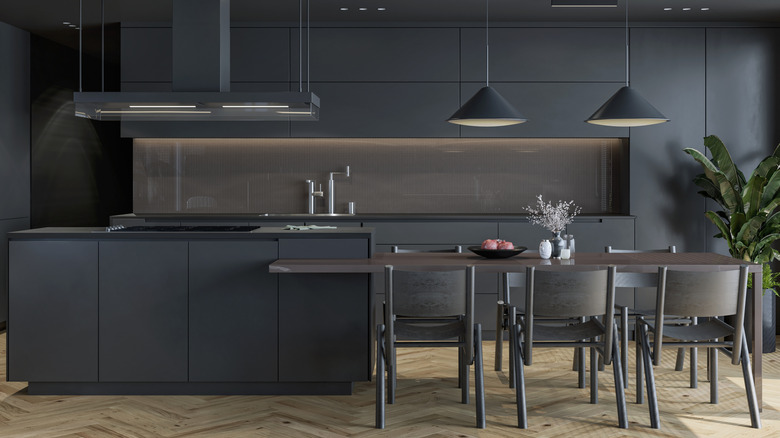
Brightening your kitchen can make the space feel larger than it is and keep it looking clean, but those aren't the only advantages. Preparing meals safely in a dark kitchen can be challenging, especially when you're using sharp knives and handling hot pots and pans. You might also dislike spending time in your kitchen if you struggle to see what you're doing. Fortunately, there are plenty of ways to brighten a dark cooking space.
From selecting light-colored and reflective surfaces and utilizing paint tricks to adding or replacing bulbs and increasing natural light, these kitchen updates can boost functionality, enhance mood, and improve safety. They can also make your kitchen look more stylish and create a positive environment. While some of these fixes are quick and easy, others require time, planning, and monetary investment. The upside is that you can incorporate as many of these as you want (depending on what your budget allows) in order to create a brighter kitchen where you enjoy spending time.
Choose a light-colored countertop
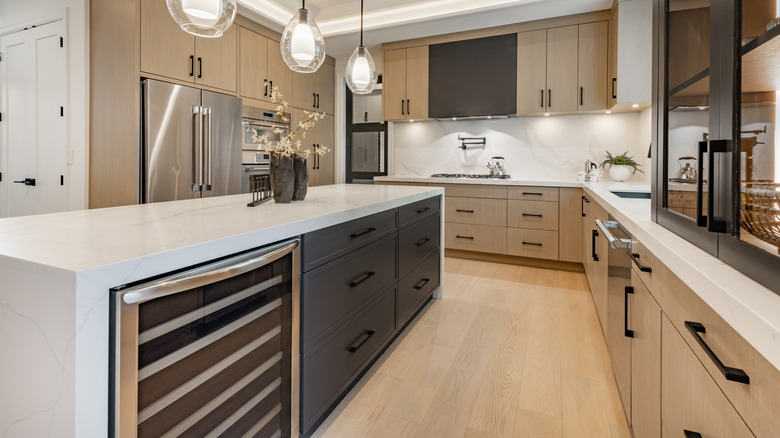
There's no denying that your kitchen's color palette can really affect how light the room feels, and that includes your countertop. Dark countertops absorb light, making the room feel smaller and preventing light from spreading throughout the space. On top of that, they make dust and fingerprints more apparent, meaning they require more maintenance to keep them looking pristine.
If you have the budget, replace your dark countertop with a lighter option to brighten your dark kitchen. You could certainly go with something completely white, but you may also be drawn to something a little softer, possibly with veins. While small, faint veins add subtle color and variety, larger veins can stand out and make your counters look like artwork. Brown, deep red, and gold veins, for instance, are eye-catching elements that introduce extra details and style.
Along with reflecting light and making your kitchen look more airy, brighter-colored countertops are versatile. You can pair them with both light and dark cabinetry, and with a range of colors and finishes for your floor and walls.
Paint some (or all) of your cabinets a lighter color
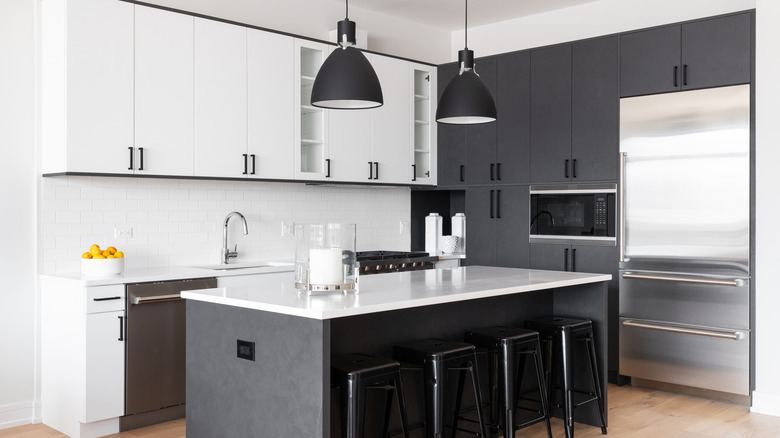
If your kitchen doesn't get a lot of natural light or have many light fixtures, the space can easily feel dark when the cabinets are painted in bold, deep hues, especially if both the uppers and lowers are painted the same shade. Making the room feel brighter can be as simple as repainting the top cabinets in a white or pastel color that complements the dark shade of the bottom cabinet.
In fact, using light hues on upper cabinets and dark hues on lower cabinets is the clever cabinet paint trick that gives small kitchens a big look. The darker color on the bottom keeps the space grounded, while the lighter color on top helps light reflect around the room. With this two-toned trick, you can choose various shades from the trendy kitchen paint colors to try in 2026, like Universal Khaki from Sherwin-Williams, C2 Epernay from C2 Paint, Hidden Gem from Behr, and Divine Damson from Graham & Brown.
On the other hand, you could repaint all of your cabinets in lighter hues. To avoid the blinding effect of all-white cabinetry, consider pairing it with a pale, neutral shade on the lower cabinets or kitchen island. You could even paint all of your cabinets in the same pale or pastel color.
Use reflective finishes for cabinets and fixtures
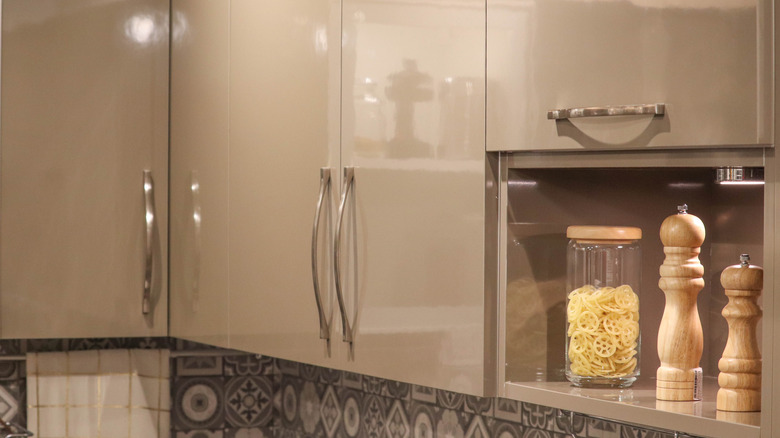
Choosing light colors for countertops and cabinets isn't the only way to reflect light in your kitchen. Paints come in various sheens and finishes, for instance, that can help reflect light. While eggshell offers minimal glossiness, semi-gloss and high-gloss enamels are super shiny for maximum light reflection.
Another option is to apply a glaze to your cabinets, preferably after giving them a fresh coat of paint or stain. This semi-clear coating, which is available in white for light-colored cabinets, adds depth and dimension by creating highlights along corners and profiles to make details stand out. Best of all, the glaze will reflect artificial and natural light to help illuminate your kitchen.
Countertops are similar in that they come in various materials that allow light to bounce off of them, such as granite, marble, and quartz. A glass backsplash and metallic, shiny finishes on appliances, sink fixtures, cabinet knobs, and other surfaces will have the same effect. On top of that, you can spring for light-colored, reflective flooring, including laminate, tile, veneer, and vinyl.
Create contrast with pops of color
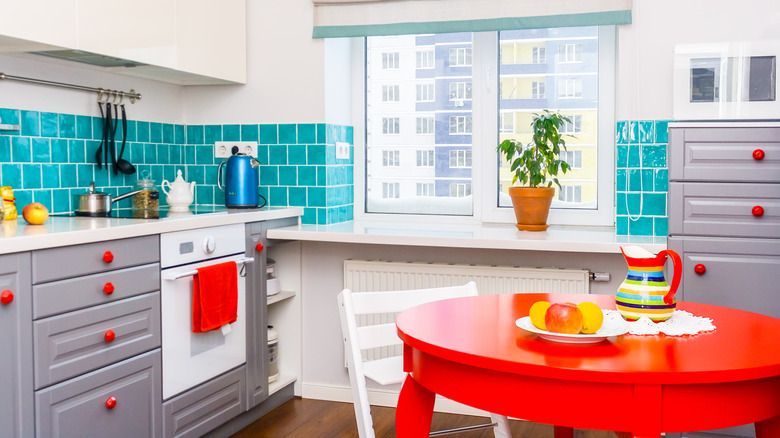
Two-toned cabinetry is one of the best ways to add contrast to your kitchen and avoid the monotony of plain white and other pale, monochrome designs. If you're using white on the uppers, pretty much any other color will pair well with it. If you're looking for contrast, some of the best paint colors to pair with white kitchen cabinets include dark olive, peppered black, deep violet, and moody blue. However, painting the cabinets isn't your only option.
Another way to introduce contrast and brighten a kitchen, even with dark-painted cabinetry, is to add pops of lighter shades throughout. For example, a light-colored glass backsplash, especially one with a pattern, can break up the dark aesthetic so that your space looks brighter. Consider choosing light-colored wall paint, floor materials, fixtures, appliances, and other surfaces to contrast with the dark cabinets as well.
If you instead decide that repainting your dark cabinetry in a lighter color is a better fit for your space, just do the opposite. Introduce pops of darker, contrasting colors throughout. Don't be afraid to use bold colors here and there to add character and personality to your space, too.
Select the right lighting for your ceiling height
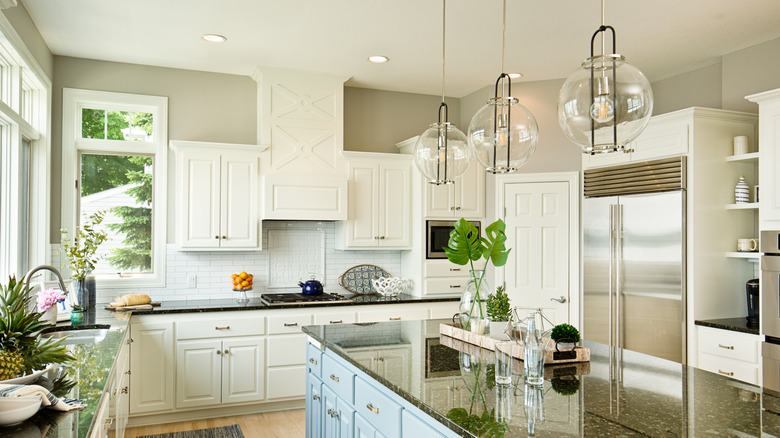
You might not realize it, but the height of your kitchen ceiling and the type of lighting you use both affect the brightness of your space. While the minimum ceiling height in homes is 7 feet, 8 feet is typical, so anything between those measurements is considered low. Lights that hang down from low ceilings can make a room feel smaller and can't maximize light dispersion. Instead, consider installing recessed lights and placing them evenly throughout the whole space.
On the other hand, dramatic pendant fixtures are one of the best kitchen design tips we've learned from celebrities like RuPaul. Rather than acting as the main source of light throughout the entire room, these fixtures are great for brightening a small, dark area of your kitchen, like an island or sink. You can get the most out of pendant lighting if the fixtures are made with shiny, reflective materials (like clear glass) and white or light colors. Wall sconces are another way to make your kitchen brighter, and they're a space-saver that won't obstruct your view.
Combining multiple lighting layers can lift any dark kitchen, and setting them to separate switches gives you complete control over how bright your space gets. For even more control over the atmosphere, put some (or all) of the lights on dimmable switches.
Install lights under your cabinets
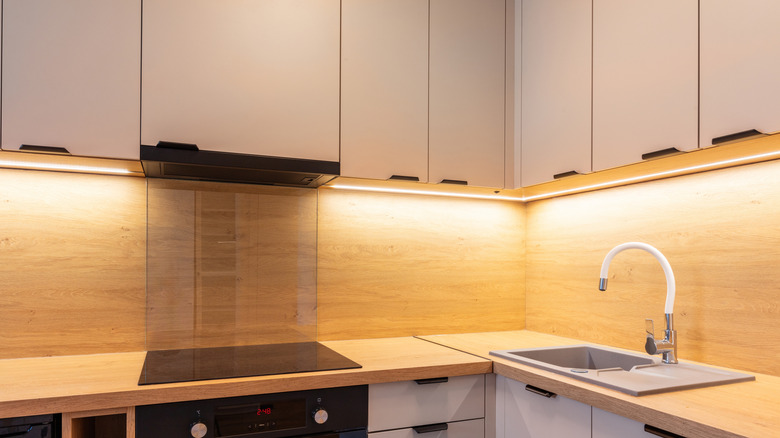
In many kitchens, the space underneath the upper cabinets is too dark for meal prep or completing small tasks. This can happen when contractors install lights too close to cabinets, creating a shadow under them when they're turned on. Shadows can also occur if your light fixtures illuminate your back when you're at the counter, as this prevents the light from reaching the workspace.
Under-cabinet lighting is the ultimate solution because the light will shine in front of you and in close proximity to the workspace. If can also provide excellent ambience as the light reflects off of your countertop and backsplash.
When selecting under-cabinet lighting, you have a few main options that come in various colors and temperatures. Light bars may be wired or battery-powered and generally range from 9 to 24 inches long. Puck lights are also wired or battery-powered but are more customizable because you can place them exactly where you need them. Typically only available as a wired option, strip and rope lights are similar: These are constructed from LED lights that are set into a plastic strip or transparent tubing. Some strip lights have a tape backing that allows you to simply stick them to the underside of your cabinets.
Add glass doors to the upper cabinets
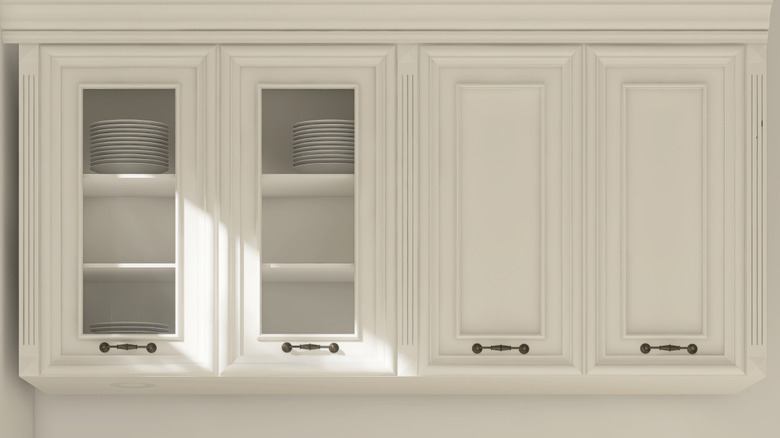
Glass-door cabinets are a kitchen trend from the '90s that's making a comeback, and they're a great solution if you need to make your kitchen feel more airy and open without repainting your cabinets. Since these introduce a different texture, they break up the closed-off aesthetic of solid doors and allow light to shine through so that the cabinetry looks lighter and brighter. Additionally, they give you a dust-free space to put anything from neatly stacked tableware to vintage collectibles, creating a classic, timeless design.
To maximize these effects, glass-fronted doors are typically used on upper cabinets, but you can use them on lower cabinets, too. You can even use them for your kitchen island and butler's pantry. However, we don't recommend using them on all of your cabinets. Instead, choose a few cabinets where the glass doors can act as accents with curated, organized dishes behind them. This will still give you some hidden storage, so you won't have to worry about how presentable everything looks.
Another thing to keep in mind is that clear glass is the best option for making a dark kitchen brighter, especially if you intend to keep your cabinets' deep color. However, frosted and textured glass, whether it's fluted or reeded, can add visual interest.
Replace upper cabinets with open shelving
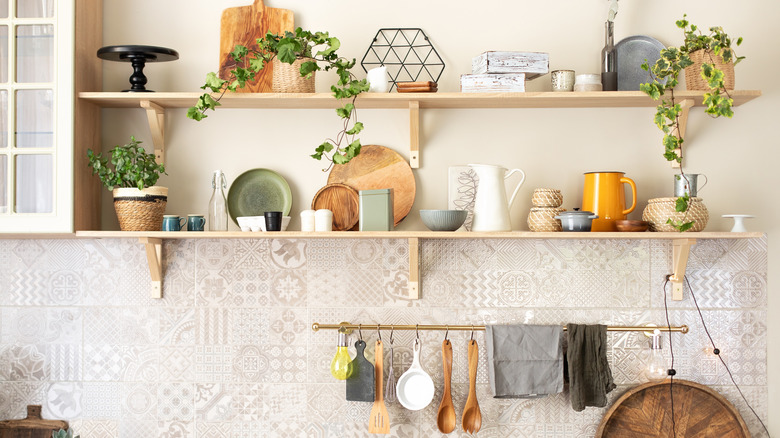
While glass-fronted cabinets provide a great middle ground when you want to make your kitchen airy and bright without losing storage space, completely replacing some of your upper cabinets with open shelving is another option. Removing some of the solid-fronted cabinets will allow more natural light to bounce around the space and make the room look bigger, creating the illusion of a brighter kitchen.
Open shelves, which are simply shelves mounted on walls without any enclosures, still give you some storage while also creating balance. Combining open shelves with closed cabinets is a great way to add flexibility to your storage options, just like with glass-door cabinets.
Open kitchen shelving offers other benefits, too. Since you can clearly see what's on the shelves, you're more likely to keep items organized so your kitchen doesn't look messy. This design makes everything convenient to grab, even for guests, and it works great for odd areas, like around doorways, where closed-in cabinets just wouldn't be ideal. Best of all, since kitchen remodels can get expensive, open shelves can be a budget-friendly solution.
Change your window curtains or rods
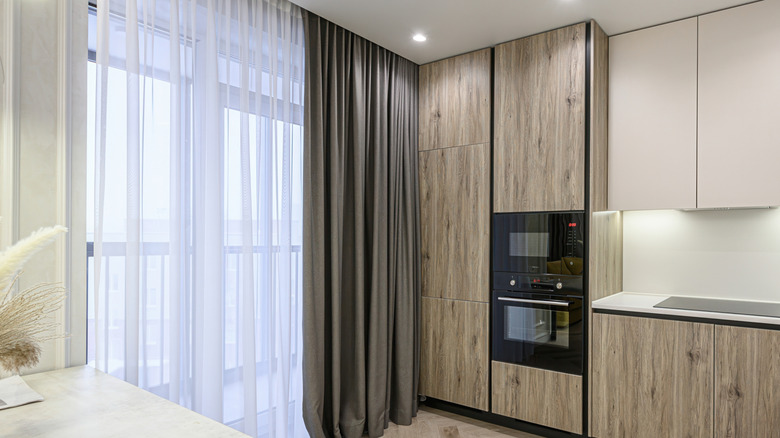
Having plenty of natural light in your kitchen is just as important as having the right artificial lights to prevent the room from getting too dark. While colorful drapes can keep out glaring sun while giving your kitchen design a cohesive element, they may not let in enough light if you have dark cabinets. Fortunately, you have a couple of options to improve the flow of natural light through your windows.
The first option is to replace the rod if you want to keep your current window treatments. A curtain rod that's longer than your windows' width will allow you to gather the fabric on each side and let in more light when you need it the most. However, even when pulled aside, dark-colored window treatments can make a room feel darker and smaller than it actually is.
That's why, budget allowing, new window treatments are the best option. They let in more light, even when they're covering your windows. Some examples include plantation shutters, Roman or solar shades, slatted blinds, and sheer curtains. We recommend light-colored window treatments to maximize their brightening effects.
Set up a mirror to reflect existing light
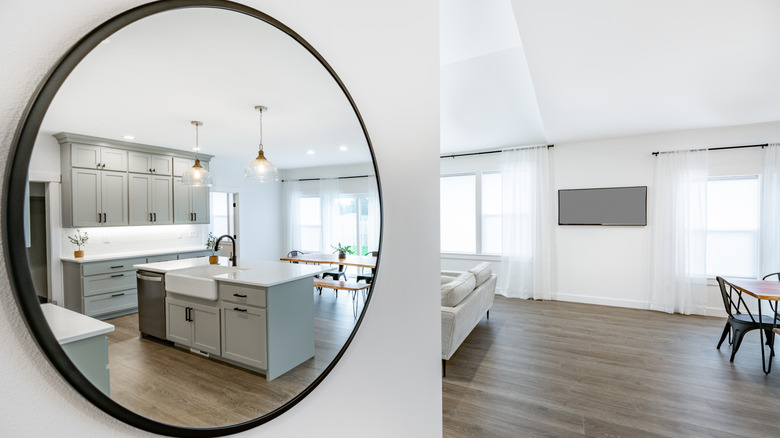
Like other reflective surfaces, mirrors are a great way to bounce light around your kitchen and make the space brighter. Adding a mirror to a wall opposite your kitchen windows will give you the best results, as it will reflect the most natural light around the space. You can even add a bit of old-timey style to the room (for an affordable price) with gold-framed mirrors, which are one of the HomeGoods kitchen decor items that could definitely pass as vintage.
You don't have to use just one large mirror, either. Instead, hang multiple small mirrors around the kitchen, strategically placing them where they'll reflect natural and artificial light to brighten the area. Another option is to replace your kitchen's current backsplash with a mirrored backsplash, or to use an actual mirror in its place. This design choice can be particularly useful behind the cooktop or sink. Lastly, mirrors can add artistic texture and make your kitchen look bigger.
Add a skylight
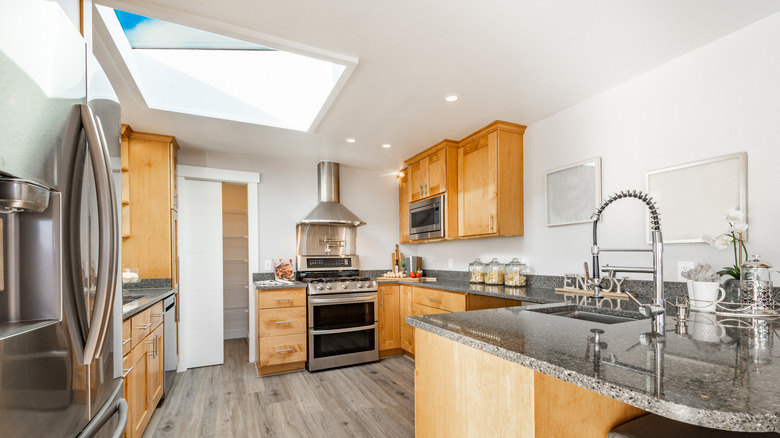
Utilizing all the natural light in your kitchen and ensuring that you have the right artificial light fixtures still might not be enough to brighten the room to your liking. If that's the case, you can definitely add a lot more natural light by installing a skylight in your roof. This is an especially effective option if your kitchen doesn't receive a lot of natural light from its regular windows, as the sun will beam down from above.
While a skylight requires a lot of work to install and can be costly, it easily brightens rooms because of its size. If you're on a smaller budget, though, a sun tube or tunnel could be a better option that's much simpler to install. This type of lighting is comprised of a tube with an acrylic dome that sticks out of the roof. It collects and magnifies light that flows through a light diffuser on the ceiling end, brightening your kitchen evenly. With strategic installation, which only takes about three hours to complete, one or two sun tunnels can introduce more than enough natural light to your space.