
10 Burger Chains That Are Trying To Make A Comeback
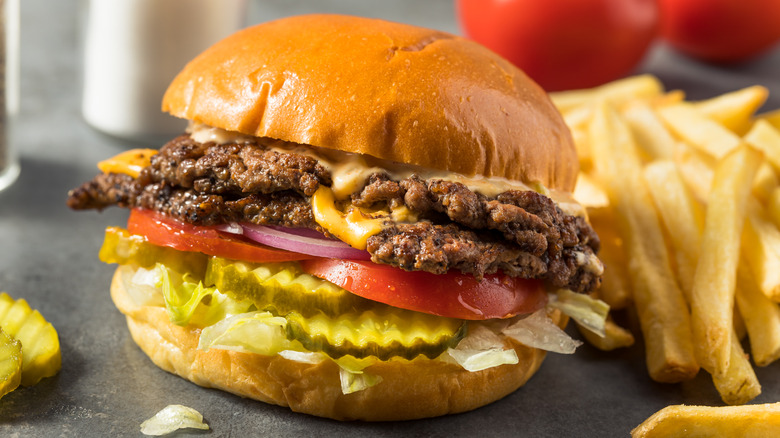
There's nothing more American than a good burger. The simple combination of meat and bun has been pleasing taste buds for generations, and so it's no wonder there are countless burger restaurants in the United States. However, not all of them have been as successful as the titan that looms above them all (we're talking about McDonald's, if that wasn't already obvious). For every burger chain that made it big, there's another one that failed to take off nationwide; and for each burger chain that's flying high, there's one that's had a run of bad luck.
However, a lot of burger businesses that have been struggling are ready to make a comeback. Chains like Fuddrucker's, Fatburger, and Smashburger are going all out with their plans for the future, in hopes of turning things around. Even big names that you might not expect, such as Burger King and Wendy's, are mounting a major push to reassert their dominance after a period of difficulty. Let's check out the burger chains that might be the winners of the years to come.
Fatburger
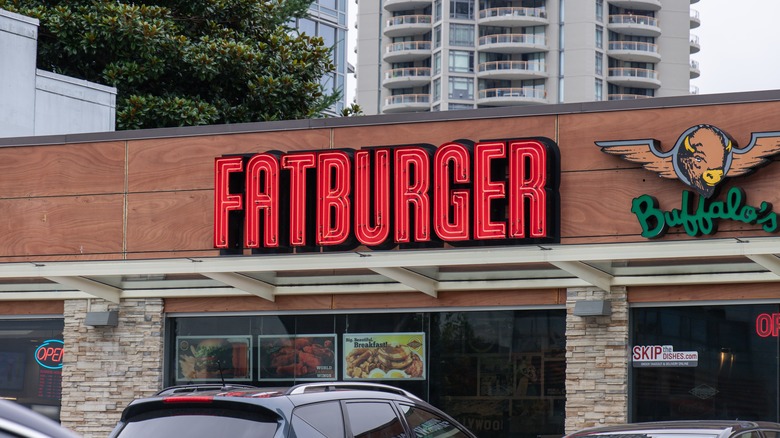
For the last 15 years or so, it seems like Fatburger has been clinging on by its fingertips. The burger chain has seriously struggled since the 2000s, and in 2009, a bankruptcy claim was filed after its then-parent company, Fog Cutter Capital Group, struggled to keep up with loans. During the 2010s, the brand never quite took off in the way that some of its competitors did, and it stayed largely in the background. Then, in 2021, it was dealt a fresh blow, with labor shortages meaning that it was unable to staff its restaurants adequately.
Given the sheer number of years that it's been having a rocky time, no one would blame Fatburger for throwing in the towel. However, it's doing anything but that, and 2025 has seen the chain fire itself up for a huge push for a bigger hold on the market. In April, its current owner, FAT Brands, announced it was switching to almost a pure franchising model, while simultaneously signing off on an agreement to build 40 new Fatburger restaurants. Those restaurants, which will be built over the next 10 years, will be located in Florida and will expand the brand's footprint in the state massively. Then, in September, it stated that it was making a long-awaited return to Japan, with four new restaurants to be built in Okinawa. This push for national and international presence sends a clear signal: Fatburger is back.
Smashburger
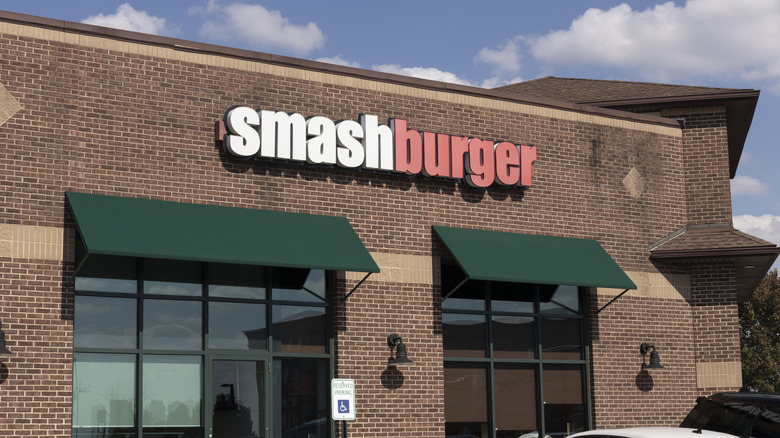
Ever since the first smash burger was invented, they've been all the rage. Sadly, Smashburger, the chain that specializes in serving them, hasn't always had that same appeal. The concept has seen a steady shrinking in its size over the last decade, ever since it was bought by Jollibee Foods Corp. in 2015. Since then, Smashburger has lost more than 100 of its units, and it's consistently been underperforming when compared to similar restaurants like Shake Shack and Five Guys. Its sales, too, have also been on the decline.
However, folks at Smashburger have clearly decided that enough is enough and that it needs to make a comeback in style. It's done so by firstly securing a new CEO, Jim Sullivan, who was promoted in August 2025. Sullivan announced that it was time to give Smashburger a shot in the arm, which the brand would do through various avenues, first by reinvigorating its menu, and also by giving customers a serious sense of value. In the summer of 2025, it did so with its "Summer of Smash" promotion, which offered classic orders for just $4.99 — and that generated increased traffic for the brand.
Fuddruckers
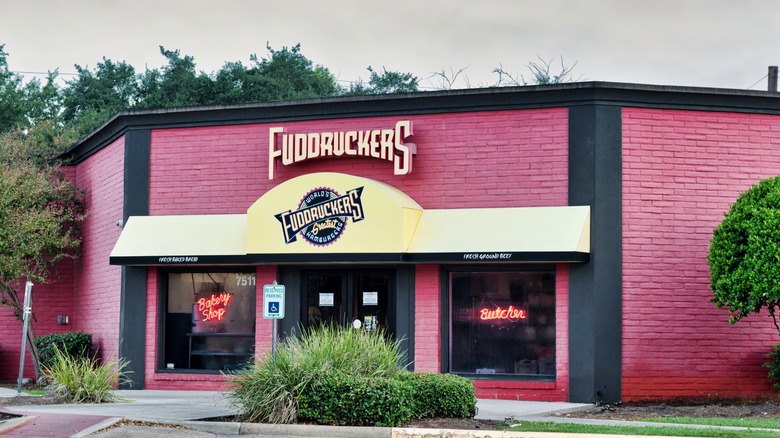
Fuddruckers may have been around since the '80s, but just because a brand's a little older and still kicking, doesn't mean it's remained successful. Fuddruckers entered a period of difficulty back in the 2010s, when it had to file for bankruptcy alongside its parent company, Magic Brands LLC. After this bankruptcy claim, it was sold to Luby's, but the business decided that Fuddruckers wasn't worth the effort and in 2021 sold it once more to Black Titan Franchise Systems, a company owned and managed by franchisee Nicholas Perkins.
Well, it turns out that the sale may have been the best thing that could have happened to the restaurant. Cut to 2025, and Fuddruckers is on the rise again, a few years after Perkins stated that he wanted to make it a market leader once more. The restaurant began to move into territories that it had formerly operated in but had to leave, with both new locations opening and the brand reopening old units. Perkins seems to be serious about bringing Fuddruckers back into the conversation, and we're excited to see where it goes next.
Sonic
Toward the end of the 2010s, Sonic was having a tough time. The restaurant's history extends all the way back to 1953 (when it was known as Top Hat, before it took on the famous Sonic name), but as the 21st century rolled on, customers began to tire of its retro offering and its unhealthier menu full of items that you'd probably want to avoid ordering. By 2016 and 2017 its sales gradually declined, and while the heads of the company blamed a slow-moving consumer landscape, it was clear that something was wrong. It marked its eighth consecutive sales decline in mid-2018, which came at the same time as a widespread closure of its stores.
However, now it seems as though Sonic's dark days are in the past — for now, at least. And 2024 saw Sonic launch an ambitious new advertising campaign heralding the "new era" of the restaurant, looking to break through the standard messaging that comes from burger companies with a light-hearted, humorous vibe. In 2025, it's focused on revamping its menu and offering $1 options to its customers, representing a brand-new value proposition. Alongside all this, Sonic has also been opening new stores in locations it formerly left, marking a quiet but confident return to form.
Burger King
How can Burger King make a comeback if it never really went away? We understand why you might be thinking this: After all, this chain is still one of the biggest in the country, and has been for decades. However, there was a moment not so long ago when it looked as though its future could be in serious jeopardy. In 2023, it announced that it was closing up to 400 of its stores, after several of its franchisees announced they were filing for bankruptcy. By the end of the year, the company's messaging was that it still intended to close units and that its debt expenses were looking pretty rough. It cast somewhat of a bad light on the restaurant and made it seem slightly weak in comparison to its biggest rival, the indomitable McDonald's.
In the years following, though, Burger King has been working hard to reassert itself. And 2025 saw it push forward its "Reclaim the Flame" comeback plan, which was first conceived in 2022, and which will see parent company Restaurant Brands International invest $550 million into the brand through to 2028. This plan also saw it heavily promote its new Whopper by You platform, which allows customers to contribute ideas to create new versions of its iconic sandwich, and which has given the brand renewed life. It's suddenly looking a lot more exciting.
Wendy's
Wendy's may be one of the most recognizable restaurants in the country, but recognizability doesn't necessarily lead to continued success. The chain has made a lot of mistakes in the past, and 2024 and much of 2025 were particularly challenging times, during which it struggled in an environment where customers were turning away from fast food due to higher prices. At the end of 2024, it announced that it was closing a whopping 140 restaurants, in a bid to balance its portfolio and trim down on underperformance. This was meant to boost Wendy's fortunes for the coming year, but in August 2025, it stated that it was having to cut its sales outlook, and explained that it was expecting its global sales to drop by up to 5%.
Clearly, this caused a lot of distress in the Wendy's camp — so much so that in October 2025, it mounted an all-out offensive. The brand launched "Project Fresh," a four-point strategic plan designed to reinvigorate the brand and increase value. The launch announcement came with a statement from chairman Art Winkleblack, who noted that both the board of directors and Wendy's management weren't happy with how things had been going, and that they needed to get back on track. You can expect to see Wendy's have a lot more presence in the coming years.
Steak 'n Shake
The roller coaster ride of Steak 'n Shake's fortunes has been pretty wild. During the 2008 financial crisis, the brand was almost done for, and was losing roughly $100,000 per day with barely any cash reserves. It managed to mount a comeback, and by 2009 was generating excellent cash flow — before the end of the 2010s saw it begin to decline once more, with consecutive years of losses. Going into the COVID-19 pandemic, it was in a rough place, and its performance was up and down for the following few years.
In 2025, though, it looked as though it had finally gotten its groove back. The year saw the culmination of a long-term transformation at Steak 'n Shake, in which it closed approximately 200 locations, removed table service, and created a speedier experience for customers. This created an incredible reversal of fortunes for the brand, which had already been on the rise through 2024. In the second quarter of 2025, it disclosed a 10.7% increase in same-store sales. Steak 'n Shake's success goes to show that store closures aren't always a bad thing: Sometimes, they're just a repositioning.
Back Yard Burgers
Back in 2023, it looked like Back Yard Burgers was done for. In July of that year, the burger chain announced it was filing for Chapter 11 bankruptcy for the second time, following a rough couple of years coming out of the COVID-19 pandemic. The chain had seen its units shrink from 35 to just 20 in the space of around six months. If that wasn't bad enough, it's worth noting that Back Yard Burgers was once almost 10 times the size: Back in the 2000s, it had 180 restaurants across the country. It couldn't keep up with competition, though, and was overtaken by competitors like Shake Shack before filing for bankruptcy in 2012.
However, in 2025, it managed to emerge looking not quite stronger than ever, but certainly on the cusp of new success. Back Yard Burgers emerged from bankruptcy after two years, thanks to the stewardship of CEO Mark Cote, who had originally joined the brand in 2022. And 2025 was also the year the restaurant launched a fresh new look, coupled with wide-scale celebrations and limited $1 burgers. The combination of confident new promotions and newly balanced books is pretty promising.
Red Robin
Red Robin's comeback has been relatively slow, and not without hiccups. It started back in 2023, when newly appointed CEO G.J. Hart revealed his "North Star" plan for the brand, following several years of rocky waters. The restaurant took a big hit during COVID and struggled with staffing its units. Throughout 2021 and 2022, its stock price was in freefall, and in mid-2022, former CEO Paul Murphy announced he was leaving the brand to retire.
It was clear that things needed to turn around — and although it took a while for Hart's plan to take hold, by 2025 it was in full swing. Its sales reports started to demonstrate serious profit, with Q1's results outperforming its predictions, leading to a rejuvenation of its stock price. Hart was replaced by new CEO David Pace, who continued to improve the restaurant's proposition to diners. Pace put promotions and value at the top of his agenda, positioning Red Robin as a direct competitor to other fast-casual chains, a place that it hadn't inhabited for a good few years. It feels like it's now on its way back, and it's doing it in style, with its gourmet burgers once again pleasing its customers.
Shake Shack
Shake Shack had a rocky start to the 2020s. The brand had experienced a good few years, but its rapid expansion and decision to introduce Grubhub to its services saw confidence in it drop. Its stock prices began to look pretty volatile, as investors tussled with whether they wanted to remain associated with the restaurant. And COVID-19 knocked it back even more: In the third quarter of 2020, it experienced a massive drop in sales and revenue.
It seemed as though Shake Shack had some reckoning with its future to do, and it managed to accomplish that. The brand gradually came back from this shaky year with renewed growth, and 2025 has seen its comeback culminate in high sales and new plans. In January of 2025, Shake Shack stated it planned to grow to 1,500 stores in total and looked to expand its footprint into suburban America. With an almost 15% increase in revenue (in Q4 of 2024), it seems like Shake Shack's burgers have a bright future ahead of them.