

10 Retro Coffee Habits Younger Generations Don't Understand
We may receive a commission on purchases made from links.
Coffee is the great equalizer, as adults across all generations have come to love and rely upon this daily staple for its flavor and caffeine content. But the way we prepare and consume coffee has changed significantly over the last hundred years, with the introduction of new and increasingly more sophisticated coffee makers and machines that have, in turn, altered our perception of what a good cup of coffee might taste like. Just as older generations still use many old-school cooking practices younger generations might not understand, there is a long list of retro coffee habits that speak to a time before coffee pods, cold brews, artisanal blends, internet cafés, and to-go drive-thrus, many of which younger generations might not understand.
To bring some light to the generational differences in coffee consumption, we got insights from Professor Jonathan Morris from the University of Hertfordshire, author of "Coffee: A Global History" and the co-creator of the "A History of Coffee" podcast series. We also sought out input from Luis Jurardo Laverde, founder of specialty food brand Laverde Artisan, which has started producing its own specialty coffee. These experts' research and on-the-ground knowledge of coffee consumption across generations have helped to portray just how our perception of coffee has changed over the years, and keeps evolving with the times.
Choosing convenience over quality
The rise in specialty coffee's popularity in recent decades has emerged in tandem with today's café culture. While coffee out once meant hailing down a server offering endless refills from a percolator, today, the role of the barista has taken center stage. Younger generations tend to presume that coffee out is meant to be superior to what they might be able to make for themselves, since barista-prepared drinks have given coffee drinkers more choices in terms of coffee flavor, texture, and even temperature. As Jonathan Morris explains, "The perceived value of these beverages is reinforced by the fact they are made by a trained barista using machinery not available to the average consumer at home."
Younger generations might consequently have more pointed expectations for their coffee. "One of the biggest changes I see is that consumers are bringing expectations developed in cafés back into their homes," says Luis Laverde. "People still want convenience, but increasingly they do not want convenience to mean compromising on quality." Often, younger generations are willing to pay more for quality, and they are obliged to. The increased demand for specialty coffee has placed origin, processing, extraction, and quality at the center of the conversation, which has inevitable economic factors today. Laverde continues, "We are in an interesting moment where consumers are becoming more knowledgeable about quality at the same time as producing and moving good coffee around the world has become more challenging."
Keeping it simple and consistent
The way younger generations view coffee has evolved significantly with the changing coffee industry, a greater awareness of the coffee supply chain, and the greater choice of brands and variants that have become available in recent decades. Coffee was less about quality of product and more about consistency of flavor for much of the 20th century. Rather than emphasizing a particular coffee bean, brands used lower-grade coffee blends. As Jonathan Morris explains, these "were then largely dark roasted, meaning that what the consumer tasted was primarily the roast and the body of the beverage," which took priority over the actual flavor. This method of coffee production ran parallel with a growing production of robusta coffee, which, Morris explains, is a more resistant and economical species than arabica.
Where once robusta was what the average coffee drinker consumed, today's younger coffee consumers tend to prefer arabica. While they might like quality to be consistent, they've also become more accustomed to a greater variety of choices. According to Louis Laverde, whose food brand also produces the specialty coffee Colombian Madrigal, "A younger café customer today has a much wider universe around them. Specialty coffee, cold brew, different origins and processing methods, alternative milks, seasonal drinks and even adjacent categories such as matcha are all competing for the same occasion." Variety is key, and younger generations do not shy away from experimenting or testing out different kinds of coffee or coffee preparation.
Using coffee pretext for a chat, but not for work

Cafés as meeting places have existed for centuries, but their role as a public space has shifted in the 21st century with the rise of internet cafés and remote work culture. As Jonathan Morris says, "the whole coffee shop [phenomenon] was built on the back of using coffee as a cover price for a cafe experience that would usually result in extended dwell times and the opportunities for socialisation that this would provide." Today, if not being used as an office away from home, a café might just as likely be a rendezvous point for a business meeting as a space to catch up with friends. Furthermore, thanks to mobile ordering and takeout culture, cafés are also places where customers might not stop to sip their drinks at all. Luis Laverde elaborates, "That is what makes the modern café so interesting: it can be a meeting place, a workplace, a social space and a convenience stop, sometimes within the same hour."
This has changed significantly in the last few decades, as meeting up for coffee was previously less about the quality or efficiency of the brew and more about the social pretext. This is something that often falls to the wayside amongst younger generations' perception of café culture. As Laverde says, "Sometimes the value of the coffee is not simply the drink. It is the conversation that happens around it."
Having coffee at breakfast ... and after dinner
Throughout the 20th century, coffee was often served at the extremes of the day — right at the beginning, and at the very end. Younger generations also see the value in a caffeine boost to start the day, and may be inclined to supplement this with another boost in the afternoon. The habit of having coffee after dinner, however, is not a tendency they are so familiar with.
Part of the reason after-dinner coffee might be more common with older generations was the popularity of decaf back in the day. According to Jonathan Morris, decaf was popularized in the early 20th century in response to competitor beverage brands. As he explains, "Competitor products to coffee, notably the cereal drink, Postum, began portraying coffee as leading to very negative health outcomes as a result of caffeine consumption. This reputation stuck up until the 1990s, reinforced by dietary advice that has since become more nuanced."
Although decaf isn't completely caffeine-free, it could and can be more responsibly consumed at any time of day. "Decaf allows someone to retain the flavour and ritual of drinking coffee while reducing caffeine," Luis Laverde says. Furthermore, there was a vested interest in drinking coffee, whether decaffeinated or not, after dinner. As Morris explains, "Throughout its history, coffee has been viewed as having beneficial digestive properties, hence the reason for consuming it after a meal."
Always drinking hot coffee
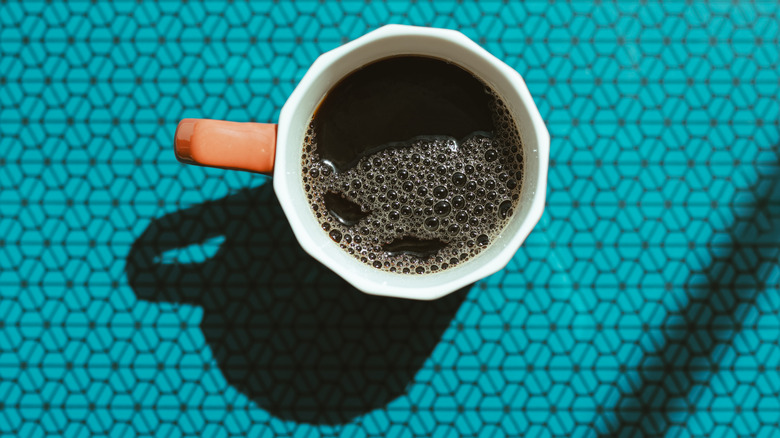
Cold coffee has been around a lot longer than today's popular variations, but, according to Luis Laverde, "Cold brew, ready-to-drink products, and large café chains helped transform cold coffee from a variation into a category in its own right." Through trials with his own coffee brand, Laverde notes that "younger consumers seem particularly comfortable moving between formats." Consumers now seek out coffee in many different styles throughout the day. A hot coffee in the morning is often replaced by a cold brew or an iced coffee to go in the afternoon. As Laverde sums up, "That flexibility is a significant part of modern coffee culture."
Among younger generations, cold coffee is a more common phenomenon, from nitro cold brew to iced lattes to fast food drive-thru frappés, especially if opting to order a drink in the summertime. Older generations seem to prefer things the old-fashioned way. The trend towards consistency amongst older coffee consumers goes for coffee temperature, too. Compared to Gen Z coffee drinkers, Boomers and the Silent Generation tend to prefer hot coffee no matter the time of year, which is just one of a few notable Boomer habits when ordering coffee.
Carrying thermos flasks
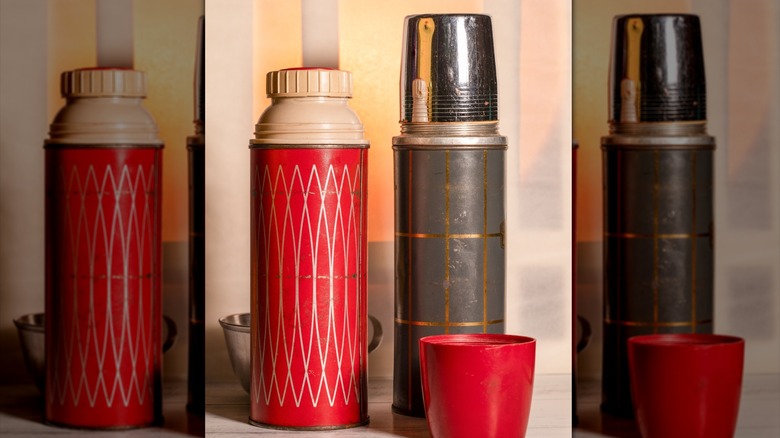
Running parallel to the trend of older generations preferring warmer coffee over cold or iced, the use of thermos flasks has become something from a bygone era. In today's world of increasingly more sophisticated insulated bottles and cups that can keep liquids at temperatures both hot and cold, water is nevertheless the beverage easiest to tote around. Because they don't keep things as satisfyingly temperature-controlled, retro thermos flasks might appear a bit quaint to younger generations who've grown up accustomed to more sophisticated insulation technology.
In a time before cafés could be found on almost any street corner, a thermos of hot coffee, prepared at home and packed to take to work, was the main way people got their extra caffeine boost throughout the day. Now, even though many consumers might use their Yetis and Hydro Flasks for coffee, it's also become the norm to seek fresh caffeine at every opportunity. Instead of refilling from a thermos or insulated bottle, it's just as common nowadays to hop down to a nearby café during a coffee or lunch break to grab a quick drink to-go. The rise in specialty coffee consumption, particularly amongst younger generations, has also encouraged this habit. As Luis Laverde notes, "Specialty coffee drinkers are more likely than traditional coffee drinkers to have their coffee prepared outside the home."
Preparing coffee at home more often
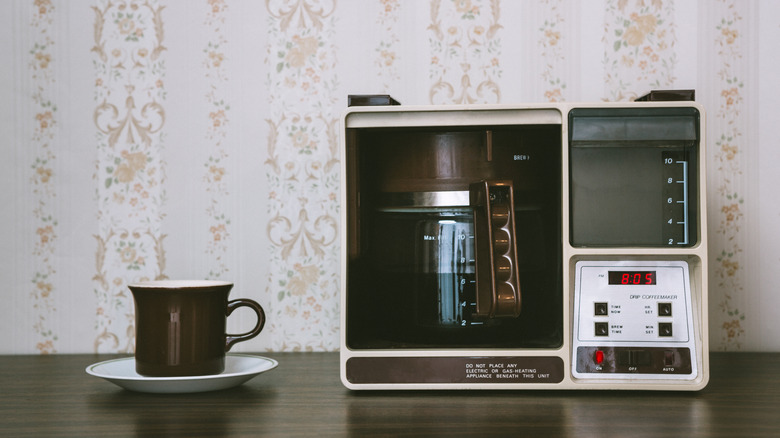
The 21st-century trend towards specialty coffee and café culture has prompted younger generations to frequently seek out their coffee from nearby cafés. Whether they sit down to enjoy a daily coffee or habitually order one to-go, the daily coffee ritual often entails going out, rather than preparing a drink at home. This runs contrary to the way coffee consumption was for much of the 20th century, when brewing up a pot of coffee at home was the most common way to consume it. Thanks to percolators and vacuum brewers, homemade coffee became a relatively simple, automated process with a consistently satisfying result. The same was true when drip machines became more sophisticated in the 1970s.
Today, however, even those who do opt for home-brewed coffee can still have an artisanal experience with the abundance of different coffee technologies available. As Luis Laverde says, "Consumers can choose between drip machines, single-cup systems, French presses, pour-over, moka pots, home espresso machines, bean-to-cup machines, cold-brew equipment and increasingly sophisticated grinders." Nevertheless, there's an easy way to ensure that home coffee is of café quality. Per Jonathan Morris, "The easiest way to up your coffee game, pretty much whatever type of coffee you drink, is to buy fresh beans and use a grinder just prior to brewing — this will give you a much fresher taste due to the aromatics and flavour compounds that are released and then rapidly disperse."
Repurposing old coffee cans
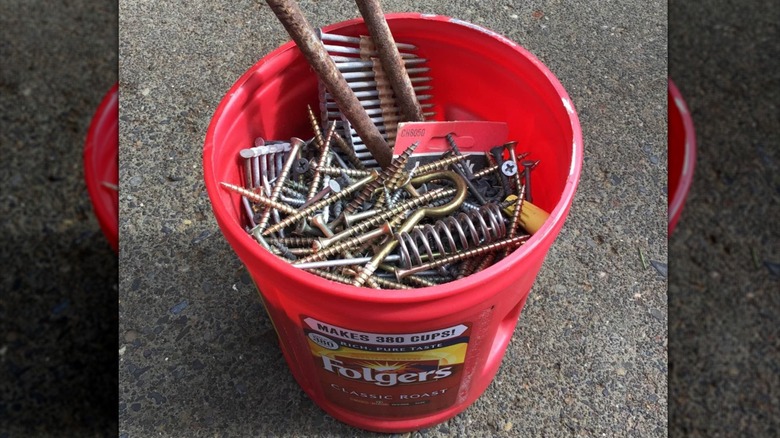
Some common retro coffee habits have nothing to do with the coffee itself. One trend that younger generations have not picked up on is the widespread reuse of coffee canisters once they're empty. It's a common sight to see Folgers, Maxwell House, or Kirkland brand canisters being reused and repurposed in many a garage, as these make for convenient storage containers. One of the more common uses is for bits and bobs like nuts, bolts, nails, screws, or even tools, as these containers make it easy to keep small items in one place, whether they're organized or not.
Some people have also caught on to using coffee canisters as a form of disposable Tupperware. It's a convenient way to transport a batch of baked goods to a gathering, and an easy means of sending people home with leftovers. Some people even buy certain coffee brands for the express purpose of being able to reuse the canisters, even if they don't care for the coffee inside them, which is something younger generations don't tend to find too relatable.
Making homemade artisanal flavors
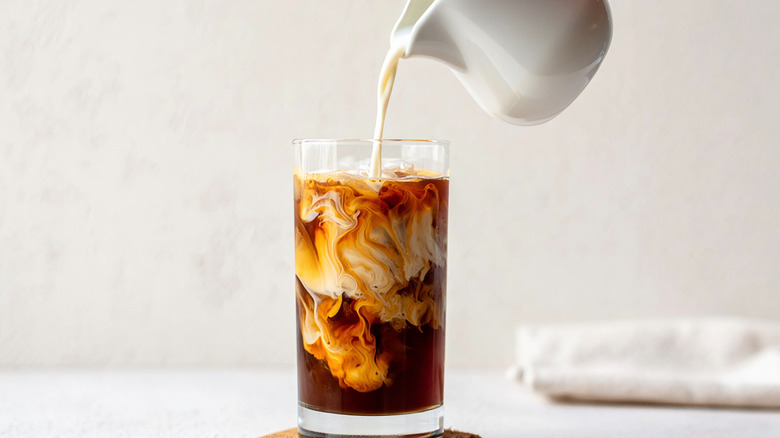
Before the rise of the artisanal coffee movement, those who made their own coffee at home had plenty of tricks up their sleeves for adding a bit of spice or extra flavor to their morning brew. Younger generations might be bewildered but intrigued by the number of pantry staples that can improve a regular cup of joe. Adding Swiss Miss chocolate powder to coffee made for a satisfying morning mocha, while percolating spices such as cinnamon or cloves with the coffee grounds can infuse the final result with some more intense flavor.
Adding condensed milk is another common retro coffee hack. This combination became especially common in Vietnam as a way to sweeten and flavor the beverage — the basis for many variations of beloved Vietnamese coffee. It's also a common ingredient in Spain, which makes a café bombom of equal parts coffee and condensed milk. Yet another common retro coffee additive is chicory root, which has a naturally bitter flavor. Chicory is one of the healthiest things to add to coffee, and being naturally caffeine-free, it has been commonly used as a coffee supplement. Both pure chicory and half-chicory half-coffee mixtures are popular beverages in France, as well as in New Orleans, with its historic French connection. As Luis Laverde explains, "Historically, [chicory] could be used to extend coffee when coffee was expensive or difficult to obtain, but in places such as New Orleans it eventually became part of the flavor tradition in its own right."
Boiling with eggshells, a pinch of salt, or fish gelatin
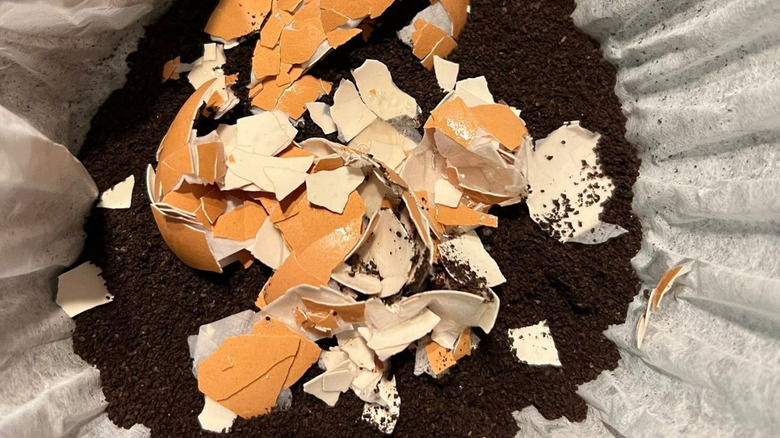
Before the introduction of superior coffee grinders and filters, older generations had a slew of ingenious methods for ensuring their coffee wasn't full of grounds or bitter flavor. Adding a pinch of salt to a bitter cup of coffee is a well-known way to mellow the flavor for those who prefer their coffee black. According to Jonathan Morris, a slightly older (and perhaps less savory) method of cutting bitterness entailed preparing grounds with isinglass, a gelatin produced from fish air bladders, that could improve coffee's flavor. Ingenuious as these methods may be, a dose of cream and sugar can also achieve the same effect.
A third form of retro coffee flavor enhancement also works as a natural filter. This old-school hack makes use of eggshells as the secret ingredient. Being naturally alkaline, they counteract the coffee's bitterness, and their calcium content encourages the grounds to settle. This clarifies the coffee, giving a smoother cup without the need for any fancy technology. Simply crushing up eggshells and adding them to the grounds is all you need for this trick to work. Our access to effective coffee filtering equipment has made these retro methods seem a bit quaint, but as Luis Laverde says, "A lot of old coffee tricks make much more sense when you consider the equipment people did not have."