

The 5 Differences Between Chick-Fil-A And KFC Chicken
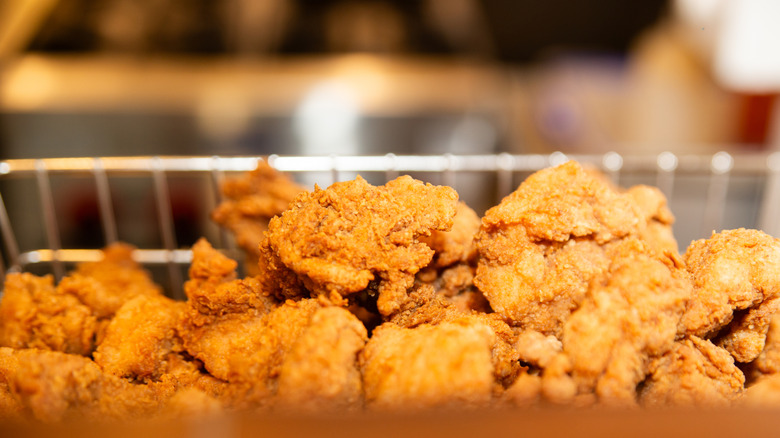
Chick-fil-A and KFC have a lot in common. They're both chicken-focused Southern fast food icons, and both are commonly credited as industry pioneers. KFC's franchise era began in 1952, proving that fast food fried chicken was a successful and repeatable business model. And while Chick-fil-A founder Truett Cathy was not the first to put fried chicken on bread, he did have the first extremely popular fast food fried chicken sandwich.
But eating at either of these establishments is obviously a very different experience. And each one's chicken preparation process has lots of little (or large) differences along the way, from raw meat to finished food, that distinguish each chain's product. Each chain's chicken differs significantly in seasoning and wash, the coating of liquid that helps seasoned flour stick to the raw meat. These, along with different cooking oils, form the heart of why each bite is so different from the other. But perhaps most obvious are the skin and bones (or lack thereof).
The seasoning
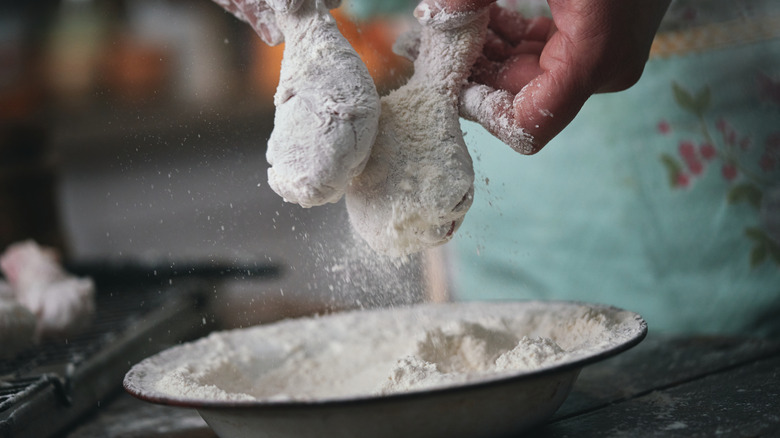
The exact seasoning blend for signature fast food products is often a company secret, and neither of these chains is an exception. But it's clear from their very different eating experiences that these two chicken restaurants use different seasoning profiles, even if it may not be clear exactly what they are. Chick-fil-A's seasoning blend is thought to include paprika, mustard powder, sugar, black pepper, and monosodium glutamate (MSG). Underlining the mystery, Chick-fil-A is commonly thought to brine its chicken in pickle juice, but according to a former employee on Reddit, this has not been the case since a recipe change in the mid-2000s.
KFC, of course, is famous for its secretive blend of 11 herbs and spices. A popular KFC copycat recipe claims that the blend is salt, thyme, basil, oregano, celery salt, black pepper, mustard powder, paprika, garlic salt, ground ginger, and white pepper. While KFC denies that this is the actual recipe, many who have made it say it's spot on — even without using a pressure fryer, as KFC does.
The wash
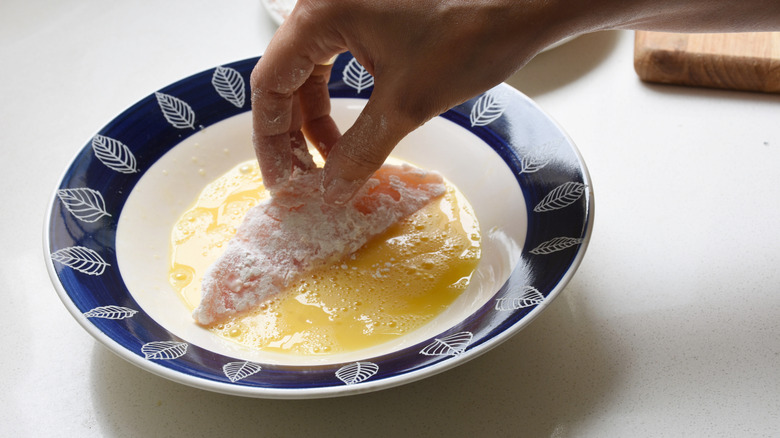
Patting the raw chicken dry is a vital part of keeping fried chicken breading in place, but the wash that follows also matters. After the chicken is dry and thinly floured, it's coated in some kind of liquid to help the outer coating of seasoned flour stick to the meat. Depending on the liquid used, it can make a big difference in the final product, as is the case with these fast food giants.
According to a former employee on Reddit, at Chick-fil-A, every piece of chicken is dipped in a combination egg-and-milk wash. The viscosity of beaten eggs is excellent for keeping the flour on the chicken, and combining it with milk provides a mild boost to adhesion and more significant benefits for moisture retention. The result is juicy chicken with a crisp coating that generally sticks to the meat, which cannot always be said of KFC.
On the other hand, the Kentucky-born fast food icon washes chicken with just plain cold water. Compared to eggs, which must be purchased, this is likely a significant system-wide reduction in operating costs. However, water is a weak binder for a chicken wash, which may be part of why the coating (in my experience) is prone to falling off KFC's chicken.
The cooking oil
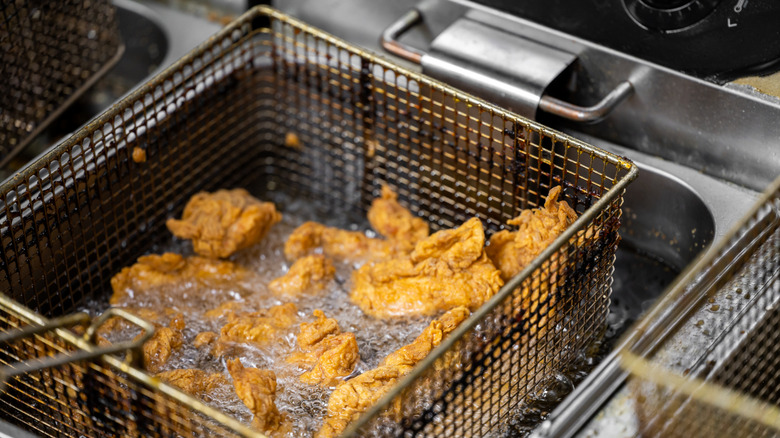
There are lots of different oil options for frying chicken, each with its own positives and negatives. There are valid reasons for cooks (or fast food chains) to choose different oils, including KFC and Chick-fil-A. Both, however, use oils selected or processed to suit their frying needs.
Since 2007, KFC fries its chicken in low-linolenic soybean oil (LLSO), a change it made amid a broader consumer trend against artificial trans fats. LLSO has zero trans fats and a high stability, meaning it resists breaking down from light, oxygen exposure, or high heat. The last one is especially critical for a busy fast food kitchen, which will use the same oil for multiple batches of food.
Chick-fil-A's oil of choice is much more straightforward. The chain uses 100% refined peanut oil for all of its breaded chicken products. And to put those with allergies at greater ease, refined peanut oil is generally not thought to be a major allergen, because the refining process removes nearly all peanut proteins.
The crispiness
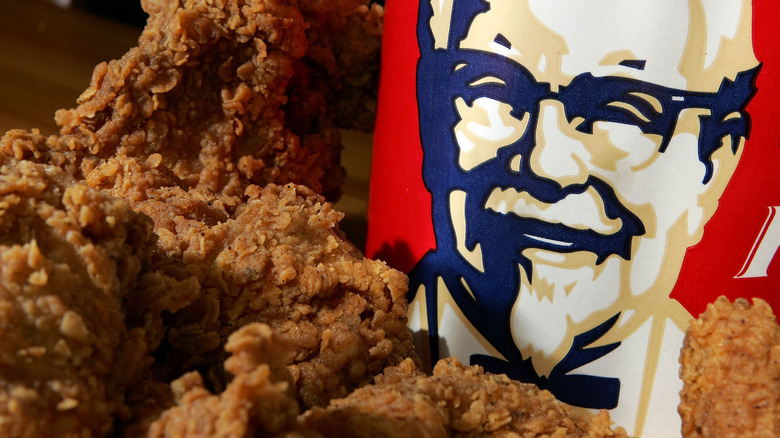
When restaurants have been around for a few generations with expanding and changing menus, it's not uncommon to brand the product that started it all as the "original." At Chick-fil-A, this is the Original Chicken Sandwich; at KFC, this is the Original Recipe chicken. But in the early 1970s, KFC took a step that Chick-fil-A still has not followed: Extra Crispy chicken.
Extra Crispy differs from KFC's Original Recipe in its double-dredging of seasoned flour, but also in its cooking method. Extra Crispy pieces are fried in a traditional open-top fryer, unlike the pressure fryers KFC uses for its Original Recipe chicken (and which Chick-fil-A uses for its signature chicken). KFC does not release sales figures for its Extra Crispy chicken, though it must be somewhat popular, having been on the menu for over half a century. However, it did have one notable hater from the start: KFC founder Colonel Sanders. After selling the business in 1964, he became highly critical of its direction, including in a 1978 Associated Press article that quoted him calling the Extra Crispy recipe "a damn fried doughball stuck on some chicken."
The number of bones
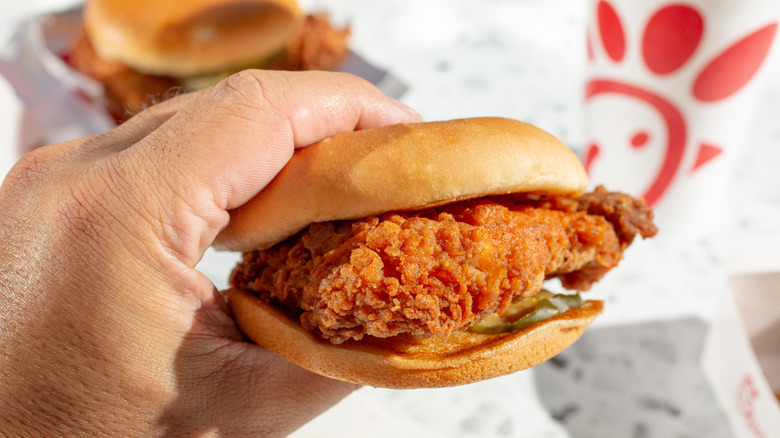
It's possibly the most obvious difference between these chicken chains' meats, but Chick-fil-A only sells boneless fried chicken, whereas KFC sells a variety of boneless items as well as bone-in cuts. In both cases, this likely comes down to company heritage. Chick-fil-A is so famous for boneless chicken that Truett Cathy named the business after the sandwich, which he'd invented years earlier at his Dwarf House restaurant. And the fast food chain hasn't wavered, with two notable but small exceptions. Bone-in wings were once a limited-time offer at Truett's Chick-fil-A, a combination restaurant and museum in Georgia, and they've also appeared on the Little Blue Menu, a Chick-fil-A concept that has tested different menu items.
In contrast, though bone-in chicken is how KFC made its bones, the chain's menu has expanded significantly beyond that. KFC experimented with boneless items as early as the 1980s with the Chicken Little, a diminutive fried chicken sandwich that helped broaden the chain's offerings. Today's KFC menu includes a plethora of boneless chicken items alongside the Colonel's famous Original Recipe (and the Extra Crispy he despised).