

6 Aldi Fresh Seafood Items Worth Every Penny And 3 To Skip
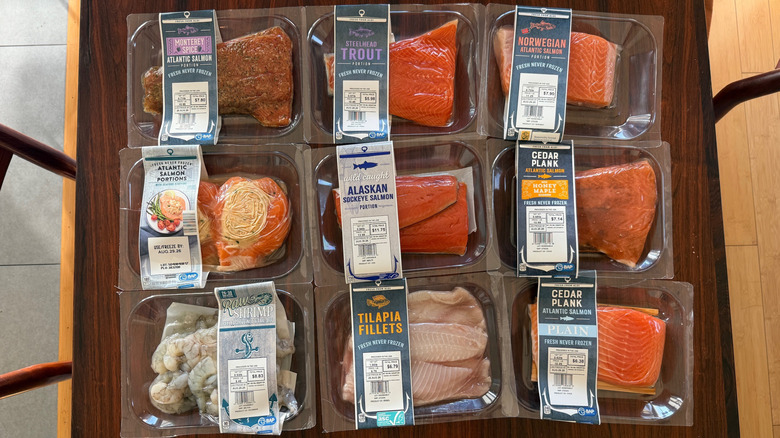
Ever since the discount grocery store brand from Germany came stateside, Aldi has become very popular thanks to its budget-friendly pricing. Most of us have to be more cost conscious these days, and Aldi has a lot of items that are cheaper than other grocery stores.
While Aldi has plenty of seafood in the frozen section like frozen salmon fillets, the store also carries a decent selection of fresh, never-frozen seafood. The fresh seafood at Aldi tends to come in smaller packages (less than a pound), making it a good option for smaller households.
At the time of writing, all but one of Aldi's fresh seafood offerings is fish, with most of it being salmon. So which one is worth the buy? To answer this question, I purchased the fresh seafood at my local Aldi in Alhambra, California, and cooked them for a taste test. Aldi also sometimes offers limited-time items that may vary store to store, so keep in mind that the selection may be a little different than your local store.
Buy: Cedar plank Atlantic salmon
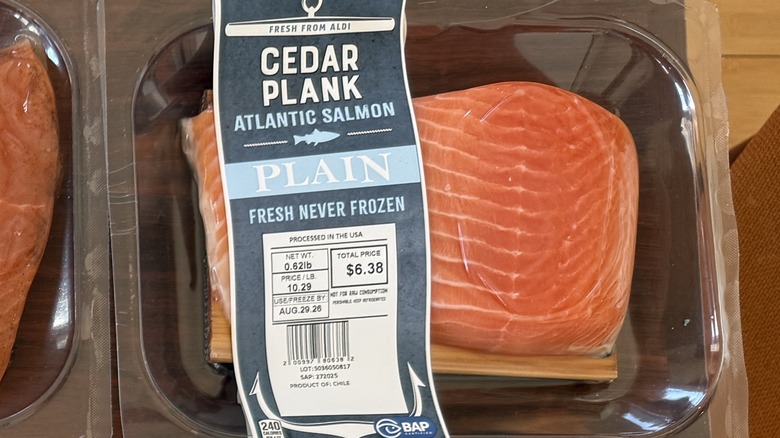
Priced at $10.29 per pound, the Atlantic salmon from Aldi is cheaper than Sprouts (about $20 per pound) or Ralph's ($15.99 per pound). It's a farm-raised salmon from Chile, according to the packaging.
You can see the visible marbling on the salmon and it smelled fresh upon opening, without a strong fishy aroma. The flesh also felt firm. I like that this fish comes with a cedar plank in the package. After all, there's a reason a lot of people love grilling salmon on cedar planks.
I decided to bake this in the oven with the cedar. The salmon was nice and fatty, tasting pretty rich and buttery after baking. Overall it was a pretty good quality farm-raised salmon and I enjoyed it. Given that it's more affordable at Aldi compared to other grocery stores, this is certainly a great value.
Buy: Wild-caught Alaskan sockeye salmon
Most of the fresh seafood offered at Aldi is farm-raised, but there is one exception: the wild-caught Alaskan sockeye salmon. Because it's wild-caught, it's more expensive than the farm-raised options, but Aldi still offers it at a lower price than other grocery stores. Wild sockeye salmon is $24.99 per pound at the Ralph's near me while Aldi priced it at $13.99 per pound.
Wild sockeye salmon is leaner than farm-raised salmon. You can see from the lack of marbling on the one at Aldi. While that's good health-wise, it's a little trickier to cook properly. Treating it the same as a fattier, farm-raised salmon is the biggest mistake people make when cooking wild-caught salmon. Since it's not as fatty, overcooking it can more easily lead to a drier salmon.
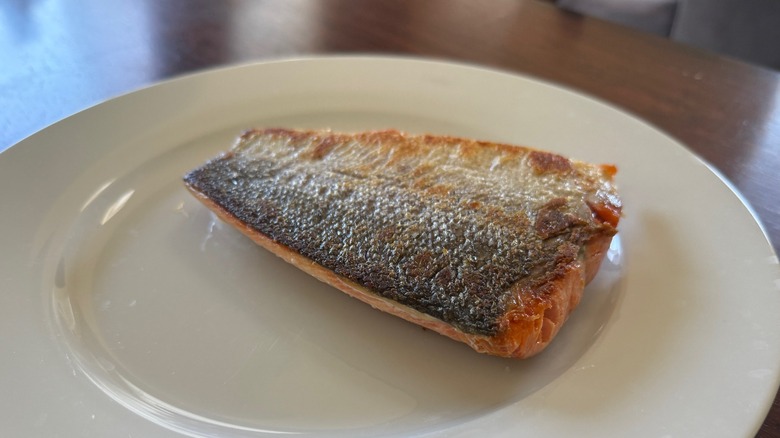
I pan fried this salmon to get a crispy skin, and the result is definitely drier and not as buttery as the farm-raised salmon. However, it has a stronger and richer flavor. My friends prefer the fattier, farm-raised fish after tasting both side by side, but there are certainly good reasons to opt for wild-caught. It's healthier due to less fat and also tends to have more minerals. If you're looking for wild-caught fish at an affordable price, this is an option worth considering.
Buy: Norwegian Atlantic salmon
The Norwegian Atlantic Salmon is a farm-raised salmon from Norway. It's offered at $11.29 per pound which is a little pricier than the Chilean one. However, Norway has stricter environmental regulations for its fish farms, so the Norwegian salmon is a more sustainable option than the one from Chile.
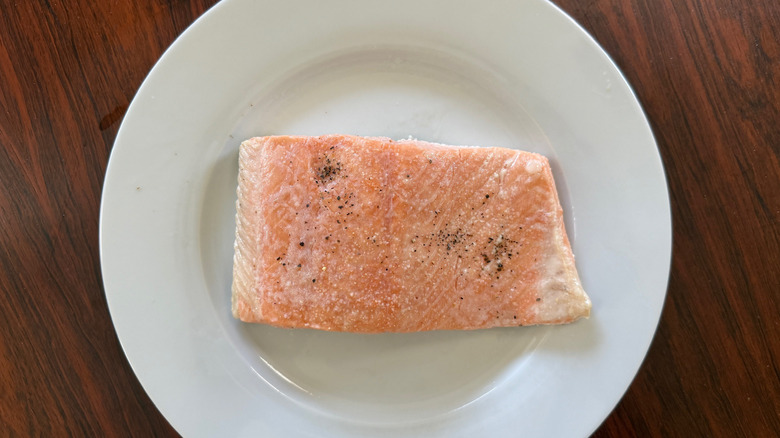
The Norwegian salmon is lighter in color. I also found it to be milder in taste, but a little sweeter. It has a similar if not slightly higher fat content than the Atlantic salmon from Chile. It was rich and buttery, and I enjoyed it even with very little seasoning.
As far as taste goes, it comes down to personal preference whether you would enjoy the milder and sweeter Norwegian salmon or the more flavorful Chilean one. If you're concerned about sustainability, the use of antibiotics, and the environment the salmon you're eating is raised in, the extra dollar for the Norwegian salmon is worth it for the peace of mind.
Buy: Steelhead trout
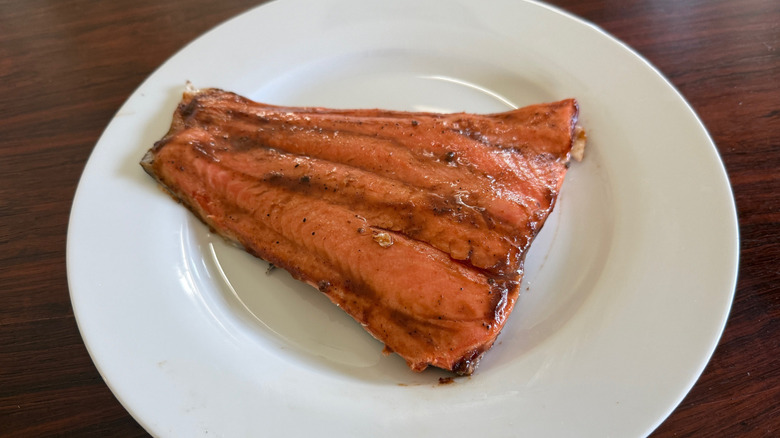
This fish looks like salmon at first glance as it has the same color, but steelhead trout and salmon are different. While both are in the Salmonidae family, the steelhead trout is a type of rainbow trout. It's a smaller fish compared to the salmon and usually not as fatty. The steelhead trout at Aldi is farm-raised and it is leaner than the farm-raised salmon, but it actually has more fat content than the wild-caught sockeye salmon.
According to the label, Aldi's steelhead trout comes from Peru and it's sold for $10.49 per pound, which is only slightly more expensive than the Atlantic salmon. That's unusual, as steelhead trout is generally known as the more affordable alternative compared to salmon. Even so, Aldi's steelhead trout is still cheaper than other grocery stores like Sprouts. The Aldi steelhead trout has a less fishy taste and is sweeter than the salmon. I prepared it with a barbecue sauce, but in retrospect, it probably pairs better with a less sugary sauce, since the fish itself is already sweet. It also has a softer texture than the salmon even though it's leaner and not as buttery and fatty. For people who prefer a sweet flavor profile and delicate texture, Aldi's trout is worth buying.
Buy: Monterey Spice Atlantic salmon
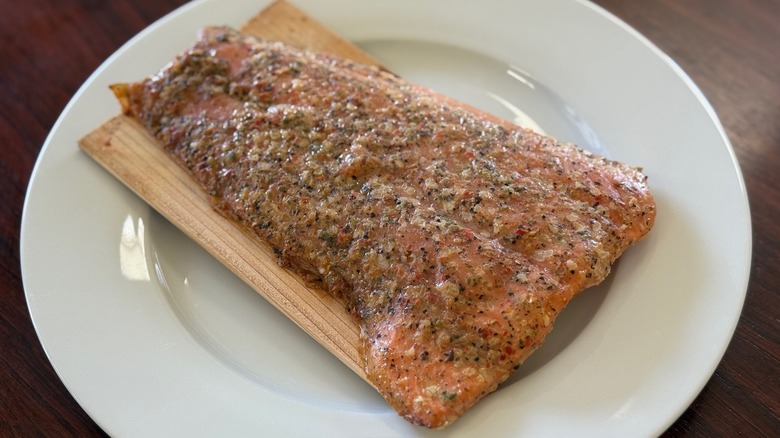
Made for ease and convenience, this salmon comes pre-spiced with Aldi's Monterey Spice blend. The salmon itself is the farm-raised Atlantic salmon from Chile that Aldi also offers on a cedar plank. But what is Monterey Spice? Based on the ingredient list, the spice blend contains dehydrated onions, bell peppers, and celery, along with garlic, parsley flakes, and other undisclosed spices.
Since I didn't know exactly what the spice blend contains, I wasn't sure how this would taste, but I ended up really enjoying it. It was very flavorful, savory, and worked well with the taste of the salmon without overwhelming it.
The Monterey Spice salmon is priced at $10.99 per pound, so it's more expensive than buying the plain salmon. Because I did enjoy the spice blend that I can't replicate myself, I think this one is worth it when you don't want to think too much about how you're going to prepare your salmon.
Buy: Tilapia fillets
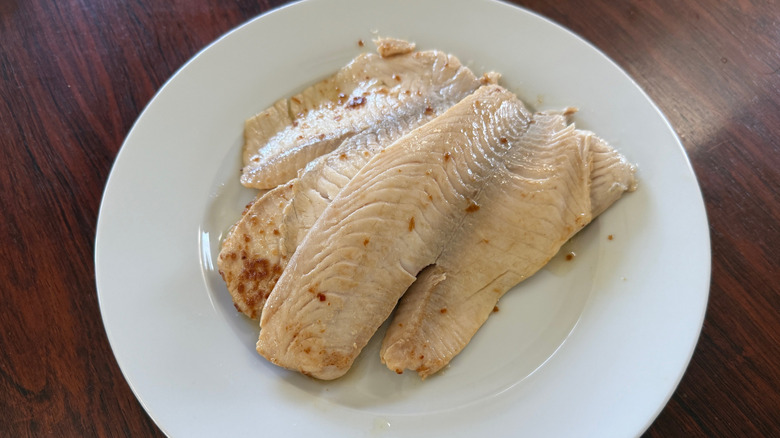
Tilapia is a common fish and one of the most affordable options out there since it's particularly easy to farm. The Aldi pricing makes it even more affordable. The fresh tilapia fillets at my nearby Aldi are sold for $6.79 per pound, which is cheaper compared to Ralph's, where it costs $8 per pound.
Tilapia is a firm, mild fish, and that's exactly what I got here. Honestly, tilapia isn't my favorite, but if you like tilapia, the one at Aldi is impressive for its price. It was fresh without a strong fishy aroma, mushy texture, or flakiness. The fillets also had uniform thickness. I pan fried them with an Italian-style onion sauce and enjoyed the final result.
Tilapia has a bad reputation because some farms that raise this family of fish have questionable farming practices, like using hormones or low-quality feed. We don't really know how the tilapia at Aldi, which comes from Brazil, is raised, but the packaging does sport a label indicating that the fish is certified by Aquaculture Stewardship Council as being farmed responsibly.
Skip: Honey Maple Cedar Plank Salmon
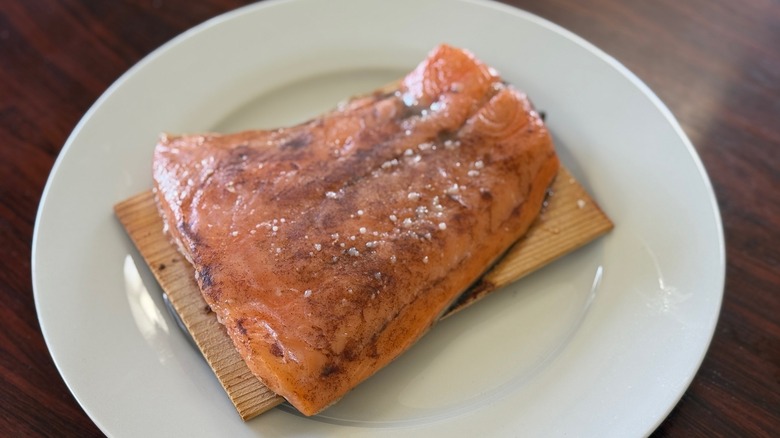
This fish is similar to the Atlantic salmon on a cedar plank that Aldi offers, but it's even easier to prepare, as it's already glazed in a honey-maple dressing. You don't even have to think about seasoning this one — just pop it in the oven.
Perhaps it was the particular cut I got, but I thought the fish itself was firmer and not as fatty as the plain salmon on a cedar plank. The honey-maple glaze makes it harder to see the marbling on the fish itself, so it's more difficult to choose a piece with the kind of fat content you want. After baking, I found it to be less buttery than the plain version.
The flavor of the salmon in the honey-maple glaze was actually pretty good, but while the glaze is enjoyable, it's a simple glaze that only adds sweetness to the fish and not much maple flavor. The honey-maple option is $10.99 per pound compared to $10.29 per pound for the plain, and in this case, I didn't think it was worth the extra cost.
Skip: Seafood stuffed salmon
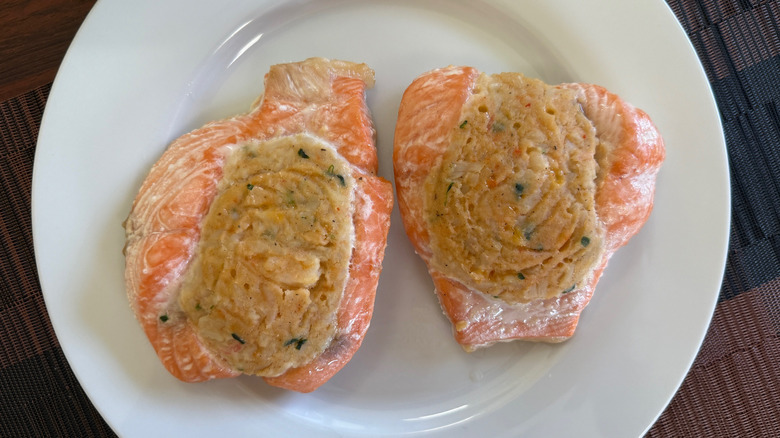
The seafood-stuffed salmon seems to be a limited-time item that is offered periodically at Aldi. According to the label, the salmon is Atlantic salmon that's fresh and never frozen. However, the seafood stuffing was previously frozen.
The seafood stuffing is savory and creamy, and there was definitely small shrimp in there. However, most of what the stuffing is made of is what Aldi is calling "lobster surimi" and breadcrumbs. According to the ingredient list, that surimi consists of pollock or cod, wheat starch, potato starch, egg whites, and other non-seafood ingredients. I followed the directions on the package to cook this at 375 degrees for 20 minutes, but I think cooking it that long dried out the salmon too much.
It's offered as a pack of two for $9.99, which supposedly weigh around a pound per package. Each portion is mostly stuffing and lined with salmon, though, so there's not that much fish. It's a quick and easy meal, but because the stuffing is mostly cheaper ingredients, the price per pound on this isn't as good. Skip this unless it's on sale.
Skip: Raw shrimp
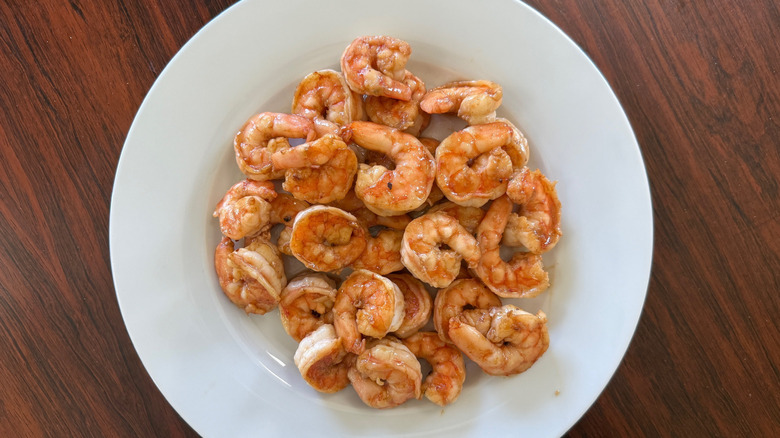
These are jumbo shrimp that have been peeled, deveined, and the tail has been taken off so it's convenient to cook. The packaging did not say whether the shrimp have never been frozen or if they were previously frozen. I had asked one of the staff members at Aldi who told me that they are fresh. I'm still skeptical, however.
The shrimp already smelled a little fishy upon opening the package. After all, shrimp is one of the fastest seafood items to spoil, lasting in the fridge no more than two days. I pan fried the shrimp and upon tasting, the texture was pretty firm and springy. The taste, however, was on the fishy side.
Having pre-peeled and deveined shrimp certainly comes at a price, since it takes work to process it. The shrimp is sold at $9.49 per pound. Given the quality of the shrimp and how quickly shrimp goes bad in the fridge, I think opting for frozen is better in this case.
Methodology
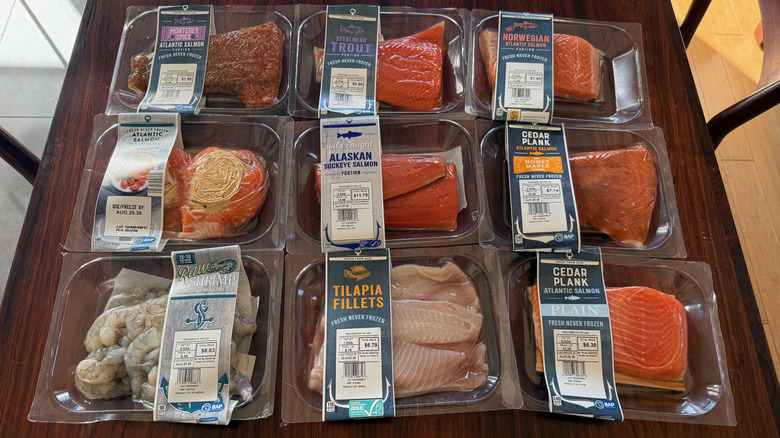
For this taste test, I purchased the fresh seafood available at my local Aldi in Alhambra, California. Some of the items may be limited-time items that are not available at all Aldi stores. For the seafood that already came with a glaze or spice rub, I prepared it as-is by baking it in the oven. For the rest of the seafood, I chose simple preparations so that I can taste the seafood without it being masked by strong-flavored sauce or seasoning.
To determine if each product was worth it or not, I compared Aldi's prices to other big grocery stores near me. As for the quality, I checked whether the seafood was fresh upon purchase based on the smell and firmness. After cooking, I considered whether it was dry or had a buttery texture and taste. For the ones that came pre-seasoned, I considered if the flavor of the seasoning is worth the extra convenience cost.