

How To Pick The Best, Juiciest Tomatoes At The Grocery Store
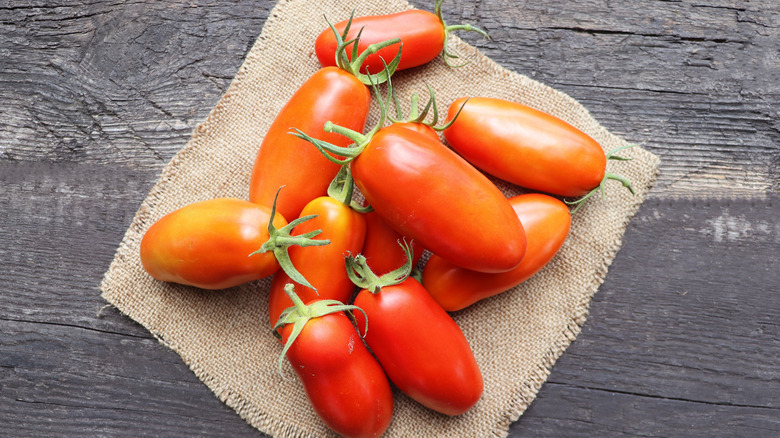
Buying tomatoes isn't as simple as you might think. This staple of the vegetable section (even though it's botanically a fruit) is part of countless dishes, and many of them rely on its freshness and flavor to truly come alive. Unfortunately, obtaining that can be difficult, especially if you're buying your tomatoes in a grocery store. When tomatoes are at their best, they're exceptional: Full of vibrancy and vigor, with showstopping colors and moreish flavor notes. When they're bad, though, they can be mealy, gritty, dull, metallic, and plain old disappointing.
So, if you can't grow tomatoes at home and you're buying them from stores, how do you ensure that you're separating good from bad? Turns out, buying the best tomatoes at a grocery store involves learning how to assess your produce properly, buying it at the right time, and, where possible, opting for certain stores or avenues for purchase.
A subject this nuanced needed some expert attention, so we turned to two people who know tomatoes better than most: Adam Weiss, founder and master gardener at Pike Lane Gardens, who leads corporate programs rooted in wellness and sustainability; and Lindsey Chastain, founder and managing editor of Waddle and Cluck, a digital magazine for modern homesteaders. They told us everything we need to know about how to pick the juiciest tomatoes, and we're passing it on to you.
Learn some key visual cues
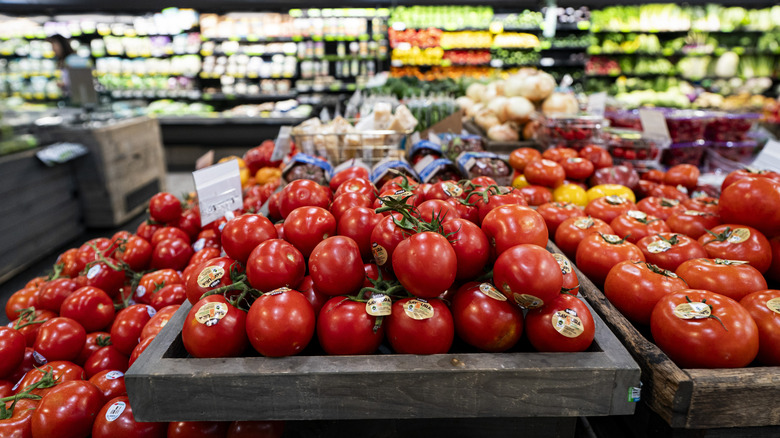
Like all produce, tomatoes will give away much about their quality by how they look — and learning the difference between a good and bad appearance is a good first step in getting the right ones. Given that tomato prices have been shooting up in 2026, that's more important than ever. Lindsey Chastain recommends starting with the skin of the tomato. "It should be smooth and not have any wrinkles," she says. "Wrinkles means it's overripe and starting to go bad." Well-grown, ripe tomatoes will have a vibrant appearance, but vibrancy doesn't necessarily mean uniformity. Both Adam Weiss and Chastain say that tomato appearances and colors can vary from type to type, and Chastain further states that if your tomatoes are too perfectly red, it can be a sign they were gassed.
So, while you want to try and find tomatoes with a healthy appearance, be conscious of the fact that if your produce is a little pink, green, or orange, that might actually be a sign that it's ripened naturally — and it might taste better. "The prettiest tomato usually isn't the best-tasting tomato. Commercial growers are trying to get the best-looking tomato because that's what people usually choose," advises Chastain. Combine a visual assessment with feeling your tomatoes, smelling them, testing their weight, and checking out their origins, and you should be onto a winner.
Give your tomatoes a feel
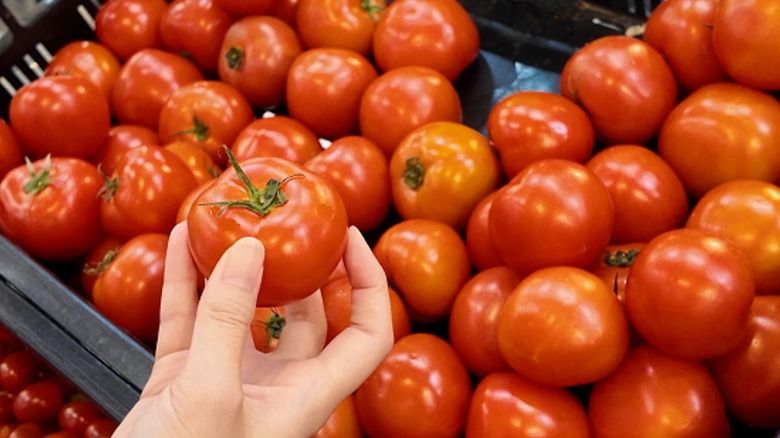
If you want to pick the best tomatoes, you really need to get hands-on with them. It's not enough to just look at the produce; learning how ripe tomatoes feel is a key step in ensuring you get the juiciest ones. The main thing to consider is its give. "A perfectly ripe, juicy tomato should feel somewhere between an apple and a peach. Not hard, not soft," says Lindsey Chastain. "If you press gently it should give and bounce back." If there's no give whatsoever, then it's not fully ripe yet, and was picked too soon.
Weight is also a useful indicator of ripeness, but it's not foolproof, given that they come in so many different varieties. "Heavier tomatoes are generally juicier, but you have to be comparing tomatoes of about the same size for that comparison to work," says Chastain. A lot of the time, how firm a tomato is can be a more reliable indicator of ripeness than its appearance: If a tomato has a minor blemish but a little bit of give to it, Chastain states that it'll likely be a better option than a perfectly uniform fruit that's firm to the touch.
Check out the stem
Your tomato's stem can tell you a lot about its ripeness — and also when it arrived in your grocery store. "If the stem is green and a little sticky it was recently harvested. If it's brown and dry the stem has no moisture left, so it's been a bit since harvesting," says Lindsey Chastain. While the appearance of the stem alone won't alert you to how juicy your tomato is, it can be a good visual as to how likely it is to be either unripe or lacking in freshness.
Tomatoes that don't have stems aren't necessarily worse than those that do, but if you suspect that it's been removed to hide a lack of quality, Chastain recommends checking out the stem scar. "Check for mold, a dark scar, or any wetness," she advises. "If you see any of those signs, don't buy that tomato."
Buy seasonally
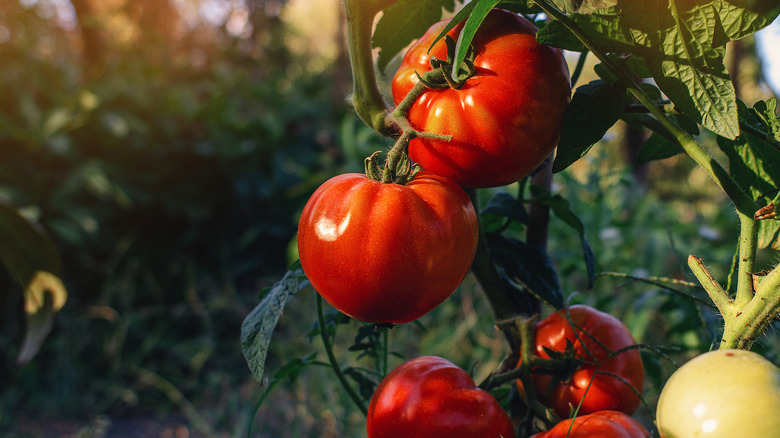
Like all fruits and vegetables, tomatoes are naturally seasonal — and their quality is intrinsically tied to when they were grown. As Adam Weiss states, "I don't think I've ever had a great tomato in the winter months. Ever." Weiss told us that tomatoes are a warm-weather plant, and they will therefore naturally thrive in more temperate climes (although when they're at peak ripeness for you will depend on your growing zone).
While modern growing techniques have turned tomatoes into year-round produce, the ones you get in the winter months will still likely never compare to those grown and bought in the summer. So, you want juicy? You're gonna have to try and aim for when tomatoes are at peak ripeness where you are.
That said, Weiss states that there are ways to enjoy the flavor of warm-weather-grown tomatoes throughout the winter. You can slow-roast tomatoes and then freeze them, for example, to capture their intensity for when it's cooler, or turn them into a tomato sauce. If you're hoping to enjoy them fresh, though, respecting the seasonal nature of the plant will help you get the best out of it — and a well-grown summer tomato will turn even the biggest hater into a fan.
Opt for boutique grocers or farmers' markets where possible
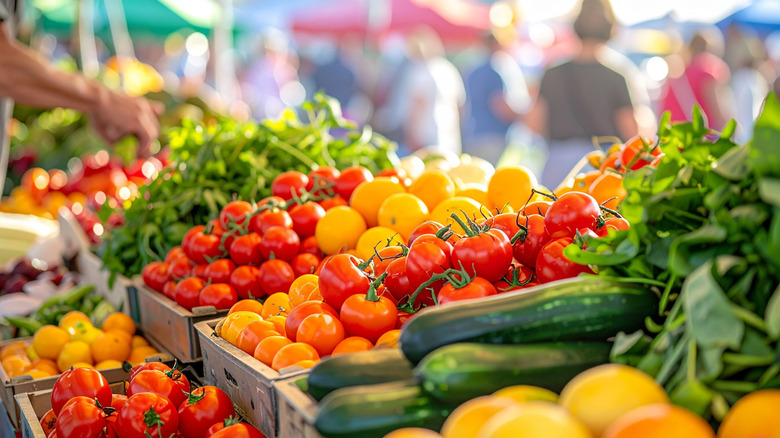
While it may not be an option for everyone, buying your tomatoes at a boutique grocer's or a farmer's market will usually, if not always, give you better produce. This is something that both Adam Weiss and Lindsey Chastain agree on. "You will be amazed at how they taste," says Chastain on tomatoes bought from farmers' markets. Weiss states that markets and boutique grocers "will offer a wide variety" of tomatoes, particularly heirloom varieties, which have been grown from the same seeds for 25 to 50 years (or more) to retain their excellent flavor.
Shopping at these kinds of locations, instead of larger grocery stores, will also give you greater access to organic produce and allow you to participate in a smaller supply chain, buying direct from the source or with fewer middlemen. Weiss says that how long it takes for tomatoes to get to grocery stores versus farmers' markets is similar, but with the latter, you'll just get better produce. Shopping at markets or boutique stores also allows you to cultivate a closer relationship with them, which can therefore inform your purchases. So, Weiss recommends getting to know your grocer, aligning yourself with them, and asking where your produce has come from.
If you can, opt for organic
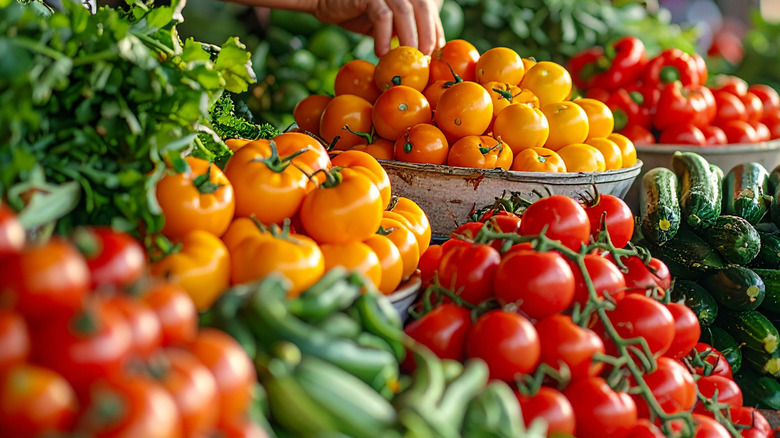
Tomatoes thrive when they're well-grown using organic methods — and this can affect their flavor. Adam Weiss told us that organic varieties generally have thinner skin and greater color intensity, and they tend to have more give than store-bought, non-organic tomatoes. As Weiss says, the latter can end up "hard as a rock" — which is hardly what you want to be eating. That combination of give and thinner skin, in particular, will lead to a more pleasant eating experience. Oh, and you don't have to think about any pesticide or chemical use, which is always nice.
While you may be able to find organic tomatoes outside of farmers' markets or boutique produce stores, Weiss states that "it is more the exception to the rule when you will have an organic variety in your mainstream grocers." Yes, you might find one or two here and there, but your options will likely be pretty limited. That's why he recommends choosing non-mainstream buying locations whenever possible, so you can access a wider variety.
Try to find heirloom varieties
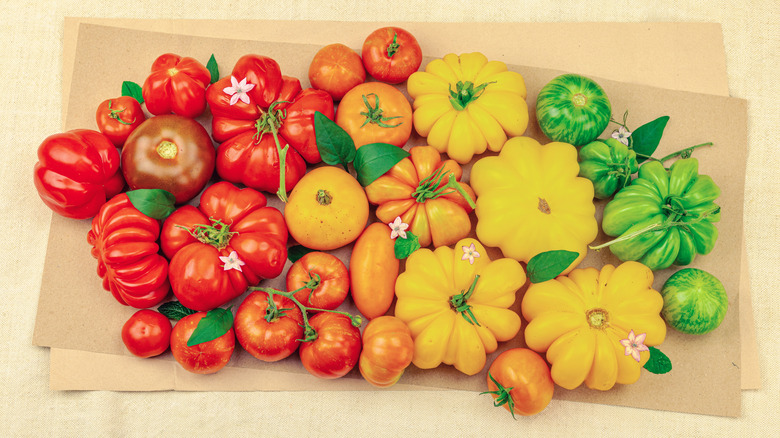
If you want the best tomatoes, you have to pay attention to what they're called. The term "vine-ripened" might imply that the tomatoes you're about to buy were grown in an open field under direct, glorious sunlight, but as Adam Weiss confirmed, the term errs on the side of marketing spin. Instead, what you should really look out for is the term "heirloom," or get to know the names of specific heirloom varieties, so you can seek them out.
Why? Because heirloom tomatoes belong to a direct lineage passed down for generations, and are specifically prized for their nuance, flavor, and juiciness. While they can be more expensive, they're generally worth it. Don't be put off if the heirloom tomatoes you find aren't red or uniform; some of the best ones aren't. Weiss is a fan of Sungold cherry tomatoes, which have an orange tint to them, and Brandywine Pink (which, as you'd expect, have a pinkish color). If you're unfamiliar with the nuances in heirloom tomato colors, Lindsey Chastain recommends assessing them in a couple of different ways. "Look for a tomato that feels heavy for its size and a little bit of skin cracking near the stem," she says. "That means it's juicy."
Use your sense of smell
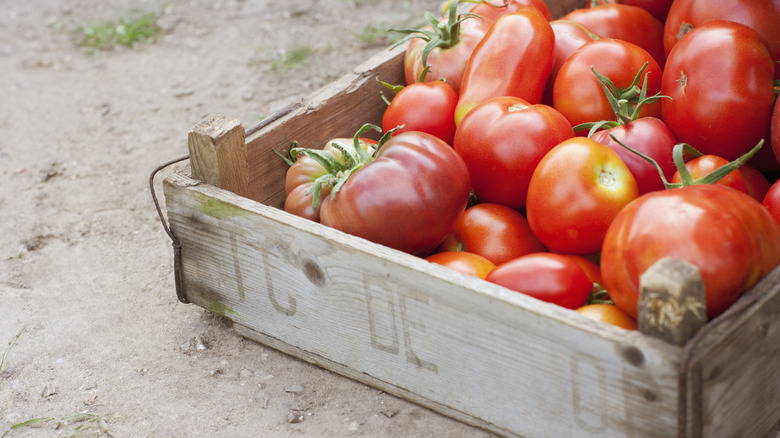
Your nose is one of your best assets when it comes to picking the juiciest tomatoes, and you should both employ and trust it. The scent of a tomato will give you a clue about whether it's ripe, but make sure you're smelling it in the right place. That place is the stem, according to Lindsey Chastain. "Always smell the stem," she says. "It should smell very much like a tomato." By this, we mean that it should have a zesty, herbaceous, colorful scent, with a pepperiness and a touch of bite to it. If you're getting all of these things when you smell it, you've probably picked up a good one.
Conversely, you should also look out for a lack of smell — and a bad one. "If it doesn't have a tomato smell, it won't have much flavor," Chastain says. Additionally, if it has a musty smell, she states that it'll be going bad and should be left where it is. If your tomatoes don't have a stem, then smell the stem scar instead.
Skip cold tomatoes
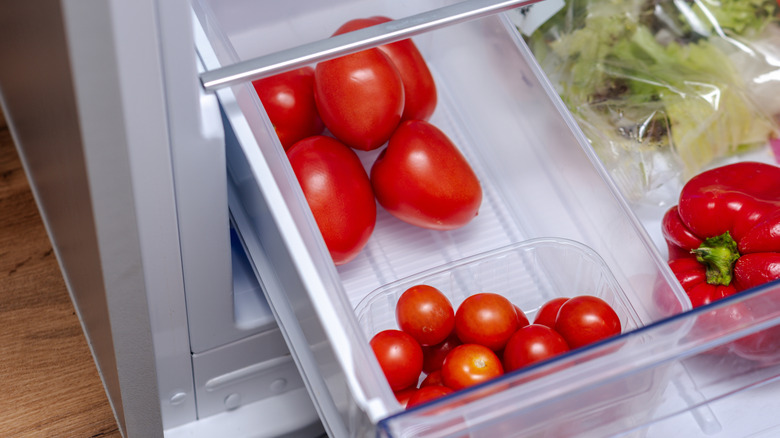
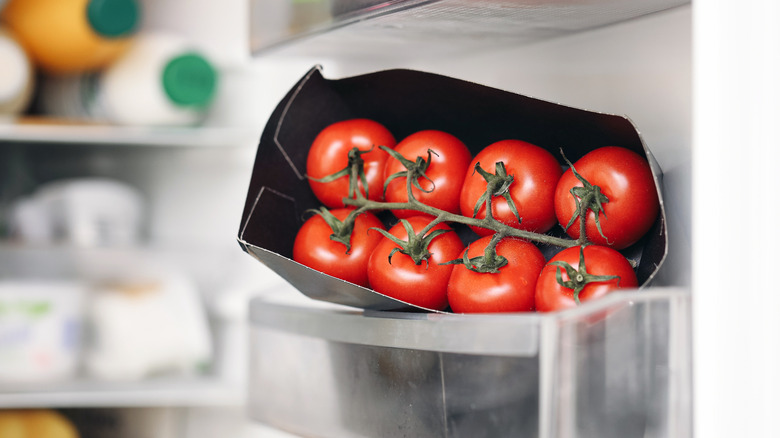
If your local grocery store keeps tomatoes in a refrigerator, you should run. Cold temperatures are bad news for tomatoes and your taste buds. "Cold damages the tomato and it will lose flavor," says Lindsey Chastain, who also notes that coolness can give tomatoes a mealy texture. "You can't fix it by resting on the counter either," she adds.
This all makes sense, of course, given that tomatoes are warm-weather plants — and luckily, the majority of grocery stores are well aware that they shouldn't be kept in cool areas. Despite this, they can sometimes end up at the bottom of a refrigeration unit, and in smaller grocers or convenience stores, they simply may not have the space to put them elsewhere. That may be the case for them, but it doesn't mean that the Caprese salad you have planned should suffer. "Skip cold tomatoes," states Chastain. Oh, and don't keep them in your fridge at home either, she says: You'll just end up ruining them.
Buy tomatoes to ripen at home (if you know what you're doing)
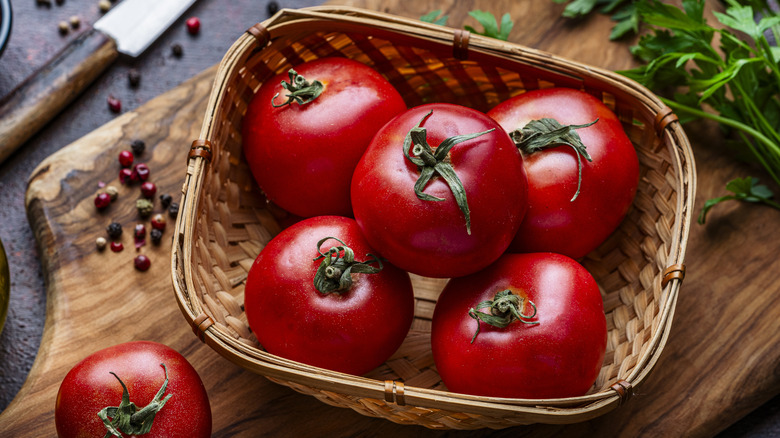
If your local store only has tomatoes that aren't quite ripe yet, you're not completely out of luck. You can still pick up some tomatoes to ripen at home, ensuring that you'll get a juicy result in a couple of days' time. That said, you need to get wise to the signs that a tomato is just about to ripen, and then, when you get them home, ensure that you're storing them properly.
Luckily, Lindsey Chastain let us know how this was done. The key is to check the blossom end, or the bottom, of the tomato, and to find ones that are just starting to blush. "Those are the ones you want," she says. Then, when you get them home, "store [them] stem-down at room temperature at home. 65-75 degrees is perfect." If you put them on a sunny windowsill, Chastain says they'll ripen too quickly; if you put them in the fridge, they'll lose all their flavor.
Chastain also warns against placing your tomatoes together. "Tomatoes produce ethylene gas, so they will actually ripen each other faster and any other fruits you store with tomatoes," she advises. Instead, keep them separate, and in one to two days, your tomatoes should be juicy and good to go.
Don't be scared of irregular shapes
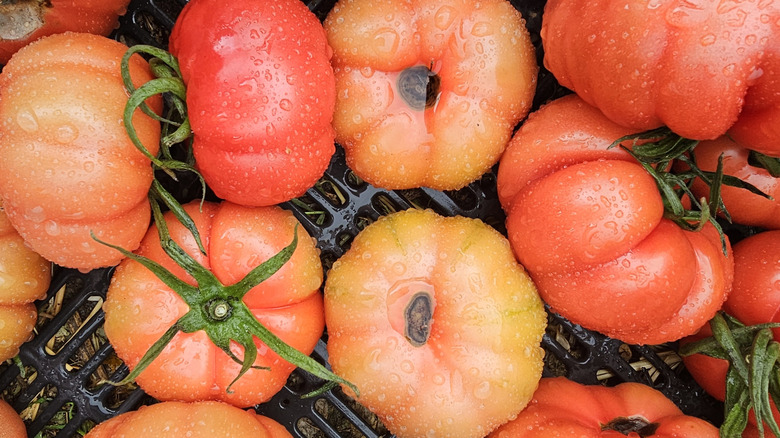
Sometimes, the key to picking the best tomatoes lies in getting over your perceptions of what you think a tomato should look like. "The prettiest tomato usually isn't the best-tasting tomato," says Lindsey Chastain. "Commercial growers are trying to get the best-looking tomato because that's what people usually choose. They are also optimizing for tomatoes that will survive the shipping process." That doesn't mean, though, that they'll taste the best. Instead, as Adam Weiss states, varieties that might not look like a "perfect" tomato may well taste better — and even if it's slightly misshapen, if it's organically grown, it's likely going to be a better option than a tomato that looks like a cartoon.
That said, it's worth keeping an eye on just how misshapen your tomato is. If it's particularly different, you may not be able to use it in the way you intended — and Weiss also says that you should try, where possible, to avoid tomatoes with noticeable blemishes. Slightly uneven colors or surface-level differences, though, can be largely ignored.