

5-Ingredient Baked Salmon Steak With Lemon Dill Sauce Recipe
We may receive a commission on purchases made from links.
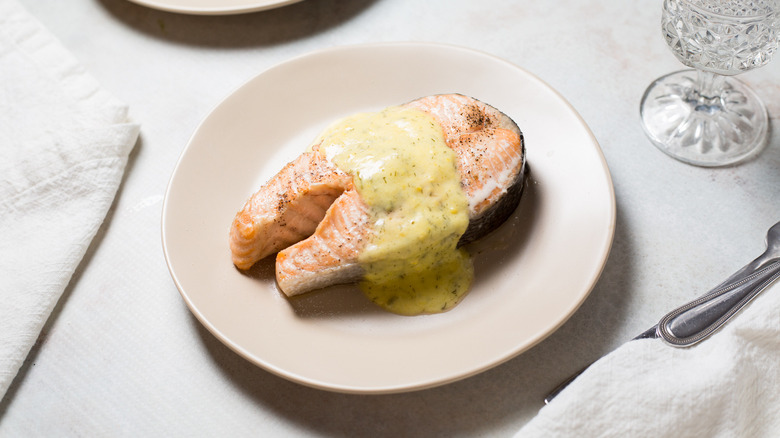
Hollandaise sauce is notoriously finicky, as it relies on emulsifying ingredients that don't normally like to combine. Despite being a bit tricky to make, it's one sauce that's definitely worth the effort, especially when infused with dill and paired with salmon, as it is in this simple-yet-refined recipe.
Recipe developer Michelle Bottalico has crafted this five-ingredient baked salmon steaks with lemon dill sauce recipe that's nothing short of restaurant-quality. The lemon dill sauce is a hollandaise with slightly modified ingredients to keep the total recipe ingredients to five. While the thought of preparing this tricky sauce can make some people think twice, Bottalico walks you through simple steps so it turns out correctly. Remember to keep the heat low at all times and to remove it from the heat as soon as it's finished.
Salmon steaks are thick cuts with twice the meat of a fillet portion, and a simple bake brings out their natural flavor without competing with the sauce. The sauce, very rich with butter and egg yolks yet somehow delicate, is a wonderful complement, and the herbal touch of fresh dill completes the flavor for an impressive dish you may turn to again and again.
Gather your 5-ingredient baked salmon steak with lemon dill sauce ingredients
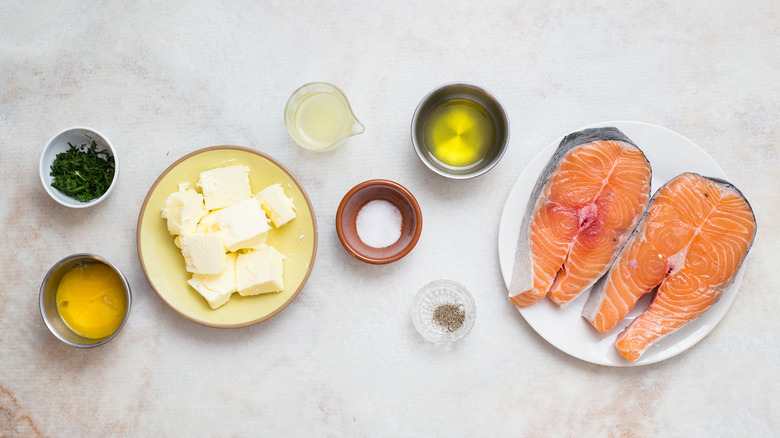
For this recipe, you will need 12-ounce salmon steaks. The actual steaks, which are rounded and contain the bone, are harder to find than salmon fillets. You can substitute fillets if needed, but double the quantity and adjust the baking time if needed, depending on the thickness. You will also need salt and black pepper. For the sauce, gather an egg yolk, lemon juice, fresh dill, and unsalted butter. Finally, you can use more fresh dill for garnish if desired.
Step 1: Preheat the oven
Preheat the oven to 400 F.
Step 2: Grease a baking dish
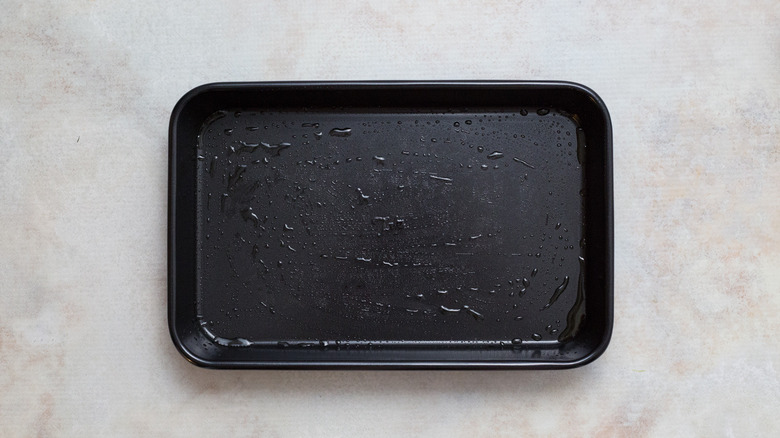
Grease a baking dish with ½ tablespoon olive oil.
Step 3: Pat the salmon dry
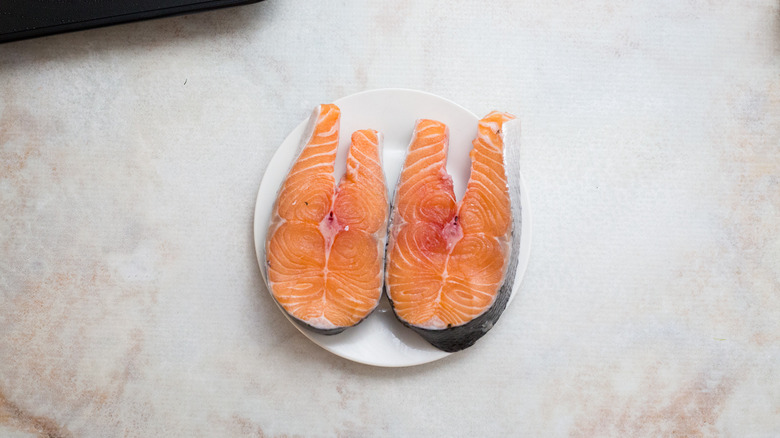
Pat the salmon steaks dry.
Step 4: Season the salmon
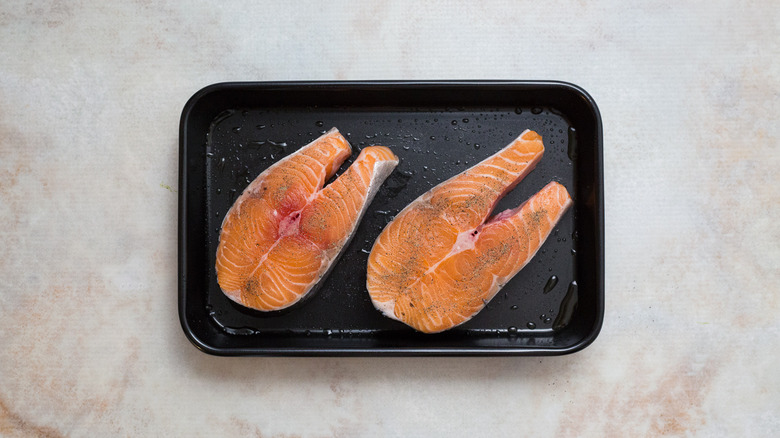
Sprinkle both sides of the salmon steaks with ½ teaspoon of salt and the pepper. Place the steaks in the greased baking dish.
Step 5: Drizzle the salmon with oil
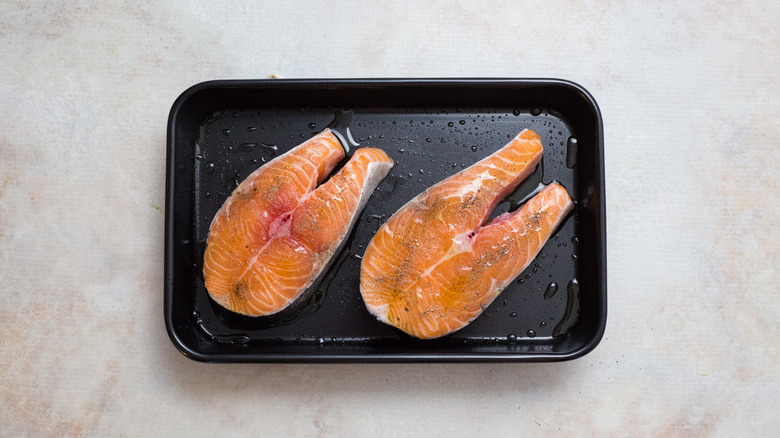
Drizzle the remaining 1 tablespoon olive oil on top of both salmon steaks.
Step 6: Bake the salmon
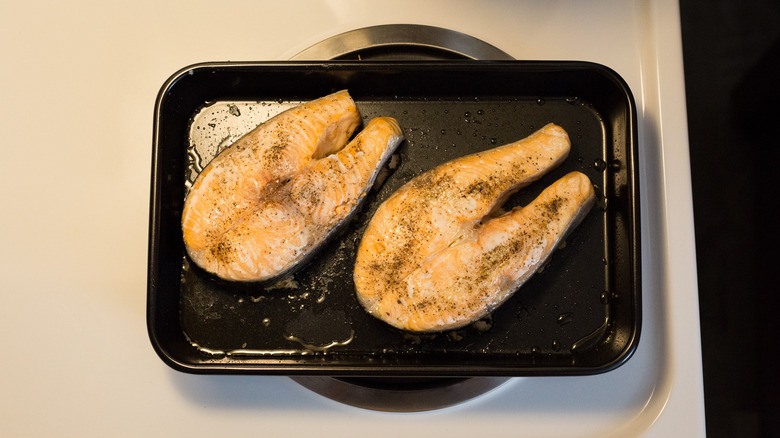
Bake for 12-15 minutes, or until the internal temperature reaches of the salmon 125-130 F.
Step 7: Start the sauce
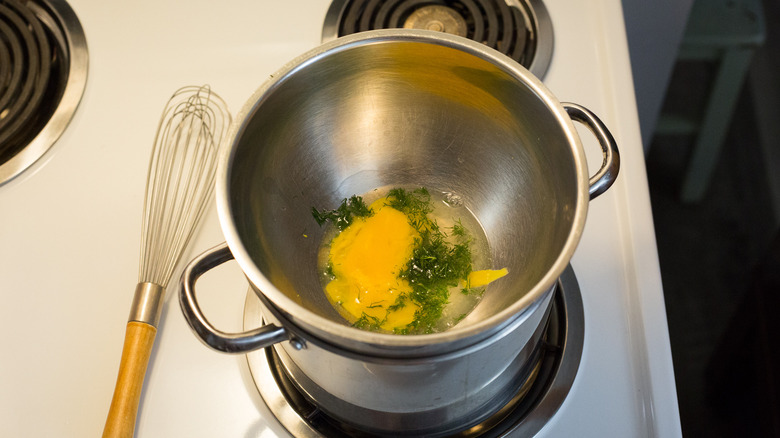
Meanwhile, place the egg yolk, 1 teaspoon hot water, lemon juice, and 1 teaspoon of chopped dill in a double boiler (a heatproof bowl set over a pot containing no more than an inch of simmering water, making sure the bowl doesn't touch the water).
Step 8: Whisk the egg yolks
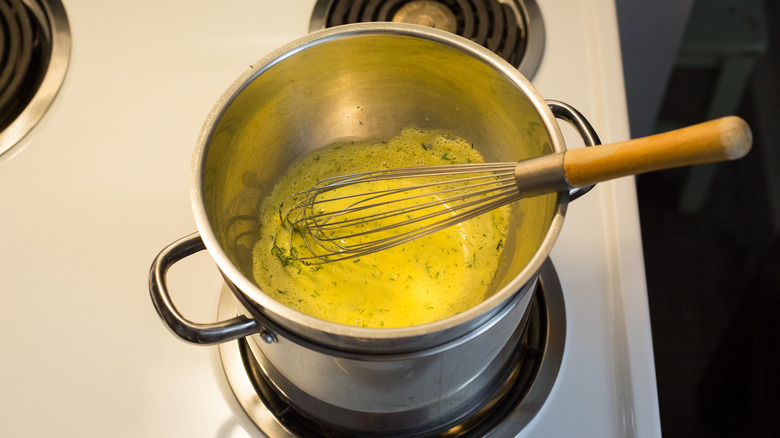
Whisk continuously for about 2-4 minutes, until the egg mixture is thickened and reaches the ribbon stage. Keep the heat low, and remove the bowl from the heat if needed to avoid cooking the egg yolk too much.
Step 9: Add the butter
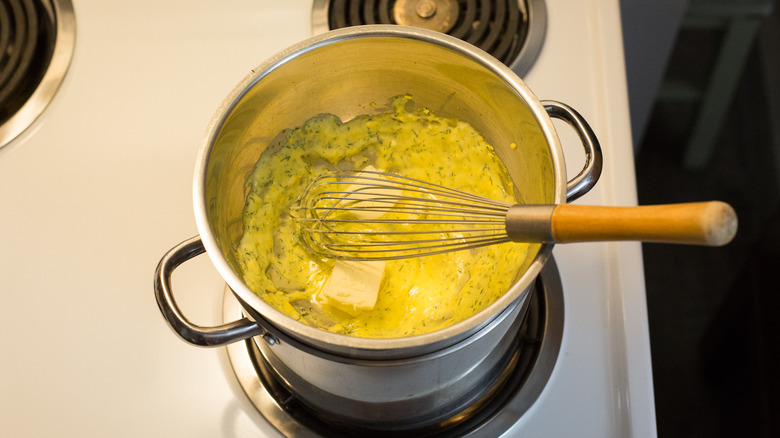
Gradually whisk in the butter pieces a few at a time, keeping the heat low so the sauce doesn't split. Whisk continuously for about 3-5 minutes, until all the butter is incorporated.
Step 10: Add the salt
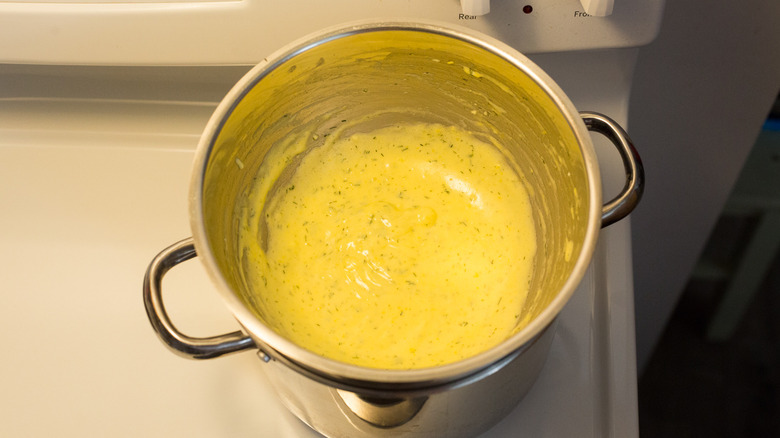
Remove the sauce from the heat and stir in ¼ teaspoon of salt.
Step 11: Serve the 5-ingredient salmon steaks
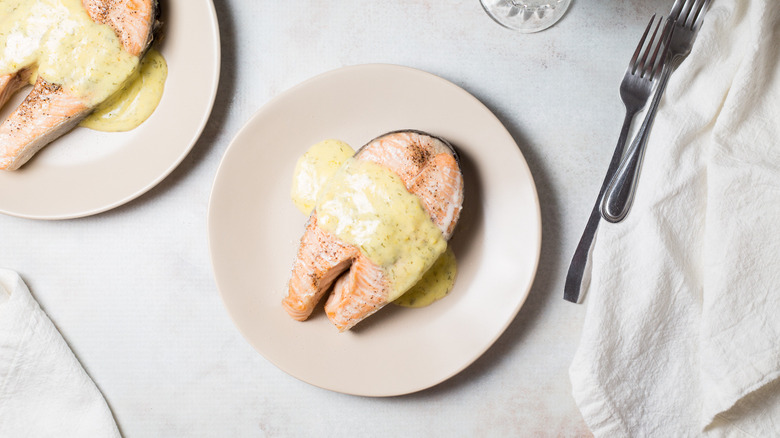
Plate the salmon steaks and spoon the sauce on top. Serve immediately, garnished with more chopped dill if desired.
Pairs well with salmon steak with lemon dill sauce
5-Ingredient Baked Salmon Steak With Lemon Dill Sauce Recipe
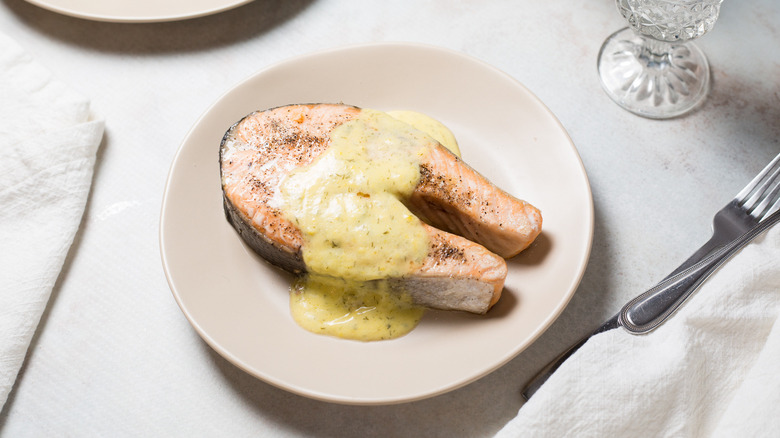
This easy-to-make, 5-ingredient baked salmon steak recipe also comes with a rich yet bright lemon dill Hollandaise sauce for topping.
Ingredients
- 1 ½ tablespoons olive oil, divided
- 2 (12-ounce) salmon steaks
- ¾ teaspoon salt, divided
- ¼ teaspoon black pepper
- 1 large egg yolk
- 1 teaspoons lemon juice
- 1 teaspoon chopped dill
- 4 tablespoons unsalted butter, cut into ½-inch pieces
Optional Ingredients
- More chopped dill for garnish
Directions
- Preheat the oven to 400 F.
- Grease a baking dish with ½ tablespoon olive oil.
- Pat the salmon steaks dry.
- Sprinkle both sides of the salmon steaks with ½ teaspoon of salt and the pepper. Place the steaks in the greased baking dish.
- Drizzle the remaining 1 tablespoon olive oil on top of both salmon steaks.
- Bake for 12-15 minutes, or until the internal temperature reaches of the salmon 125-130 F.
- Meanwhile, place the egg yolk, 1 teaspoon hot water, lemon juice, and 1 teaspoon of chopped dill in a double boiler (a heatproof bowl set over a pot containing no more than an inch of simmering water, making sure the bowl doesn’t touch the water).
- Whisk continuously for about 2-4 minutes, until the egg mixture is thickened and reaches the ribbon stage. Keep the heat low, and remove the bowl from the heat if needed to avoid cooking the egg yolk too much.
- Gradually whisk in the butter pieces a few at a time, keeping the heat low so the sauce doesn’t split. Whisk continuously for about 3-5 minutes, until all the butter is incorporated.
- Remove the sauce from the heat and stir in ¼ teaspoon of salt.
- Plate the salmon steaks and spoon the sauce on top. Serve immediately, garnished with more chopped dill if desired.
Nutrition
| Calories per Serving | 1,030 |
| Total Fat | 81.0 g |
| Saturated Fat | 26.9 g |
| Trans Fat | 0.0 g |
| Cholesterol | 340.0 mg |
| Total Carbohydrates | 0.7 g |
| Dietary Fiber | 0.1 g |
| Total Sugars | 0.1 g |
| Sodium | 907.4 mg |
| Protein | 71.0 g |

What does the ribbon stage mean when making Hollandaise sauce?
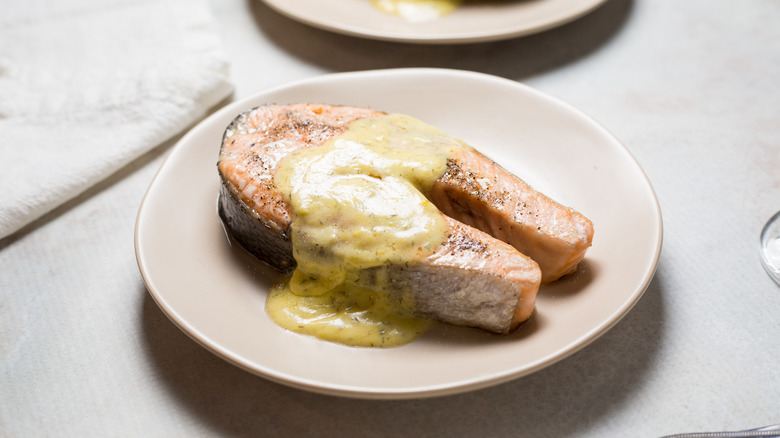
When reading different hollandaise recipes, you may find the number of minutes given for whisking the egg yolks in the double boiler can vary, which is why using a term like the ribbon stage is useful. It means the yolks are sufficiently thickened and you can move on to adding the butter. If the directions simply say to whisk until thickened, there may be some confusion.
The ribbon stage refers to a quality of sauce that, when lifted up with a whisk or another utensil, trails back down into the bowl in ribbons. By ribbons we mean long, flat lengths that don't disappear back into the sauce but stay on the surface, doubling back on each other. The ribbon stage is a term often used in baking to describe cake batter, but it's also used for egg yolks like in this hollandaise sauce recipe.
The reason terms like this are used is because cooking is not an exact science. Giving exact figures for minutes or temperatures is not always enough to ensure good results. For example, "low" or "medium" heat can mean different things on different stoves and can vary even more depending on what kind of cookware you use. That's why descriptions help cooks use their various senses to determine that something is ready.
How can I tell if my salmon is cooked correctly?
Overcooking is one of the salmon cooking mistakes to avoid in the kitchen. It's all too easy to do, since it cooks pretty quickly. Overcooked fish will be dry and tough, rather than moist and tender. Of course, undercooking is also a mistake for food safety reasons, because undercooked meat or fish can cause foodborne illness. Many recipes give a range of minutes because fish can vary in thickness and individual ovens vary in their performance.
First, the general rule for baking salmon at 400 F is that you'll need 12-15 minutes for every inch of thickness of the fish. For every ½ inch over that, add 2-3 minutes (or subtract time accordingly for thin fillets). Undercooked salmon will still have translucent areas and feel overly soft. Properly cooked salmon is firm and opaque throughout and should flake easily with a fork. Overcooked salmon is overly flaky, dry, and hard and may fall apart as well as lose most of its color.
The easiest way to check for doneness is with a meat thermometer. An internal temperature of 125-130 F is considered to be the low side of medium, but the temperature will go up a few degrees after it comes out of the oven. Aim for 145 F for salmon that will be safely cooked through while still being perfectly flaky and tender.