

Martha Stewart's Go-To Kitchen Organization Tricks

We think it's fair to say: No one knows more about kitchens than Martha Stewart. The cook and homemaker has made a career out of not just telling us how to make food in our kitchens, but how to make the most out of the space itself (and by creating kitchen goods that you really need in your home). Over the years, Stewart has given viewers of her television shows countless tips and tricks about how to make their kitchens as organized and easy to use as possible — and when you're dealing with a space that needs to be functional and fashionable, that's no easy task.
Some of Stewart's organization tricks are pretty ingenious, too. The home pro is a huge fan of mixing visible and invisible organizational hacks, advocating both for displaying certain items like pots and pans to save on space, and tucking away items like knives and baking sheets in smart ways. She's also keenly aware of how organization goes with the day-to-day use of your kitchen, and how to place items exactly where you need them, when you need them most. Ready to mix up your kitchen the Martha way? We're about to make it very easy for you.
Use modular solutions to increase customization and visibility
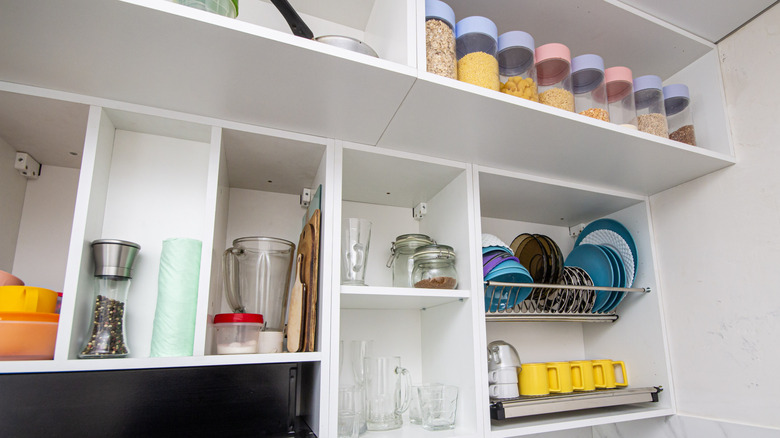
Kitchens can be a fine balance of function and style, and too often they put the latter over the former. Many modern kitchens are created without enough cabinet space to increase a sense of spaciousness — but this leaves you struggling to find a place to put all of your much-needed objects. Martha Stewart's solution is to use modular systems to store both dried goods and kitchen tools, which use open shelving to improve access to — and visibility of — all your items. Stewart stores things like crock pots, colanders, and coffee makers on her modular shelves, as well as foods such as oats and coffee beans.
By using modular shelving, you can also change its appearance and how it fits into your kitchen: If you decide you want to display more items and free up cupboard space, simply add a column of shelves and relocate things. Modular solutions aren't just for pure function, either. You can also place items like cookbooks and house plants on them to give your kitchen a bit more of a sense of style, or to showcase framed photos of your family.
Hang your pots and pans above the stove
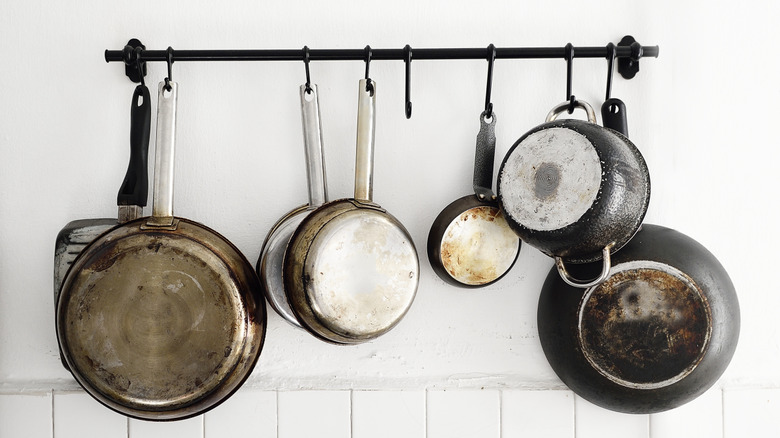
Pots and pans are one of the most annoying types of items to organize in your kitchen. They're big, clunky, and often different shapes and sizes. As such, to store them effectively, it feels like you often need to dedicate lots of space and take up entire drawers and cupboards to hide them away. Not only is this a bad use of space (think of all the emptiness and air around the pan handles, for example), but it also risks your cookware getting damaged as you stack them on top of each other.
Martha Stewart recognizes this risk too, and that's why she recommends hanging your pots and pans exactly where you need them. Place these items above your stove, or on a rack right next to it, and they'll be within easy reach. Because your pans are in full view, there's no rooting around to find the right size: You just pluck the one you need straight off the rack.
Hanging pots and pans is also a great way to display that expensive cookware you might have, but never get to show off. Importantly, though, if you are hanging them above the stove, make sure you have enough space to cook. Hang them too low, and they'll just get in the way.
Tray dividers will be your best friend
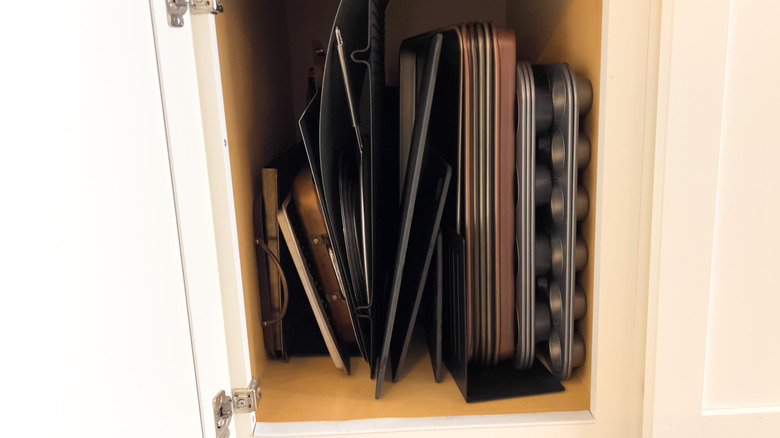
Baking sheets and trays are surprisingly troublesome items to store in your kitchen. When stacked horizontally, they can take up a strangely large amount of space, due to their often awkward dimensions. Like pots and pans, they can also be prone to wear and tear when placed on top of each other, causing them to deteriorate more quickly.
Martha Stewart is all too aware of these pitfalls, and so she incorporates tray dividers into her kitchen design. She places these dividers into slim cupboards that would otherwise be difficult to find a use for, and puts her baking sheets and trays on either side, grouping them by type, size, and function. The dividers keep them organized and easy to access.
Tray dividers are simple enough to find online for a few dollars, but if you want to take your organization to the next level, you can also get pull-out ones. Mount these in your cupboards, and place your trays inside. There'll be no need to scrabble around at the back of the cupboard for the right tray: They'll be on display for you when you most need them.
Install a pull-out tray under your sink
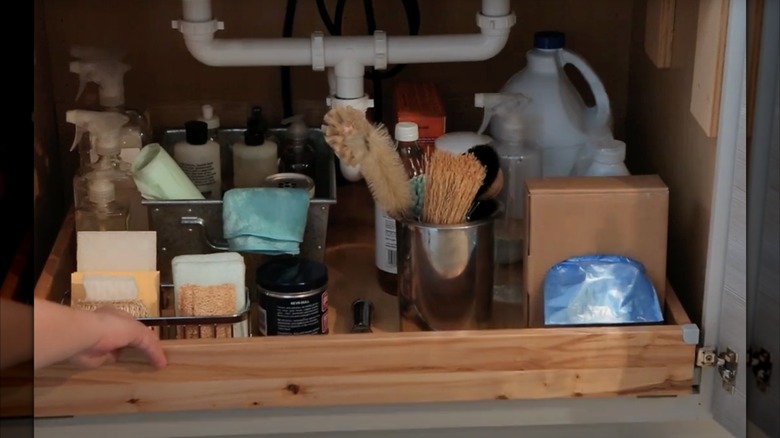
The area under your sink is often a space that isn't used to its full potential, and most of us resort to throwing all of our kitchen cleaning products in there in one big, jumbled pile. While this is a logical use of an awkwardly-shaped cupboard, it can also present problems. Cleaning products can get shoved to the back of the space, and, well, totally forgotten about.
To avoid this, Martha Stewart advises that you install a pull-out tray under your sink. You can pull it out whenever you need anything, and see every item you've stored there. A pull-out tray also makes everything way easier to organize, and allows you to take stock of all of your cleaning products without having to manually grab everything and place onto the counter or floor.
Bear in mind that pull-out trays are also useful elsewhere in your kitchen. If you have a low cupboard dedicated to utensils or tools, for instance, a pull-out tray can help you avoid piling them onto the kitchen floor to grab the one you need. They can also be great for cupboards storing dried foods.
Store things right where you need them
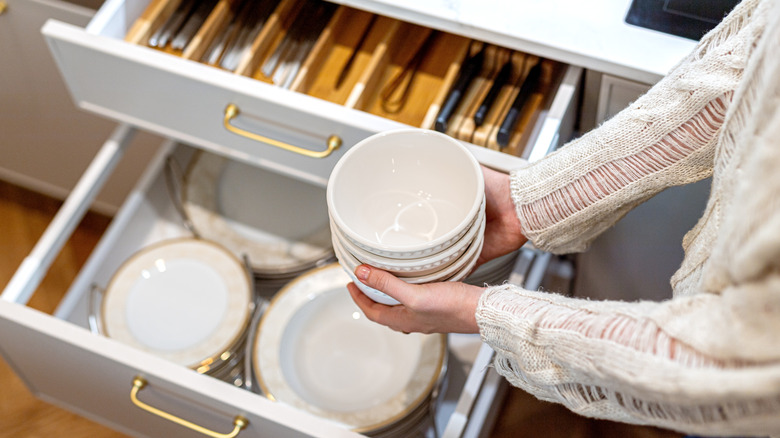
Putting things in a logical place in your kitchen sounds simple, right? Sadly, it's something that often gets overlooked. When you move into a new home, you often have to make a lot of quick decisions about where you place items in your kitchen. This can lead to things being placed in random, disparate locations. You might find you have to walk halfway across the kitchen to get an often-used ingredient every other day, or quickly leave the stove to grab a utensil that you've placed on the other side of the sink. It can be pretty annoying.
That's why this is one of Martha Stewart's main organizing principles: Put things where you need them. Keep your pots and pans near the stove, your mixing bowls under the counter, and mugs, coffee maker, coffee, and sugar next to each other. Similarly, cooking tools like spoons and spatulas should be within easy reach of your stove, and cutting boards and knives should be grouped together.
If you're reading this thinking your kitchen feels like it's lacking this kind of cohesion, it may be worth devoting a day to reorganizing everything. You'd be amazed at how useful a rejig of your storage can be. Oh, and it will also allow you to devote time to a deep clean as you do it.
Create a knife drawer
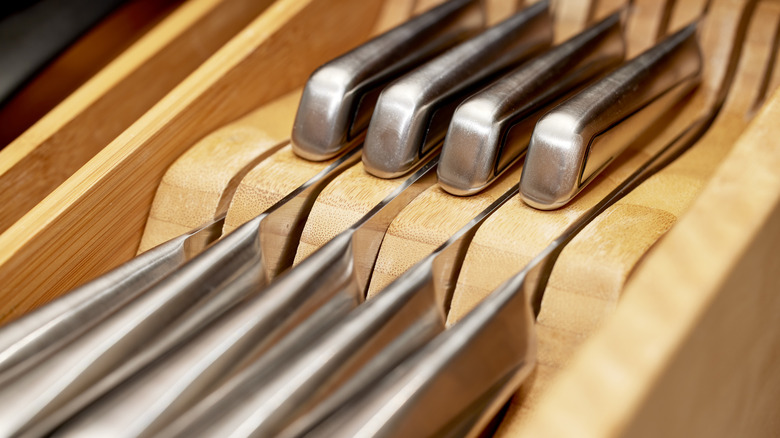
Storing knives isn't just challenging, but it's sometimes dangerous. Knives can frequently get thrown in with the rest of your utensils and cutlery, and this creates a sense of disorganization and a risk of you cutting your fingers whenever you pull them out. Improper knife storage can also cause them to blunt more quickly than you'd like, and force you to spend money on replacing them.
Martha Stewart sees the issue here too, and she gets around all these problems by creating a knife drawer. Place a knife block or a liner in an accessible drawer (Stewart uses a cork liner, which helps to keep the knives secure while looking great), and put your knives in size order. Try grouping knives by the design of their handle: This will make the appearance of the drawer even more attractive. A knife drawer can also be a great idea if you have children, as you can childproof that one space instead of having to do so on multiple drawers. Your kids will know that drawer is strictly off-limits, and everyone remains safe.
Install a Lazy Susan wherever you can
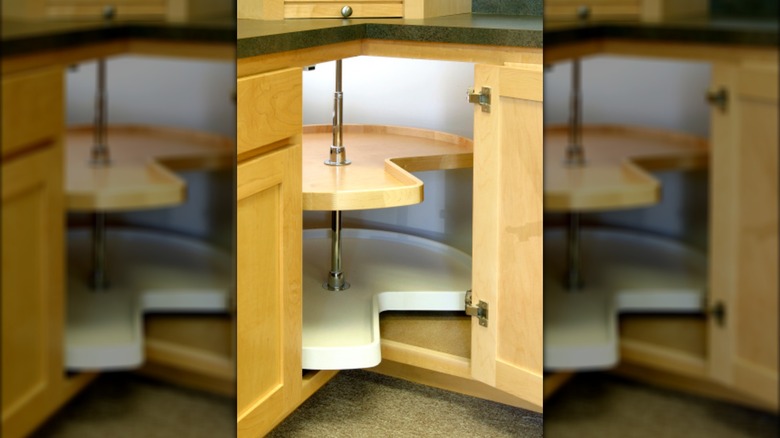
If you know anything about Martha Stewart, you'll know that she loves a Lazy Susan. The home pro places these delightful spinning contraptions virtually anywhere that will fit in her kitchen, and no matter where they end up they provide a huge help with organization. Stewart routinely places Lazy Susans in her corner cabinets, where they allow easy access to all of her crockery and kitchen tools without having to pull everything out. Items like ceramics and infrequently-used tools are perfect for storing with Lazy Susans, but they're also awesome for putting plates and bowls on.
Lazy Susans are a huge help in the fridge, and particularly on upper shelves that store items like pickles, preserves, and sauces. These foods have an unfortunate knack of being pushed to the back of the refrigerator and spoiling — but a Lazy Susan allows you to keep stock of everything and use and replace items routinely. Plus, it may just provide you with the inspiration needed for an exciting dinner.
Use the space above your refrigerator for infrequently used items
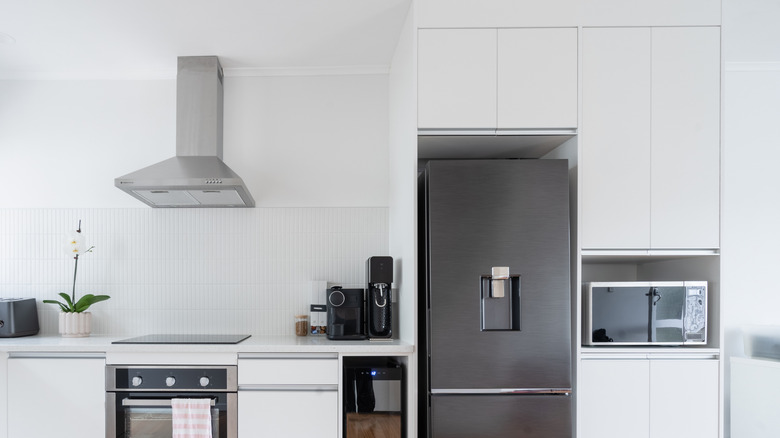
Whether you have an integrated or standalone fridge, the space above it can often be underused. If you have a cupboard over it, it can frequently go ignored, and end up an awkward storage space for something that collects dust for the next five years. If your fridge is a standalone model, you can be left with a gaping chasm above it, with dead space that could be used for something.
Well, Martha Stewart thinks you should be using that space right now. She particularly likes it for objects like platters, jugs, and vases, which are taken out on occasion but not rarely enough to justify removing them from the kitchen entirely. Appliances like slow cookers, which tend to be brought out during winter months to make all of those unexpected foods, can also be safely stashed up there. The space above your refrigerator is also a good location for bulk-buy dried goods like big bags of rice or pasta, which you can decant into fashionable jars that you place on the countertop.
Place containers in your drawers
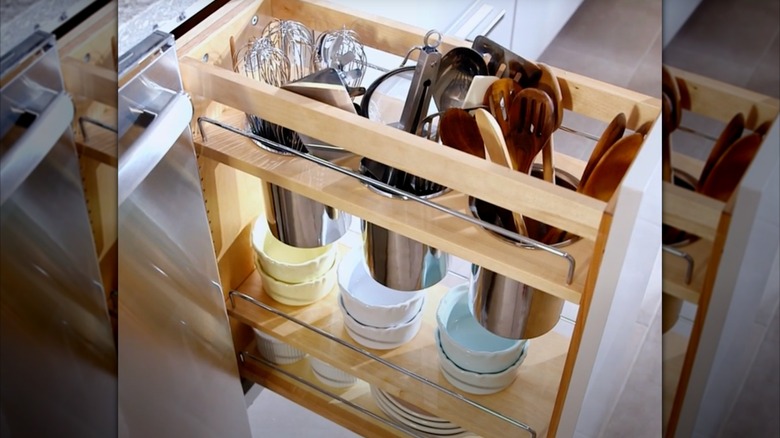
Organizing utensils in your kitchen can be a deceptively annoying task. You can either put them all in a drawer and have them get jumbled up and difficult to retrieve, or you can place them in containers on your countertops and lose space. Martha Stewart, though, has the solution to these problems — and hers is to combine both things into one. She places containers in her drawers and uses them to house all of her longer utensils, like wooden spoons, tongs, spatulas, and whisks. When she needs one, she pulls out the drawer, grabs the item she requires, and tucks the rest back out of sight.
Stewart groups her utensils by type when doing this, but you can organize them however you see fit (as long as you're not just making more clutter). You can also use containers in any orientation you like: If you prefer having your utensils lying flat, for instance, grab some dividing containers and place them horizontally in your drawer. Stewart, however, prefers using deep containers that she places in a tall drawer in her lower cabinets.
Store items like onions, potatoes, and garlic in mesh drawers
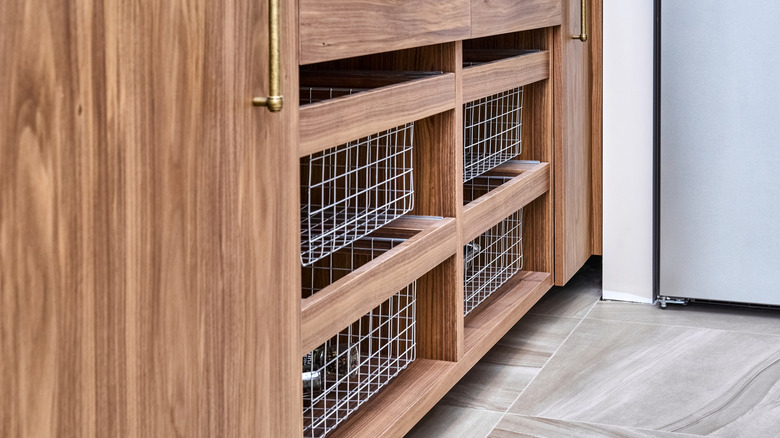
Vegetables like onions, potatoes, and garlic pose a storage challenge. They require good air circulation to stop a buildup of moisture and dampness, but also need to be kept out of direct sunlight. Stashing them in a dark drawer may help with the latter, but not with the former — and you can find that they deteriorate more quickly than you'd like.
Martha Stewart opts to keep her onions and potatoes in a mesh drawer, which provides good access to air but also shades them from bright light. She inserts these drawers into a modular shelving unit, but it's also possible to mount them in an integrated cupboard used to store other items. Mesh drawers also give you an easier view of your veggies, so you don't have to dig them out to assess their quality regularly.
If you are going to place them in a cupboard, though, bear in mind that closing the door may limit the air circulation you need. It might be worth removing the cupboard door and creating a dedicated space for vegetable and dried goods storage.