

11 Mascarpone Alternatives Worth Buying
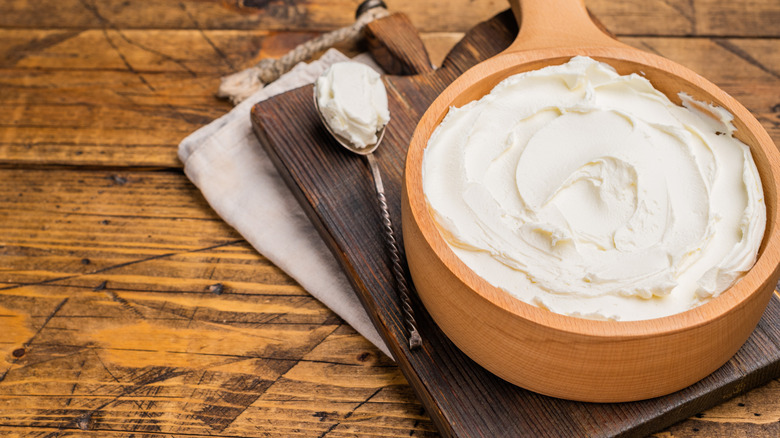
Mascarpone is a thing of beauty. Originating from the Northern region of Lombardy in Italy, this rich, thick cheese has a velvetiness and lusciousness that makes it irresistible and elevates any dish. While typically used in tiramisu and other desserts, mascarpone is just at home in savory dishes as it is in sweet ones, and can add heft and creaminess to pasta sauces and risottos or top bruschetta. For many, it's a must-have in their kitchen.
For others, though, it can be a rare purchase, partly because of its price. Good mascarpone can be not just hard to find, but very expensive, particularly in comparison to other creamy cheeses that could stand in just as well. Just as mascarpone can be used as a substitute in itself, alternatives can be used in place of the cheese in a lot of recipes — and sometimes, they can bring a new twist you might not otherwise get. These alternatives can often be more affordable, and you might find them to be a little more adventurous, too. Ready to try something new? Here are some of our favorite mascarpone alternatives, and how they compare.
Cream cheese
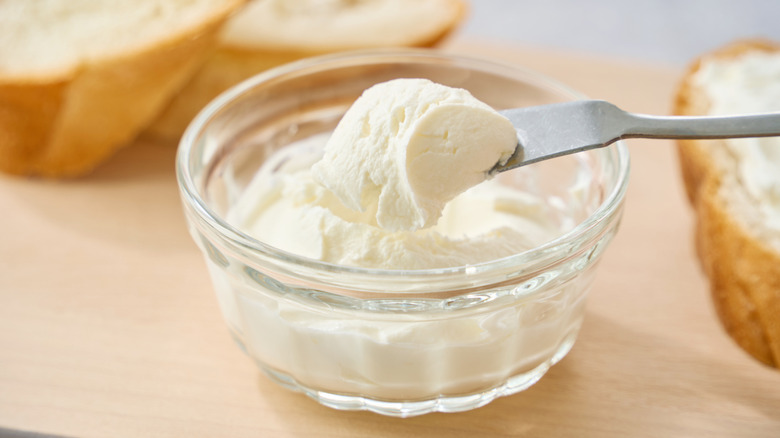
It's probably no surprise cream cheese can be a mascarpone replacement if you're in a pinch and need something similar. On the surface, the two feel fairly interchangeable: Both are soft, spreadable cheeses with a relatively mild flavor that come in a tub and have a relatively high fat content. Because of these qualities, cream cheese can be used in many applications where you'd typically use mascarpone, like in icings, toppings, risottos, and soups. Conversely, you can also use mascarpone where you'd normally use cream cheese: Try adding it to a cheesecake, for example.
Having said this, it's important to remember you won't get exactly the same result by using cream cheese as you would with mascarpone. Cream cheese has a slightly different flavor and texture: It's a bit thicker and tangier. Mascarpone also has a higher fat content, and as such, it may be worth doctoring your cream cheese for it to better mimic the former cheese's mouthfeel and flavor profile. Try mixing your cream cheese with heavy cream or butter, with four parts cheese to one part of either of the two dairy products. This will add creaminess and heft to the cheese and slightly pull back its sour notes.
Ricotta
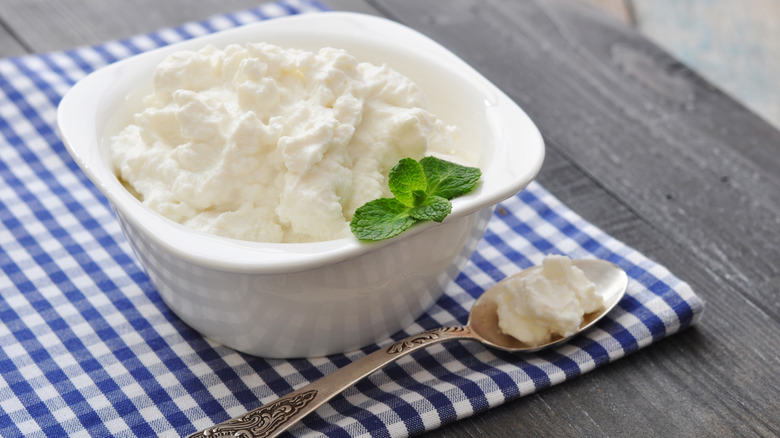
It's hard to find a perfect substitute for mascarpone, but ricotta gets fairly close. The soft cheese is, like mascarpone, relatively mild-flavored and leads with creamy notes, as opposed to funky or overly tangy ones. There's also a slight sweetness to ricotta that means it can emulate mascarpone's function in recipes, particularly sweet ones like tiramisu, and it's also useful as a substitute in filled pasta dishes. As ricotta has a much lower fat content than mascarpone, it can also be a nice choice if you're looking to create creaminess without too much heaviness.
However, there are some key differences you need to bear in mind. The first is in its consistency: Ricotta is loose and somewhat grainy, whereas mascarpone is silky and smooth. Therefore, if you're going to use ricotta as a substitute, it's important to slightly doctor it. The easiest way to do this is to blend or process it to break down its curds and make it creamier. To that end, you may also want to find ricotta with smaller curds, so it's easier to smooth out. Importantly, ricotta also has a gentle acidity to it — it's best to use it as a substitute where other ingredients are mixed in, so it doesn't stand out too much.
Sour cream (with some tweaks)
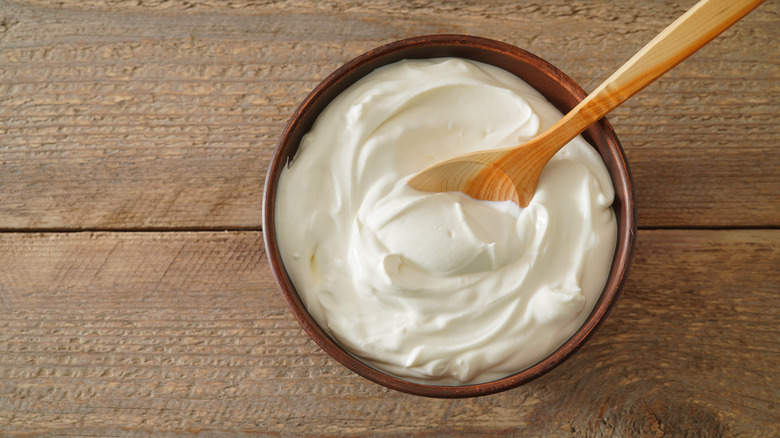
While mascarpone is technically a cheese, its high fat content means it almost feels more like a thick, whipped cream. Because of this, it makes sense an alternative like sour cream would do the job. Sour cream is less fatty than mascarpone, but they have a similar consistency and smoothness, as well as a comparable visual appearance. In some dishes, you can swap them interchangeably without any ratio tweaks, and they'll both do the job.
The clue's in the name, though. Sour cream is more acidic than mascarpone and will bring a tanginess to anything you're using it in. It can be a good idea to mix your sour cream with a milder and fattier dairy, like whipped heavy cream or cream cheese, to take the bite out of its flavor and give it mascarpone's smoothness. Another thing to remember is sour cream shouldn't be used identically in hot recipes that call for mascarpone, as unlike the cheese, its lower fat content can cause it to split at high temperatures. If this is the case, you may want to add it at the end of the cooking process to ensure it retains its integrity.
Cottage cheese
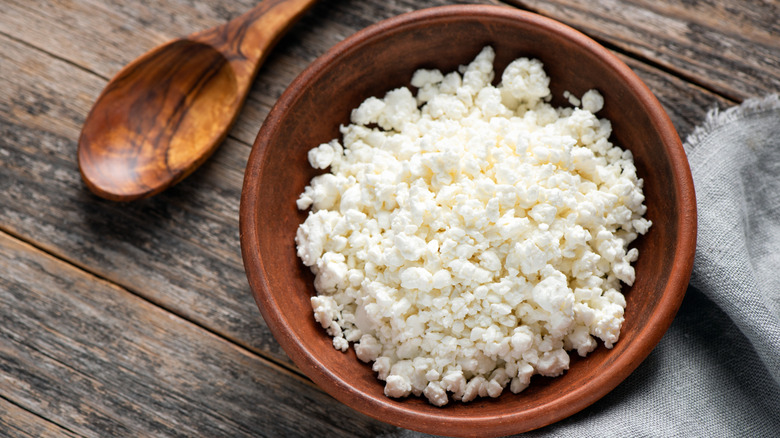
Who knew cottage cheese could be so versatile? Not only can you use it to make pancakes, eggs, and loads of other recipes, you can also sub it in for mascarpone in a pinch. This may seem counterintuitive given cottage cheese's lumpiness, but a quick whizz in a food processor can smooth it out considerably, turning it into a creamy cheese that emulates mascarpone's texture. Once it's sufficiently broken down, you can sub it in wherever you use mascarpone – even in tiramisu.
Bear in mind, though, that it'll taste different unless you doctor it with additional ingredients. The easiest way to bring it closer to mascarpone is to mix it with a little heavy cream, which will imbue the cottage cheese with creaminess and reduce some of its tang. Adding heavy cream will also improve its texture, smoothing it out and rendering it closer to mascarpone. It's crucial to make sure you're using full-fat cottage cheese, too, because low-fat or fat-free cheese won't give you the right fullness of flavor and mouthfeel.
Crème fraîche
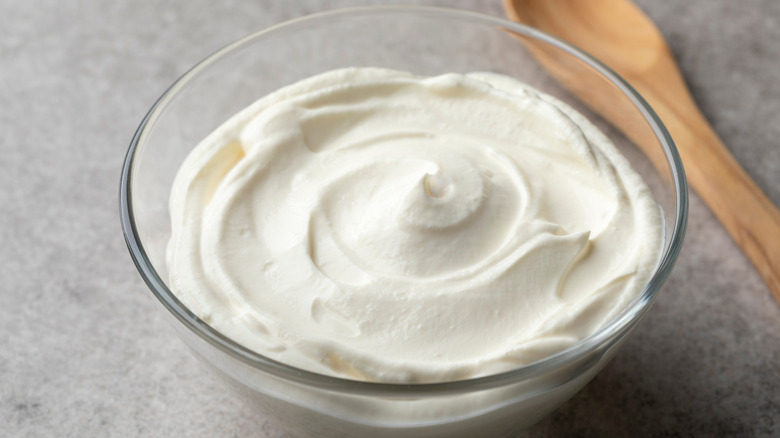
Crème fraîche is one of the easier-to-find mascarpone substitutes out there, and it has several benefits that make it a worthy alternative. It has more fat than some other mascarpone substitutes, giving it a creamier consistency that's closer to the cheese, and it also behaves well when added to hot sauces or soups. Furthermore, crème fraîche (which is different from cream cheese, remember) has a nice smoothness to it, and therefore requires less work than other mascarpone alternatives in terms of texture.
With that said, though, its taste is different. Crème fraîche has a sourness mascarpone doesn't, and an almost-nuttiness that can sometimes distract from other ingredients. Because of this, it's best to use it as a substitute in things like sauces or toppings, and savory applications instead of sweet ones. If you do want to bring it closer to mascarpone, you can mix it with sugar to reduce some of its sourness — and it's a good idea to try and find a crème fraîche that's on the less-acidic side.
Full-fat Greek yogurt
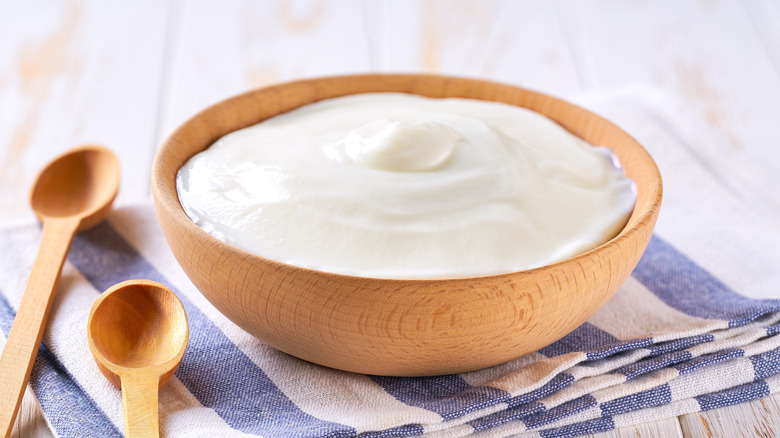
First things first: If you're substituting mascarpone for full-fat Greek yogurt, you should be ready for some differences in flavor. Anyone who's tried the two can tell them apart: Greek yogurt is tangy, sour, and has a fermented note to it, whereas mascarpone is creamy, dairy-forward, and luscious. Greek yogurt can also be thinner than mascarpone, which means it doesn't have the same integrity and can collapse on itself in situations where you need it to be full-bodied and rich.
However, now we've got those negatives out of the way, let's look at the positives. Full-fat Greek yogurt has a rich flavor and a smoothness that can stand in for mascarpone in a pinch, particularly in sauces or baking recipes. It's also fairly affordable, and if you find mascarpone to be a little characterless sometimes, it'll definitely pack more of a punch. Additionally, you can thicken Greek yogurt by passing it through a cheesecloth or strainer, which can improve its body and its versatility as a mascarpone substitute. It may not be a perfect swap, but in a lot of cases, it'll do just fine.
Whipped heavy cream and cream cheese
Mascarpone is traditionally made with the cream that forms on the top of whole milk, which gives the cheese its ultra-high fat content and rich flavor. It's little wonder, then, that heavy cream can be used as a substitute. Both mascarpone and heavy cream are rich in fat, and once whipped, heavy cream develops a thick, sturdy structure that emulates the cheese's own consistency. Heavy cream also has a straightforward flavor, unlike many alternatives, which bring too much of themselves into the equation.
It's arguable that heavy cream's flavor is a little too plain, though — and that it needs some tweaking before it's a truly worthy mascarpone dupe. Mascarpone contains acid, and so you should either add an acid source (like a squeeze of lemon juice) or another tangy dairy like cream cheese or sour cream, which will also help give it a firmer structure. Mixing in some softened butter can also help, as it will give your mascarpone substitute a fuller mouthfeel.
Tofu
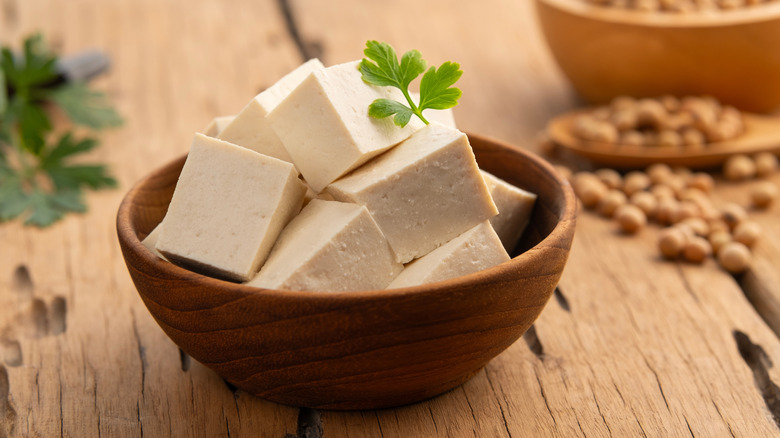
Okay, so we know what you're thinking. Tofu's the kind of thing you put in a tasty savory recipe, sure — but in tiramisu or other desserts? Well, it can be done, and tofu of all kinds can be used as a mascarpone substitute (albeit with some doctoring). Tofu's base flavor is fairly plain, giving it a lot of versatility as a mascarpone alternative in both sweet and savory dishes. Plus, it's dairy-free, so it's perfect for people who follow a fully plant-based diet.
Silken tofu is the easiest type to use straight out of the carton. While slightly jiggly if left to its own devices, by blending it with some sugar, you can create a smooth, lightly sweet mascarpone substitute that's great for a tiramisu. Some people, though, might find silken tofu's structure a little loose, and may want to opt for firm tofu instead. If doing this, you have some work on your hands. Firm tofu can be the base for a mascarpone substitute, but you'll need to combine it with a fat source like regular or vegan cream cheese or coconut cream. A spritz of lemon juice and a pinch of sugar will also bring it closer to mascarpone.
Milk powder, heavy cream, and lemon juice
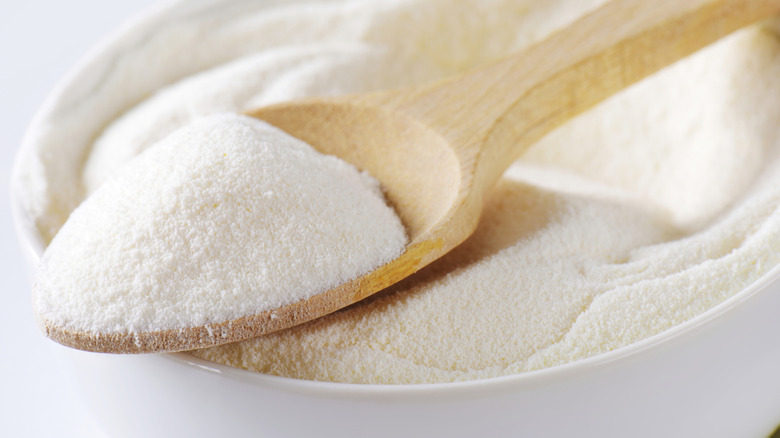
If you want a mascarpone alternative that's not too expensive, which only takes a couple of ingredients to make — and which most importantly tastes like the cheese itself — it's easier than you think. Combining milk powder, heavy cream, and lemon juice in a pan can give you a homemade mascarpone in minutes of hands-on work and a little waiting time. You start by whisking heavy cream and milk powder together and then heating them to 180 F, before adding the lemon juice and leaving the mixture to chill overnight. Once set, you then strain the mixture with a cheesecloth until it's thick and creamy.
By doing this, you're simply emulating how mascarpone is traditionally made, but on a smaller scale. You're left with a true mascarpone substitute that has both the creaminess and tanginess of the cheese, with ingredients you likely have at home. The key thing to bear in mind here is the temperature: It needs to be precise, so use a cooking thermometer, ideally one that clips to the side of your pan so you don't have to hold it constantly.
English clotted cream
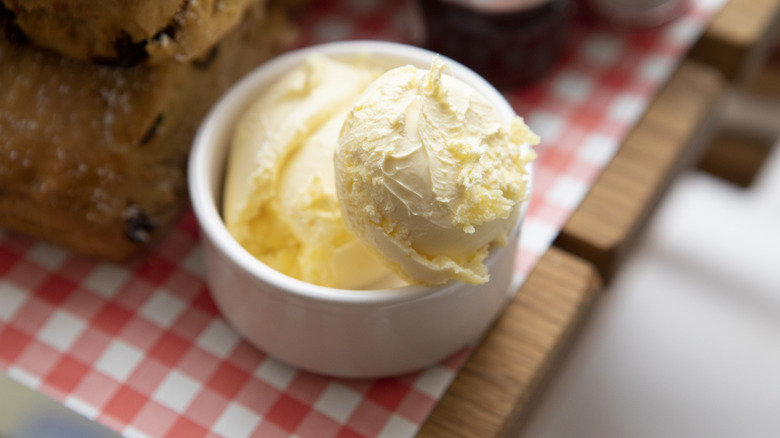
If you've never heard of clotted cream before, let us introduce you to a truly delightful ingredient. Clotted cream is a thickened cream with roots in Devon and Cornwall in South West England. It's most commonly added to scones with jam (although the order in which the two ingredients are added is hotly debated), but it can also be added to porridge, used to thicken sauces, and mixed into ice cream. As a mascarpone substitute, it's perhaps the closest of them all: Mascarpone and clotted cream have a similar fat content and thickness, and their flavors are also pretty close. One is a cheese, and the other is a cream — but other than that, there's not a lot between them. You can also substitute clotted cream for mascarpone, although doing so on a scone might earn you some worried frowns from the Brits in your life.
Naturally, though, clotted cream can be difficult to track down in the United States. The good news is it's relatively easy to make at home. Simply combine heavy cream and a small amount of unsalted butter in a pan, and simmer it for 20 minutes, until the mixture has considerably thickened. Leave it to chill in the fridge overnight, and you're good to go.
Coconut cream
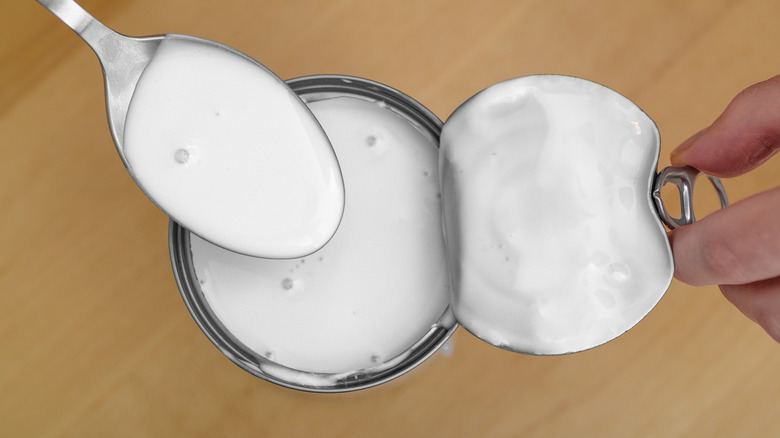
It can be difficult to find plant-based substitutes for cheese, and particularly creamy cheeses. Coconut cream can do the job remarkably well. Like mascarpone, coconut cream has a thickness and a full-bodied nature that holds its own in a bunch of recipes. If you can't find pure coconut cream, it's also easy to make at home. Just place a can of full-fat coconut milk in the fridge overnight, and skim the separated cream off the top.
However, there's one very important thing to remember here: Coconut cream has a strong coconut note to it that can quickly become distracting in recipes. If you're not careful, it can completely overpower whatever you're making, particularly if you're using it as a mascarpone replacement in savory dishes. As a consequence, it's important to tweak it slightly to balance out the coconut flavors by adding a pinch of sugar and squeeze of lemon juice. If you're buying coconut cream, you should also make sure you don't mistakenly pick up sweet cream of coconut instead, which contains additional ingredients and is meant for cocktails.