

11 Common Customer Complaints About Crock-Pots
We may receive a commission on purchases made from links.
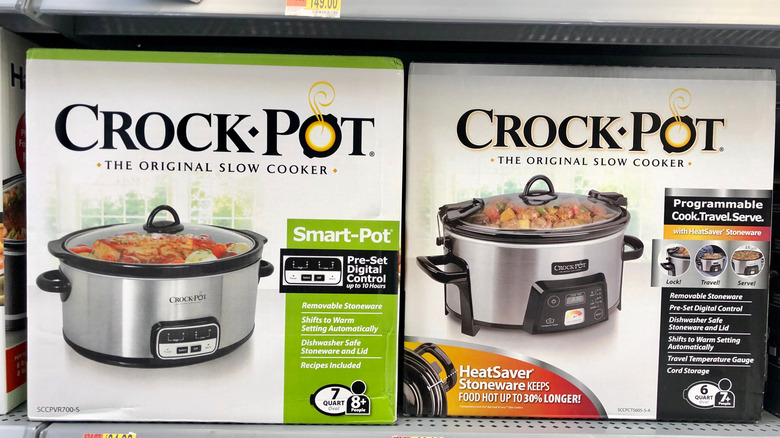
There are many slow cooker brands out there, but Crock-Pot is the one that started it all. The original manual slow cooker debuted in 1971 at the National Housewares Show, and by 1975, it already had annual sales of $93 million, eventually becoming a hallmark of 80's kitchens. It was an accident, really. The previous year, Rival Manufacturing had acquired the patent for a small bean cooker patented in 1940 by inventor Irving Naxon. But once test-kitchen employee Marilyn Neil discovered its versatility, the rest was history, and Crock-Pots became a national phenomenon.
Crock-Pot is still around today as part of Newell Brands and Sunbeam Products, and it now has a diverse product portfolio that includes programmable cookers and pressure cookers. However, we're a long way from when many people used "Crock-Pot" interchangeably with "slow cooker." Part of it is simply increased competition. Other brands such as Hamilton Beach, Cuisinart, GreenPan, Ninja Foodi, and Instant Pot (the latter functioning as both slow cooker and pressure cooker) have either sprung up or gotten in on the slow-cooker craze, elbowing away Crock-Pot's market share.
Part of the problem, though, is self-inflicted. Once considered the standard-setter for quality and value, Crock-Pot is now a constant target of vitriol. It isn't hard to find people like the Trustpilot reviewer who declared they "Will never buy another [product] from the brand...ever." So, what happened? These 11 common complaints tell the tale of a once proud brand that, at best, is now just one of the pack.
The temperature controls are inaccurate
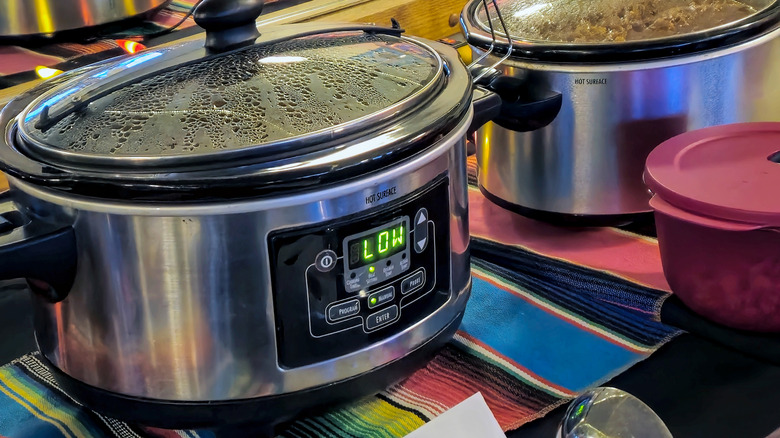
It seems like a given that a cooking appliance should be able to cook food as advertised, right? Unfortunately, in the eyes of customers, that appears to be too big of an ask for Crock-Pot, as there are numerous complaints about its products not doing what they're supposed to do. On the Crock-Pot website, a reviewer noted the temperature controls were "dangerously inaccurate" for the manual 8-quart slow cooker. According to the reviewer, the high setting barely generated any heat while the low setting was boiling the contents.
Reviews in the thread and others have observed that Crock-Pot cookers often don't come close to matching the advertised temperatures. A customer on ShopMyExchange lamented that their 4.5-quart manual cooker "won't get hot at all." On the flip side, an Amazon reviewer said of a manual 4-quart cooker, "I used it 4 or 5 times and it burns everything." Uneven cooking is another sore spot, as users have criticized Crock-Pot products for not cooking food evenly. Some of the food will be fully cooked while other parts will still be cold and raw even after following recommended usage.
It's not just Crock-Pot slow cookers, either. People have discovered similar problems with Crock-Pot multi-cookers, writing that these units cook food unevenly on low and burn whatever is over the heating element on high.
There are often limited or hard-to-use controls
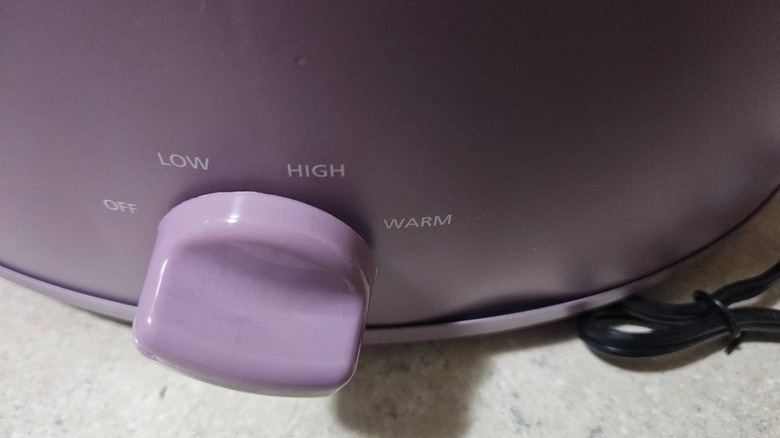
On top of the cooking issues, the Crock-Pot controls (or lack thereof) don't seem to help. The classic Crock-Pot manual slow cooker remains a very basic cooking tool. There are only four settings: Off, Low, High, and Warm. Such a setup was ground-breaking in 1971, but today, it's woefully behind the times. Users who are constantly on the go plan their schedule around when the food is expected to be done to avoid overcooking or undercooking.
So just get a programmable Crock-Pot, right? It's not that simple, sadly — quite the opposite, according to many. Complaints about these models include the LED displays disappearing, random flashing that doesn't let users select settings, and the cookers not switching back on after a power outage. Another reviewer reported having to pound on their Crock-Pot's electronic control panel when it wouldn't do anything beyond power up.
This is a widespread issue to the point that many people have theorized making products more complex is part of what has shortened the average Crock-Pot's lifespan. In other words, there are more parts that can break — the circuit board in particular. A YouTube reviewer criticized the control board on their Crock-Pot as providing "an apparent feeling of value." This part allows for fancy digital controls but is cheaply manufactured and thus can easily break or fail.
The lids are a big problem
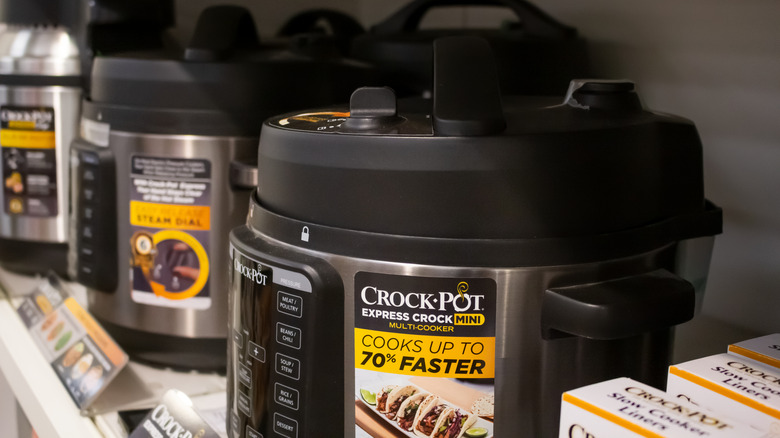
The lid is crucial on any slow cooker, as it's what holds in heat and moisture. This seemingly simple component has drawn some of the most scathing reviews on Crock-Pot products — and even a recall of over 940,000 Express Crock Multi-Cookers in 2020. It turns out the cookers were still pressurizing even when the lid wasn't locked, which led to the lids blowing off and injuring users.
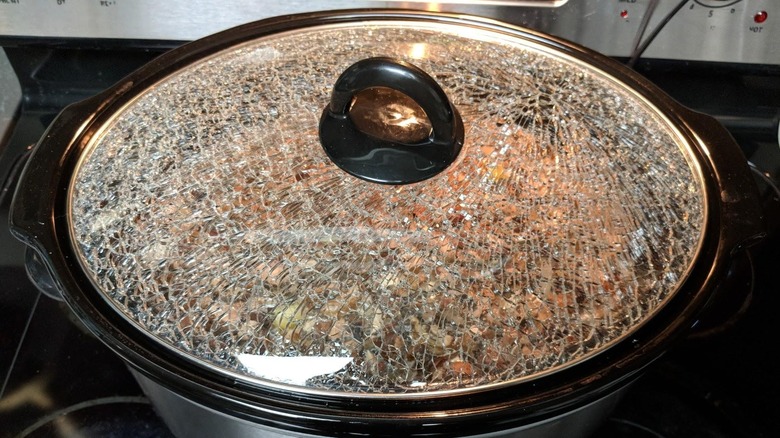
That's far from the only issue, though. We found far too many reports of glass Crock-Pot lids exploding. A Trustpilot reviewer recalled how the lid shattered when they lifted it after cooking stew overnight. "Glass went everywhere, dropping into the boiling stew, splashing liquid and releasing steam," they recounted. Another user said the lid on their Crock-Pot Cook & Carry Slow Cooker shattered after only eight months. Plus, one person had their lid shatter when they set it in the cupboard. There are also reports of hardware breaking and the handle and fasteners not being sealed against steam.
The worst part is that Crock-Pot seems reluctant to address the issue. A victim of an exploding lid reported that, even though it was a known production flaw, Crock-Pot wouldn't replace it. After one user had their cooker's lid shatter, they discovered buying a replacement lid would cost more than what they paid for the cooker. And the customer who lost their stew claims Crock-Pot wanted them to mail back the lid at their expense.
The housings are poorly designed
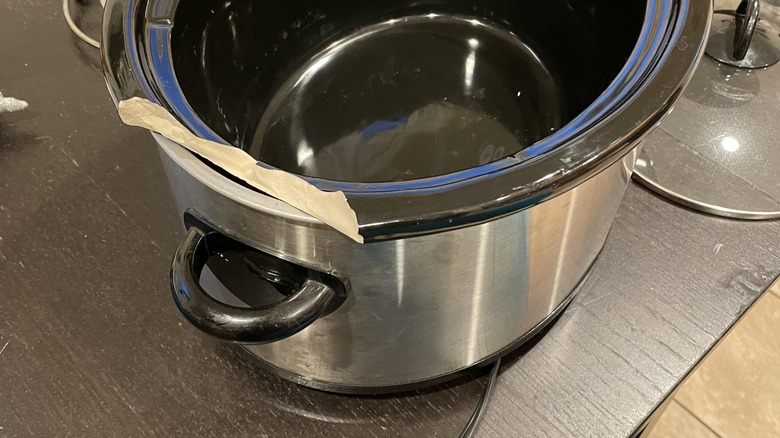
Having one part of a Crock-Pot that's continually a problem is bad enough. Owners report that's not the end of the story, though. The metal housing, which is what holds the pot and heating elements, has been known to cause myriad issues. A well-designed housing will be durable, have adequate insulation to trap heat, and eliminate hot spots in food. By many accounts, though, this component on Crock-Pot cookers is just as shoddy as the lids.
The main source of vitriol comes from how flimsy the housing and base are on modern Crock-Pot. A Reddit user who purchased an 8-quart programmable slow cooker found the housing "extremely thin" and that it could be dented "with very little force." They also noted that there was almost no insulation, to the point where the outside surface was hotter than the inside. Such inefficiency greatly increases cooking times and energy usage while being a safety issue.
Others have echoed the feebleness of the housing — and there are endless reports of Crock-Pots arriving already dented. Then there are the Crock-Pot owners who observed that, after just a few years, the housing had significant rust on the inside and/or outside. Be careful trying to remove the rust or any gunk, as that may cause the paint to peel. But getting a vintage Crock-Pot isn't exactly a safe bet, either. Some '70s-era pots used asbestos as insulation, risking exposure to this extremely dangerous fiber.
The build quality has gone down
These stories of exploding Crock-Pot lids and easily broken housings are part of a larger tale — specifically, of how much the overall quality for new Crock-Pot products has deteriorated. People rave endlessly about the durability of vintage Crock-Pots, with some still in use after decades. One Facebook commenter said the Crock-Pot they received as a wedding gift was "still going strong" after 33 years. Others echo the longevity of classic models and claim the low settings stay at a lower temperature than newer models, making them more effective for all-day roasts and simmers.
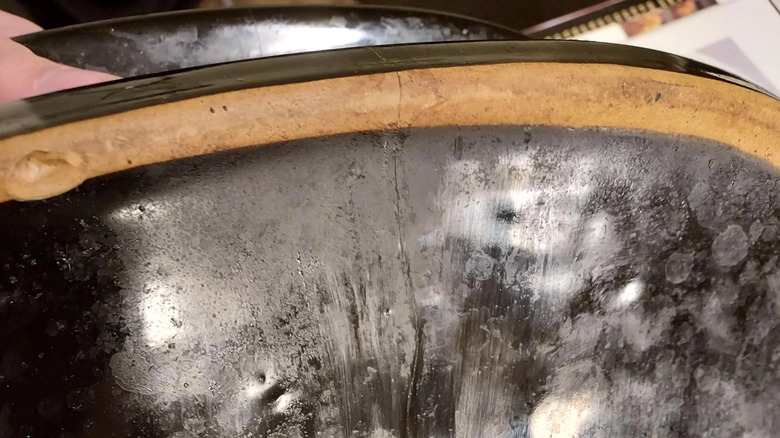
For modern Crock-Pot, it's the exact opposite. We found numerous tales of slow cookers breaking within a year or two of purchase. Sometimes, it doesn't even take that long. One particularly unlucky customer reported having three Crock-Pot products crap out on them in a four-month span. The ceramic insert pots are a particular sticking point, as they often crack, break, develop pitting, or have the glazed coating wear off even when used as instructed.
It's all far too widespread to consider it a series of one-off issues or user errors. As a disappointed customer said of Crock-Pot on Trustpilot, "The reputation for a quality item is no longer deserved." We weren't surprised that, nowadays, it appears a lot of the company's products aren't manufactured in the U.S. – and this information isn't readily listed on the Crock-Pot website.
Products are often defective

Of course, some of you may be reading about people getting a year or two from a Crock-Pot and thinking they were lucky to have that. That's because there's a long list of examples where the products are defective from the get-go. A case where the lid handle was off-center is relatively harmless and humorous. But things take a serious turn when you consider that, along with the 2020 recall we mentioned — which also led to a Colorado woman being awarded over $50 million due to severe injuries — two class-action lawsuits have been filed against Crock-Pot over its faulty products.
The first came in January 2020, alleging the Crock-Pot Express Pressure Cooker had two faulty parts: The first was a pressure valve that inaccurately said pressure had been released when it wasn't, and the second, a gasket that let users open the lid before the cooker had depressurized. The case was eventually settled in December 2022 with undisclosed terms. Then in January 2026, another class-action lawsuit claimed the non-stick coating on Crock-Pot's Easy-to-Clean slow cookers was peeling and chipping off the insert during normal use and cleaning, presenting a serious health risk. The outcome is still pending as of publication.
Defective Crock-Pot products aren't a recent development, either. In 2004, when the company was owned by The Holmes Group, there was a recall of 1.8 million slow cookers due to the handles breaking off the base. At least that time, the issue was resolved voluntarily without getting the court system involved.
They are difficult to clean
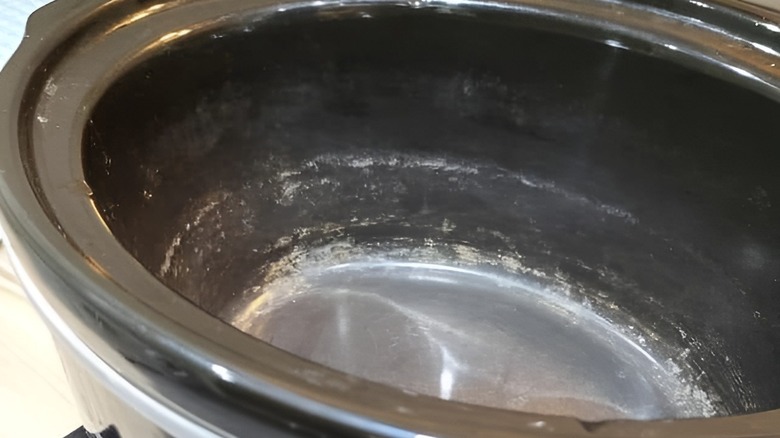
It feels like we're adding insult to injury at this point, but regardless of the Crock-Pot product, cleaning your slow cooker is anything but easy. Even if a Teflon coating isn't flaking off as you scrub, removing food residue from these cookers has proven to be a challenge. For starters, although Crock-Pot says the stoneware inserts are dishwasher-safe, it is still prone to being scratched by other items or cracking because of sudden temperature changes. Owners have even discovered mold growing in hairline cracks on the glaze. And, of course, some models don't have removable inserts.
The biggest issue is gunk from certain foods that sticks and builds up. A long Reddit thread developed after someone wrote about the "black burn gunk" from slow-cooked ribs collecting on the insert. Foods high in starch, fat, and sugar, and water with a high mineral content are known to leave residue — and adding cooking spray can actually make the problem worse.
Crock-Pot's designs don't help, either. A Trustpilot user noted that debris often builds up around the lid's hinges and hardware on their model, and because of this hardware, "the lid takes up twice the room in the dishwasher." The irony is that the only solution some people have found is to use abrasive cleaners and scouring pads — something Crock-Pot specifically advises against doing.
Instructions are often confusing or missing

Believe it or not, some people like to read the instructions for their cookware, as even low-fuss cooking after a long day is easier with a few pointers. The original Crock-Pot was legendary for what came with it. Not only was there a full manual with instructions, safety advice, and cooking guidelines, but there was also a lengthy booklet of recipes. An example booklet we found included recipes for pot roast, brisket, steak rolls, turkey pot pie, spaghetti, and dozens of other goodies.
Nowadays, though, users report they're lucky to receive any sort of documentation. Many users report their new Crock-Pot didn't come with instructions, forcing them to find the manual online or guess. This isn't as big a deal with the simpler models, but poses a problem when using complex Crock-Pots. For example, customers who bought the Choose-a-Crock with divided stoneware inserts couldn't figure out how to use the two sections.
Others did receive instructions but found them confusing or counterintuitive. Another person with a Crock-Pot SmartPot went to Reddit because they couldn't understand how the time and temperature presets worked. The weirdest issue is that, at some point, Crock-Pot changed the Low, High, and Warm labels to I, II, and a wavy line — but neglected to explain the change in the documentation. On a Facebook thread, a Crock-Pot user said, "I used a sharpie and made the single line into an L and the double line into an H so I'd remember."
Replacement parts are hard to find
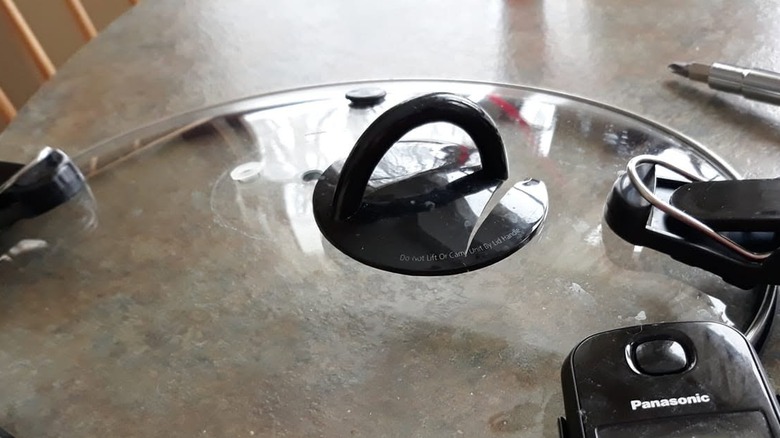
It's bad enough when the kitchen appliance you thought would be worth every penny breaks. What's even worse? Not being able to get the parts to fix it. The horror stories are rampant of Crock-Pot customers who have a lid, stoneware pot, handle, or something else break, only to have to throw the entire unit away because parts weren't available.
The Trustpilot reviews of Crock-Pot are particularly rife with these stories. One Trustpilot reviewer said that after the ceramic pot cracked, customer service told them there were no replacements in stock "and to email back in a month." Another user on the platform had their own tale of not being able to get a replacement pot, and said Crock-Pot tried offering a 30% discount off a new model — only to find the post-discount price was similar to the regular price at most online stores. Whether it's a pot, a steam release valve, a handle, or anything else, getting new parts is extremely difficult.
When this happens and the warranty has expired, it leaves owners with no good options. As a customer said on Amazon: "I don't expect free, but there should be some accommodation when they cannot provide a replacement part." For good measure, it appears Crock-Pot frequently discontinues product models and stops making replacement parts when a product is no longer for sale. On the rare occasions when the company does offer replacements, there are many reports of customers being sent the wrong parts.
The warranty stinks
Then there's this: When your Crock-Pot breaks — and we feel like we have to say when, not if, giving the number of incidents — you'll often be on the hook to pay for it yourself. That's because the Crock-Pot brand is only covered by a one-year limited warranty against manufacturing defects. Furthermore, Crock-Pot has a laundry list of situations that aren't covered under the warranty, including normal wear, accidents, using products for commercial applications, and (our favorite legalese term in this context) "damage from Acts of God."
The relative lack of coverage is not lost on angry customers. One said right on the Crock-Pot website, "Your warranty is garbage and so are your [slow] cookers." Another reviewer on Trustpilot noted that, when their barely-a-year-old Crock-Pot stopped working, the company told them to throw it in the landfill. As they put it, "A company this size should be not just filling landfills with [their] dodgy products" If that's not enough, one customer reported that customer service tried to claim a four-month-old Crock-Pot was no longer covered.
Crock-Pot's warranty especially pales versus some of its competitors. As examples, Russell Hobbs provides a two-year warranty if you register products within 28 days of purchasing, and Morphy Richards has a three-year warranty on registered appliances. Other brands like KitchenAid offer extended service plans, which can be useful on more expensive cookers. With Crock-Pot, though, you barely have any coverage options.
Customer service is terrible

The cherry on the disappointment sundae for Crock-Pot is the poor service provided to people stuck with faulty appliances and broken parts. Crock-Pot has a 1.6/5-star rating on Trustpilot, and the lack of good customer service is a key reason why. From slow responses to representatives flat-out refusing to help customers, there is no shortage of horror stories.
Consider one reviewer, who went on Trustpilot and described their four-month odyssey as, "...an appalling client service process which is clearly designed to make people give up and go away." Another review echoed this, saying an attempt to call Crock-Pot about a malfunctioning cooker was, "one of the worst customer service experience[s] I've had." Then there's one disgruntled customer, who noted a less-than-concerned representative kept requesting information he had already provided, and concluded, "Crock-Pot? More like crookpot." One reviewer even claimed the company wanted them to pay to ship back a replacement Crock-Pot that arrived broken.
Other Crock-Pot owners have written about being hung up on by customer service and being indirectly accused of fraud. And do you remember the customer from a few slides ago who was told to email back about a replacement pot? They did so, twice, only to be ignored. Given many of these loud, aggressive complaints have at least received responses from someone at Crock-Pot, it appears to be the only chance at recourse. If nothing else, customers are blowing off some steam — and doing so better than certain Crock-Pot products.