
9 Old-School State Fair Snacks We Rarely See Today
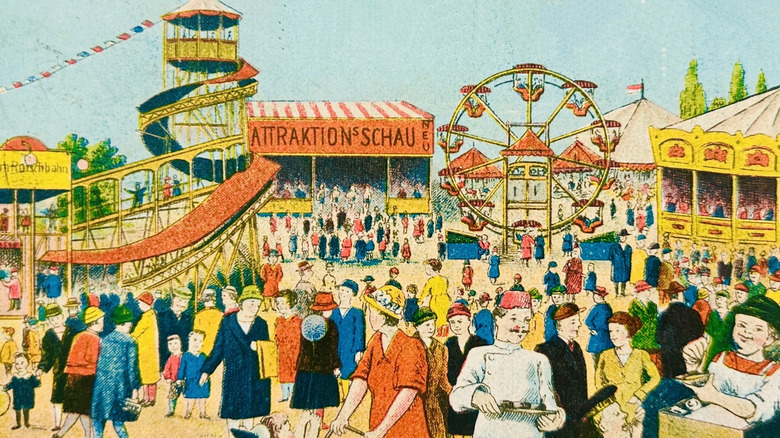
Fair foods have always inspired a sense of anticipation, with roasted, smoked, or deep-fried delicacies that fairgoers can smell from a mile away. Today, most classic fairground treats are whimsically greasy and extravagant — consider Krispy Kreme burgers, deep-fried butter, or Kool-Aid pickles among some of the outrageous fair foods offered across the United States. But back in the day, when state fairs were less like carnivals and more about coming together to showcase local agriculture, the food offered to visitors was a lot different from the culinary creations enjoyed seasonally today.
In the late 19th and early 20th centuries, fair foods were simpler confections, but no less tantalizing. Many of these offerings became widespread because they could withstand long, hot days, or because they showcased local foods. For this reason, many old-school state fair concessions became popular because they were portable, wouldn't melt or spoil in the heat, or offered a necessary refreshment during a long day of strolling the fairgrounds. From birch beer to frozen custard to fried brain sandwiches, here's a list of some iconic old-school fair foods from across the U.S. Some of these have become overshadowed by new culinary trends, while others have entered the ranks of classic carnival foods and continue to withstand the test of time.
Hand-pulled saltwater taffy
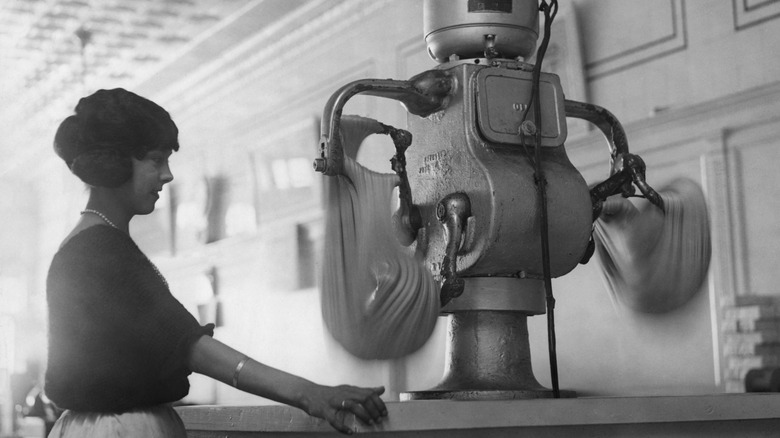
After first gaining traction on the Atlantic City boardwalk, saltwater taffy's New Jersey origins always came with a carnival association. Despite the name, it contains no saltwater whatsoever. Rather, local lore suggests that an enterprising taffy vendor coined the term after a storm sent waves flooding the boardwalk. The name, however, was more likely an advertising ploy. Taffy is still an emblematic treat in Atlantic City, and since the late 19th century, it began making an appearance in other fairgrounds across the country. It had a big moment at the 1939 World's Fair in New York, where it further proved that it makes for a convenient on-the-go sweet. Made from pulled sugar and corn syrup, with butter or oil, taffy does not melt in the heat like chocolate or ice cream would.
The key to taffy's texture is the fact that it has to be pulled and stretched before getting rolled and cut into pieces. This labor-intensive effort was once carried out by hand, but has since been replaced by machines. Hand-pulled taffy added an extra spectacle when prepared at state fairs, where spectators could watch taffy pullers preparing their next batches in addition to sampling the results of this difficult process. Taffy, in general, isn't particularly common at state fairs anymore, but there are occasional vendors, like the family-run Fowler's Candy and Concessions in the Northeast, that still make taffy the old-fashioned way — a rare, hand-prepared treat.
Pork tenderloin sandwich
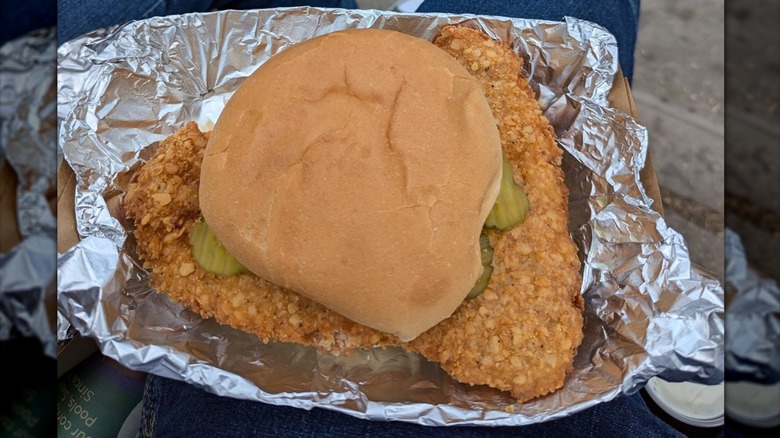
Having found its popularity in the Midwest, the pork tenderloin sandwich was a reimagined version of traditional Austrian fare. Dating back to Indiana in 1904, it was invented by Nick Freienstein, born to a German family, as a version of weiner schnitzel using the meat that was locally available. Though it originated in Austria, this dish was equally popular in Germany, and would more commonly have been prepared with veal, but pork was another variation, and there was plenty of it in turn-of-the-century Indiana. Hammered out until thin and then battered and fried, it was a delicacy that would typically be served on a plate and eaten with dining utensils if consumed in Europe. But since Freienstein sold his Americanized pork schnitzel out of a sandwich cart, he needed a way to make this breaded pork tenderloin portable.
Even though the circumference of the pounded meat was vastly bigger than a hamburger bun, no one questioned when Freienstein slapped the meat between two pieces of bread. The pork tenderloin sandwich has maintained these whimsical dimensions ever since, even after Freienstein swapped his cart for a restaurant, helping popularize his sandwiches across the Midwest. With their origins in portable dining, these sandwiches were well suited to fair food. A distinctly regional phenomenon, they can still be found at state and county fairs in Indiana, Ohio, and other corners of the Midwest. Venture beyond this breaded pork tenderloin corridor, however, and this sandwich remains mostly unknown.
Frozen bananas
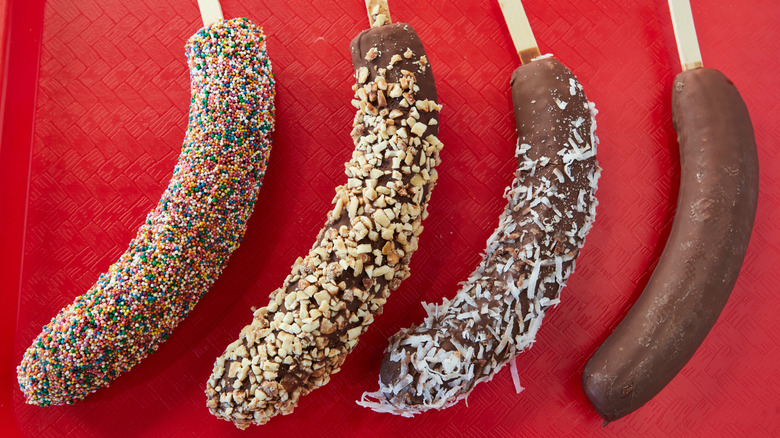
Lore suggests that the inspiration behind the frozen banana on a stick might have come from the 1933 Chicago World's Fair. Also known as the Century of Progress Exposition, it showcased many groundbreaking industrial and domestic technologies, including new approaches to refrigeration. It remains possible that frozen bananas were being served at other fairs across the country, but the most popular stand is the one that opened up around 1940 on Balboa Island, a well-known tourist destination near Newport Beach, California. Proffered to visitors stepping off the ferry from the mainland, these frozen treats, dipped in chocolate and rolled in nuts or sprinkles, were a deliciously chilled novelty. Serving them on a stick made them convenient to eat on the go, which made them naturally well-suited to being fair food.
Other variations of the frozen banana stand popped up across California, and by the 1960s these were a fixture at Disneyland and had made it all the way to the Arizona State Fair. More whimsical and refreshing than the conventional candy or caramel apples that have been fair fixtures for much longer, these cool, sweet treats were also well-suited to the Southwestern heat. Distinctly retro nowadays, frozen bananas on a stick do still make the occasional state fair appearance, but their simplicity has been overshadowed by other more elaborate fair sweets.
Fried brain sandwiches
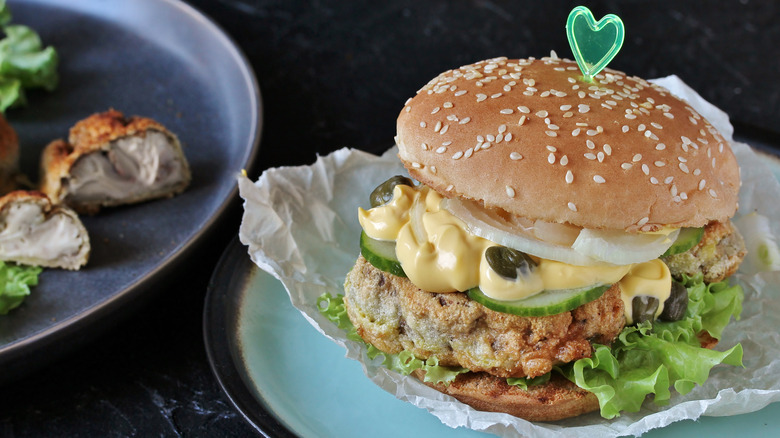
This Midwestern specialty was a truly regional phenomenon. Fried brain sandwiches were an innovation born out of the meat-packing industry, and though once consumed regularly, these have all but gone extinct. Workers prepared choicer cuts of beef in industrial quantities, but organs were not a lucrative commodity, and consequently were offered to workers for free. Brains became a common protein source for working-class families, made more palatable by breading and frying them, and made more convenient by serving them as a sandwich. The fried brain sandwich also became a local delicacy in diners between Chicago and St. Louis. It was an efficient use of ingredients that otherwise would go to waste, and a tasty creation when served with the right fixings. These sandwiches eventually started making an appearance at local state and county fairs, another convenient grab-and-go choice that fit into the fried cuisine line-up of fair food.
The outbreak of mad cow disease in the 1980s, however, brought this sandwich's popularity to a halt. Though case numbers were not exorbitantly high, fear made consumers cautious. Restaurants and vendors that once offered fried brain sandwiches attempted to pivot by frying up pork brains instead, but the stigma had already damaged a wholesome meal's reputation. Today, fried brain sandwiches are all but extinct. They can occasionally still be found served at festivals in the Midwest, notably in Indiana, but are quickly disappearing.
Frozen custard
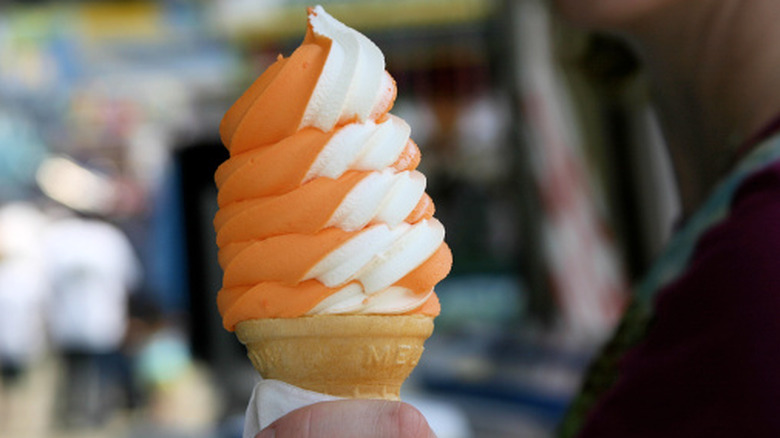
Originating at New York's Coney Island Boardwalk, frozen custard was a turn-of-the-century innovation in the growing ice cream industry. To improve texture and slow melting, the enterprising Kohr brothers, Archie and Elton, added egg yolks to their ice cream, and frozen custard was born. The difference between ice cream and frozen custard delighted customers, and this novelty treat, thicker and richer than ice cream, found even greater success after proliferating carnivals and fairs across the country. But it didn't reach its most admiring public until the 1933 Chicago World's Fair.
Frozen custard's density, from the egg yolks, a higher fat content, and less air whipped into the cream, was what helped it melt more slowly. This made it well-suited to fairground snacking without dripping as much as ice cream on a hot day. An instant success in the Midwest, frozen custard became a fixture from Chicago to St. Louis at seasonal state fairs and perennial parlors. Nowadays, it's likelier found in specialty ice cream shops more often than at local fairgrounds. But for a vintage taste of rich, sweet, cool, and satisfying frozen custard, there's still the occasional state fair vendor that serves it on the regular.
Fried dough
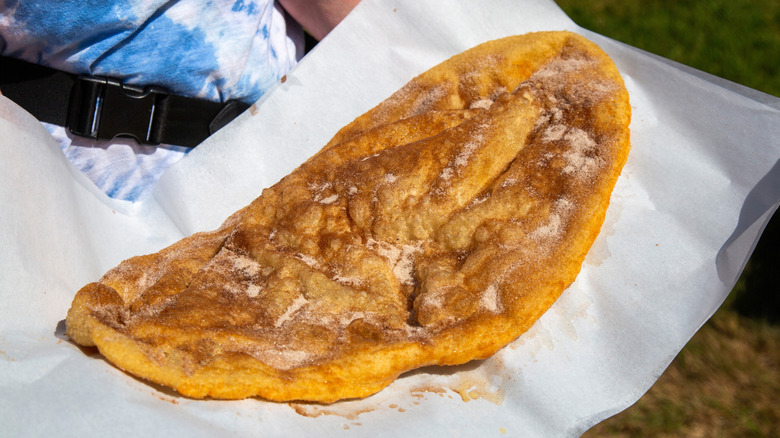
Also known as elephant ears — or, in Canada, beaver tails — fried dough is a simple but tasty snack that's become one of many quirky state fair foods. Today, it's been overshadowed by more unusual fairground fried foods. The origins of the recipe, however, have nothing to do with carnivals, as this dish was invented in the mid-19th century by displaced Navajo peoples in the Southwest, who were forced to subsist on government-provided provisions. Fry bread became a Native American culinary staple and could be made sweet or savory.
How this itinerant food of necessity became a fairground staple is hazy, but fried dough's simplicity is the root of its success. Fried dough is, in essence, nothing more than that. The yeasted dough is stretched thin, puffing up when fried to give a bubbly surface. These provide wells to catch toppings, like cinnamon sugar, making for a sweet textured experience. When called elephant ears, fried dough is typically served in large portions, but is also regularly prepared as smaller pieces of dough, in which case they might be referred to as mouse ears. Though still fixtures at state fairs in the Midwest, fried dough vendors are much less common than they were throughout the 20th century. Today, funnel cake takes precedence as a more common fried dough-based sweet, but fairgoers are often tempted away from the classics to sample novelty foods from the fryer.
Birch beer
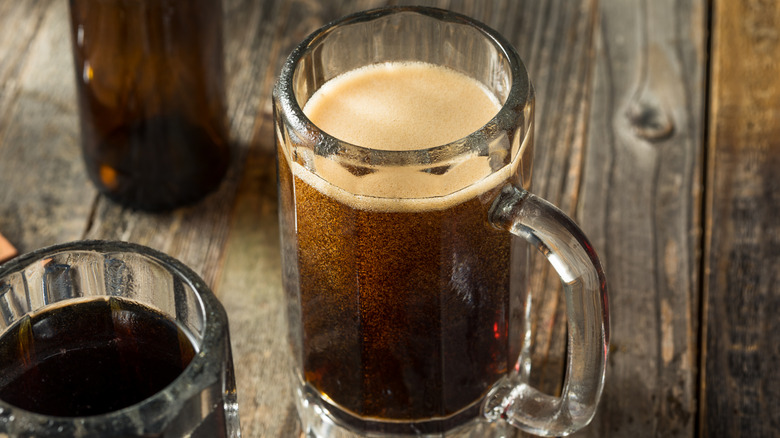
A lesser-known libation, as sweet and refreshing as its root beer cousin, birch beer is a classic in the Northeastern United States that dates back to the colonists of the early 18th century. Originally prepared as an alternative to beer, this early version of birch beer was made with birch bark and sap mixed with yeast and sugar. It was left to ferment, giving a revitalizing "small beer" that contained a low but still-present amount of alcohol, with a distinctive spicy, slightly minty flavor. Throughout the 19th century, birch beer gained popularity, especially in Pennsylvania, and became a go-to beverage to serve at fairs and festivals across the region.
Birch beer remained largely an alcoholic beverage until the end of the 19th century, when a growing temperance movement encouraged alternatives to alcohol in the U.S. The beverage turned out to be adaptable, and a non-alcoholic version could be prepared from the same ingredients by not leaving them to ferment. Non-alcoholic birch beer remained a popular choice at fairgrounds and soda fountains in the first half of the 20th century, but it has since become more obscure. With production and consumption still largely centered around Pennsylvania, birch beer's distinct taste still has vintage and regional associations, and is definitely worth seeking out to try.
Vinegar fries
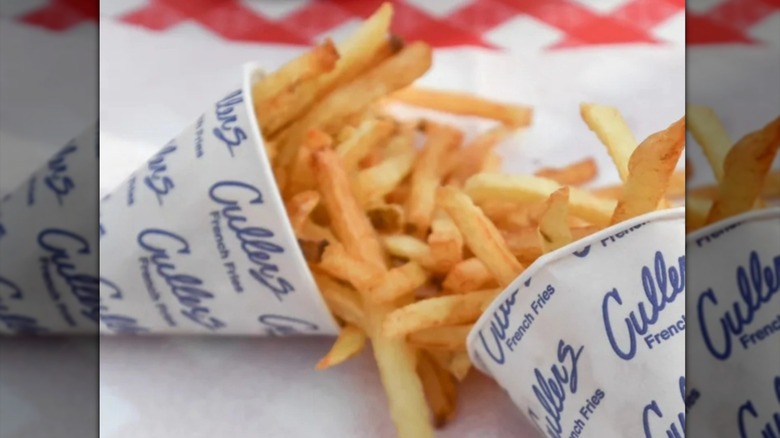
Especially popular at fairs across the Midwest and in parts of the South, vinegar fries are a state fair delicacy that make for a satisfyingly tart and salty treat. Culler's French Fries is among the best-known vendors of vinegar fries since the original stand first opened at an Illinois fairground in 1945. The vendor is beloved for a reliably crisp and savory snack, and has expanded to fairs across the country. It is, however, the topping that makes these fries unique. They're known as vinegar fries for the simple fact that they've been served with vinegar instead of ketchup since the beginning. The reason behind this condiment choice was an executive decision made by Mr. Culler himself, the original man behind the Culler's fry stand, who saw too many kids making a mess with ketchup bottles. The tidier solution became his fries' claim to fame.
Vinegar is a more common condiment in the U.K. and Canada, served as commonly as ketchup in the U.S, but serving vinegar with fries Stateside comes as a pleasant surprise to American taste buds unaccustomed to the tartness. Anyone who enjoys the savory tang of salt and vinegar chips would enjoy an even fresher take on the flavor profile with an order of vinegar fries. These have become an emblematic fair food as a special occasion treat with a retro flair that's difficult to find beyond certain regional fairgrounds.
Roasted sweet corn
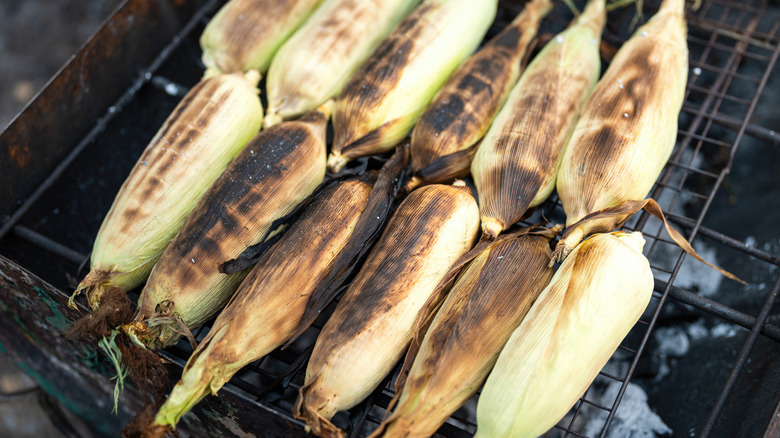
With all the elaborate fried delicacies that have come to be novelty fair foods in recent history, the simpler fare of times gone by has flown a bit under the radar. Roasted sweet corn is one of the most iconic of these truly old-school fair foods, an age-old delight that's as simple as it gets. Though perhaps not quite as popular as it once was, this is still a staple at state and county fairs, especially in the Midwest, where fresh corn is plentiful.
Roasted over open flames while still in the husk, sweet corn takes on a uniquely deep and delectable flavor, with its natural sweetness becoming caramelized as an added smokiness settles in. Keeping the corn in its husk enables it to retain moisture while it cooks, making for succulent kernels and an ear of corn that's naturally flavorful without any added seasoning. With the husk peeled away and butter slathered on, roasted sweet corn was, and still is, a delicious fair food that's entirely natural and succulently old-school. It's a rare, classic treat in today's era of extravagant fair foods.