

9 Pizza Chains That Don't Exist Anymore
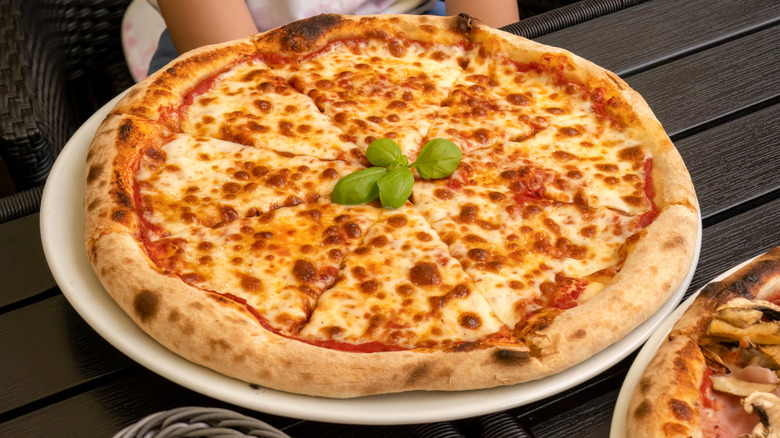
For decades, pizza has been America's premier party food. People have eaten this dish at birthdays, weddings, christenings, and everything in between — and good old pizza chains have housed folks for all of these events for as long as we can remember. It's no surprise that pizza chains are very popular in the U.S., and the likes of Domino's, Pizza Hut, and Papa John's are still going strong as some of the country's go-to destinations for bread and cheese. However, for every successful pizza business, there's one that didn't quite manage to stick around.
As a result, the history of the pizza world is littered with chains that have simply disappeared after years, sometimes decades, of success. Some of them didn't succeed because instead of stretching their dough, they stretched themselves, and pushed their ambition beyond their capacities. In other situations, pizza chains went bust because the style that they worked with went out of fashion (if you've never eaten pizza accompanied by the sound of a Wurlitzer organ, well, there's a good reason for that). Here are a few chains you might just remember eating in, long ago.
Pistol Pete's Pizza
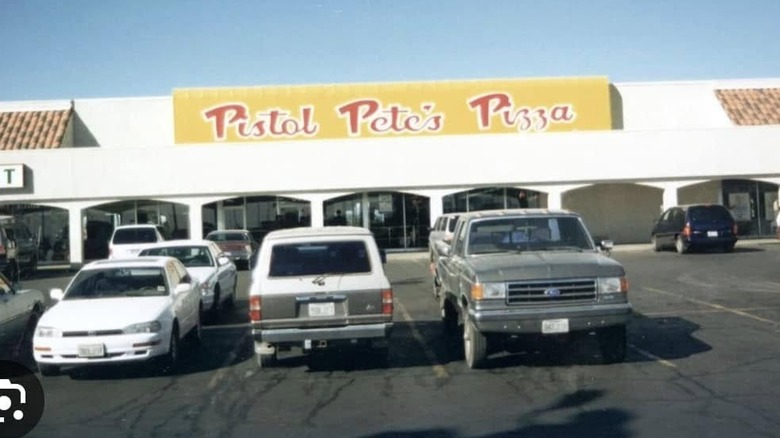
We miss the days when pizza restaurants used to be wild, weird, and fun. Pistol Pete's Pizza embodies all of these qualities, and then some. This pizza chain was a pretty big deal across Southwestern and Southern states like Arizona and Texas in the latter half of the 20th century, and it had a particular spurt of popularity in the '80s. Maybe that was because of its maximalist nature, which seemed to embody the spirit of the decade. Pistol Pete's was a strange, chaotic mash-up of video games and animatronics. Its pizza may not have been especially upmarket or special, but it was designed to feed the screaming hordes of kids that entered its doors every weekend, and it succeeded.
Pistol Pete's saw a brief period of expansion, but by the '90s, it was starting to show signs of trouble. What was once a thriving business became one at risk of closure, and in 1995, that became the case. Pistol Pete's was snapped up by Peter Piper Pizza, a competitor that's remained active to this day. People still hold a special place in their hearts for Pistol Pete's, though, and all of its oddball glory.
My Pi Pizza
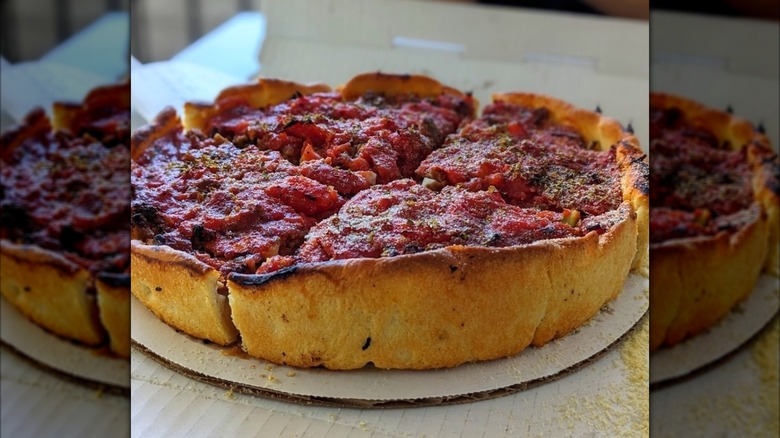
If you're a Chicago native or even just spent a little time in the city over the last half-century, then you may well know about My Pi. This local favorite first opened its doors in 1971, and over the years built up its presence across Chicago and beyond, eventually encompassing 25 locations across nine different states. My Pi's thing was Chicago deep-dish: For years, it slung out pies covered in fennel-spiked sausage or crammed with spinach. There was nothing elegant about it, but you weren't going for a fancy experience — it was all about flavor.
Sadly, though, it couldn't last forever. My Pi began to contract during the 21st century, and COVID was a particularly challenging time for the chain, particularly in the post-lockdown period when it couldn't quite compete with restaurants with better capacity. This, coupled with the aging of owner Rich Aronson, meant that it was difficult to maintain momentum. Its locations closed, and in 2025, its final Sheridan Road restaurant shut its doors. "Thank you, Chicago. Thank you, Bucktown. Thank you for 54 unforgettable years," it said in a statement on Instagram, announcing the end of the business. With that, a Chicago institution passed.
Eatza Pizza
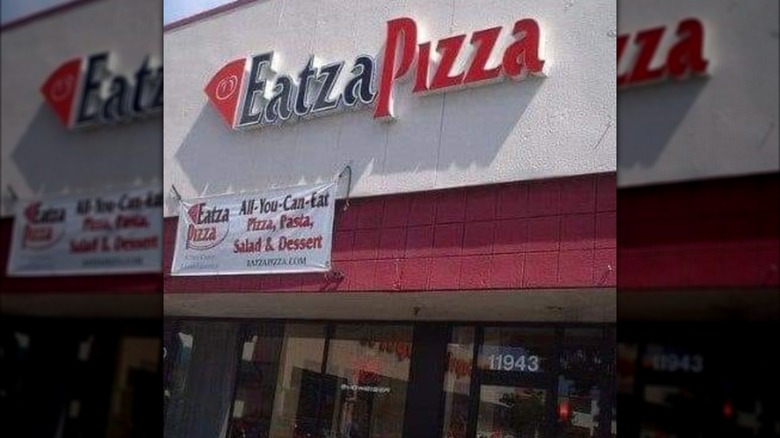
Few restaurant chains have the rise and fall that Eatza did. This pizza outfit was founded in 1997 in Arizona, and it had a buffet concept that was immediately popular. Its combo of all-you-can-eat pizza, pasta, salad, and dessert catapulted it to success, and just seven years later, it had almost two dozen locations. Cut to 2006, and it boasted 112 restaurants, either open or in active development, across 13 states — and it had its eyes on an international market, too. It felt like nothing could stop Eatza.
Well, that wasn't quite the case, and just as quickly as it became successful, it began to show signs of trouble. By January 2007, it closing multiple stores, apparently due to fairly significant financial worries (perhaps as a result of expanding so quickly). A brief burst of life came a few months later when Eatza was sold to International Franchise Associates, in the hope of supercharging its development and opening hundreds more stores. However, it wasn't to be, and within a couple of years, it shut its doors for the last time. All of those free-flowing slices of pizza dried up, and Eatza was no more.
ShowBiz Pizza Place
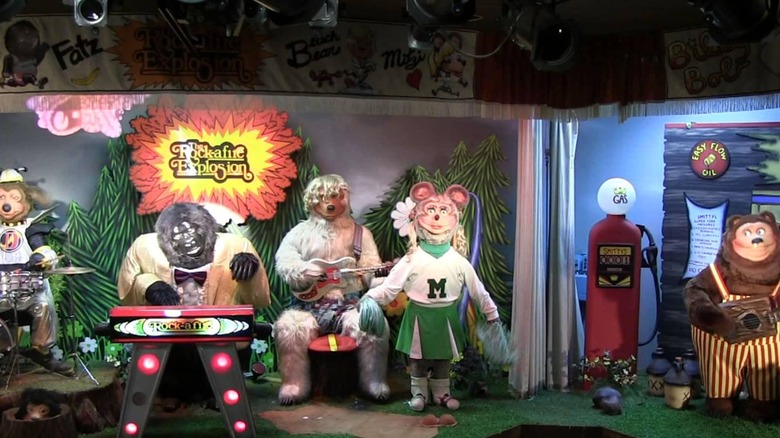
If you want an example of how truly bizarre the restaurant scene was back in the early 1980s, you only have to take a look at ShowBiz Pizza Place. This lurid, slightly psychedelic concept was an offshoot of, and inspired by, the similarly-named Chuck E. Cheese Pizza Time Theatre, which is better known now as Chuck E. Cheese. Both restaurants were pretty similar, and both heavily featured the use of (frankly terrifying) animatronic characters that would entertain you with a show while you munched on your pizza. ShowBiz Pizza Place also had a separate "disco room," where you could apparently bop your head to the music while enjoying more animatronic fun, and an indoor arcade. It all sounds a little intense, guys.
Interestingly, this classic '80s fast food spot was achieving a lot of success back then, to the point where it eventually bought Chuck E. Cheese, which was facing bankruptcy. However, while ShowBiz was the dominant concept for a good spell of time, eventually the dual business reverted back to using the Chuck E. Cheese name. Now, the latter still has a significant presence across the country, while most people have forgotten about ShowBiz Pizza Place entirely.
Izzy's Pizza
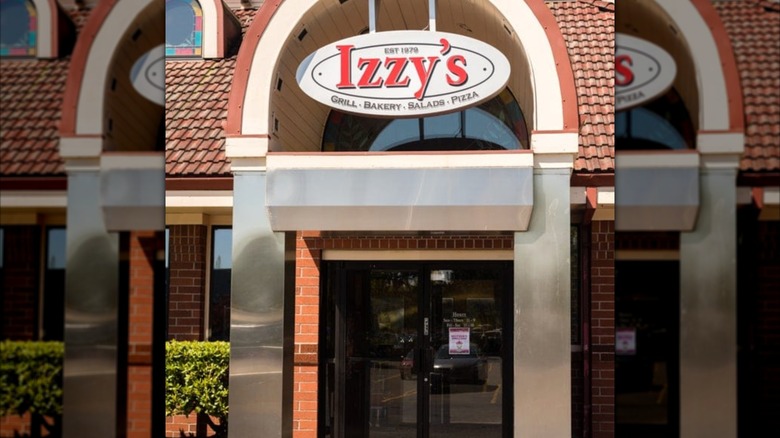
In our eyes, it's always a sad thing when a beloved pizza chain dies. It's even sadder when said chain wasn't just driven by a faceless corporation, but by one person with ambition and a dream. That was the case with Izzy's Pizza, an Oregon-based chain founded by Izzy Covalt. Covalt was, with her husband, originally a franchisee of a Shakey's Pizza, but when the chain was bought out by a larger party, she took the bold step of replacing all its signs with her own name, in a bid to get out of her contract. Covalt was sued, but stood firm and eventually won. Izzy's Pizza was willed into being, and throughout the 1980s, when Covalt was in her 50s, it continued to expand, eventually reaching three dozen locations. Talk about an inspiration!
Izzy's Pizza wasn't just a pizzeria, but a buffet too: You could grab fried chicken, baked beans, and a side of pasta with your slice. It remained popular for decades, but sadly, the COVID-19 pandemic was an incredibly difficult time for the business. Its size contracted, and it lost its last physical location. However, the story of Izzy's Pizza lives on: It reopened in 2024 as a food truck in Oregon.
Pizza Haven
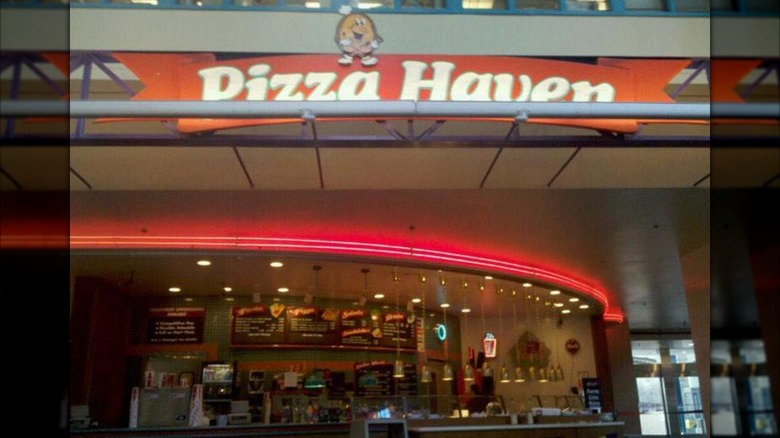
Pizza Haven is a good example of a regional chain that we wish we'd had the opportunity to try. This place was no flash-in-the-(pizza)-pan success: Starting in the late 1950s, this Seattle-based chain grew over time to have dozens of locations. Pizza Haven was a particular hit with college students, and the '60s and '70s saw a real growth spurt for the restaurant, which was supercharged by the fact that it was one of the first chains nationwide to deliver its food. It managed to expand as far south as California, and it remained successful until the 1990s.
Then, things started to turn sour. Pizza Haven (which didn't, as you might expect, explicitly serve New Haven-style pizza) was beset by a combination of financial issues and intense competition from the likes of Domino's and Papa John's. These restaurants were also operating with a delivery model and doing it at a significant scale. Pizza Haven lost almost all of its locations, apart from one in Seattle Center. Amazingly, this restaurant managed to stay ticking along until 2012 – but then, sadly, it closed its doors forever. Looks like Domino's won out on this one.
Pizza Cucinova
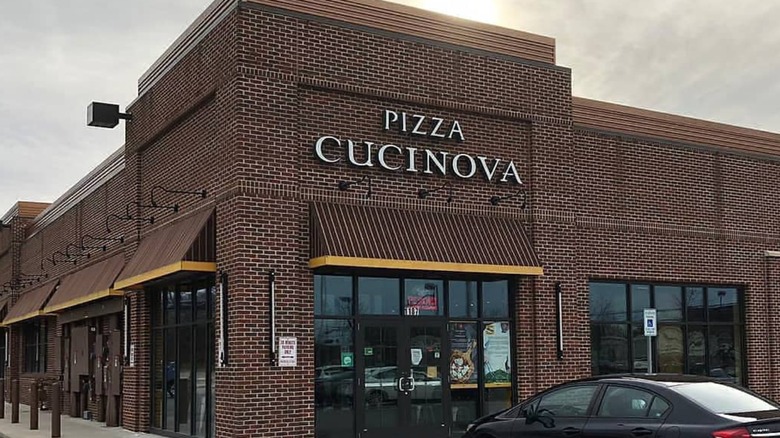
Sometimes, a struggling restaurant can try to regain its footing by introducing another restaurant concept — only for that one to fail, too. It all feels a little unfair, doesn't it? That was exactly what happened with Pizza Cucinova. This chain was introduced in 2014 by Sbarro, which at the time had just emerged from bankruptcy. The idea was that Pizza Cucinova would be a classy fast-casual offer, with specialty pizzas made right in front of you, before being cooked in a wood-fired pizza oven. As you wait, you could sip on a glass of wine, and you could finish your meal with a cheesecake. It all sounds pretty nice to us.
Unfortunately, customers didn't really feel the same. Pizza Cucinova had an initial burst of success, with several locations opening across Ohio. However, the problem was that it just didn't grab customers in the way that other pizza chains did. Instead, it feels like it fell somewhere between a chain and a sit-down restaurant, without a particularly strong sense of being one or the other. Pizza Cucinova only lasted for a couple of years before it finally closed its doors, but strangely, its website still exists to this day. It's a little bit ... ghostly.
Cap'ns Galley Pizza & Pipes
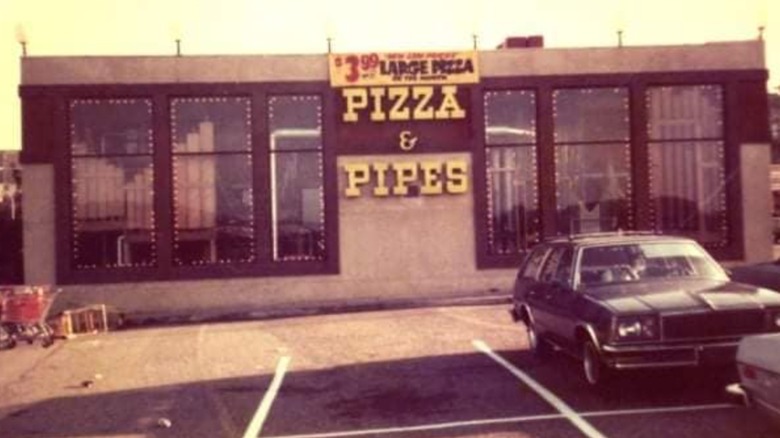
There was a very strange moment back in the 1970s when pizza and pipe organs went hand-in-hand. Yep, it was a thing, guys — and it was embodied most vividly by Cap'ns Galley Pizza & Pipes. Starting life in the late 1960s, Cap'ns Galley Pizza & Pipes gave customers a truly odd dining experience (which was also replicated across the country by dozens of other restaurants). Patrons would eat in a large, casual dining hall on cafeteria-style tables, surrounding a massive Wurlitzer organ. The organist would then appear and play a smattering of songs, while everyone ate their food to the strains of whatever they were playing. Apparently, the music from Star Wars was always a big hit and featured heavily on rotation.
Pizza & Pipes was successful throughout the 1970s and '80s and had a strong presence around the Bay Area. Then, change came in the form of Chuck E. Cheese. The newfangled restaurant and its imitators brought animatronics to the table, and suddenly, there was something a lot more shiny to go and see than a pipe organist. As a result, Cap'ns Galley began to lose its lustre, and at the start of the 21st century, it gently faded into invisibility.
Uno Dué Go
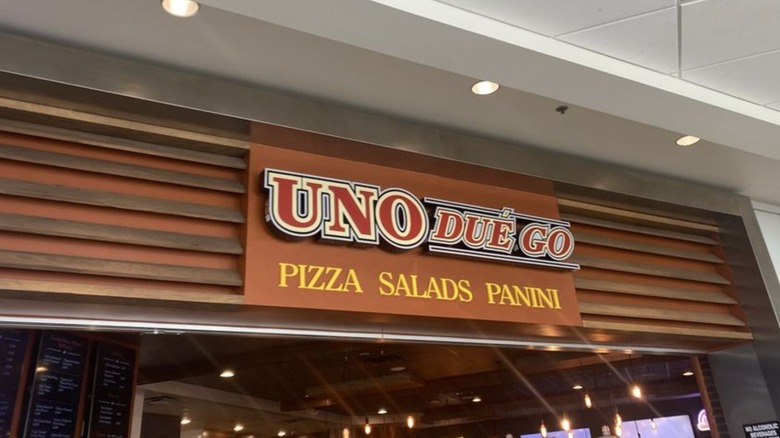
Chain restaurants simply can't help but create fancier versions of themselves to appeal to a different customer base. Unfortunately, more upmarket offshoots of chains are often doomed to fail — and Uno Dué Go is a good example. This 2013 concept was a spinoff of Uno Pizzeria, and it was designed to combine the restaurant's deep-dish pizza with a touch more class. Yes, there was the pizza, but you could also get flatbread, Italian-style panini, and observe the chefs doing their thing. It also sold baked goods and alcohol, and had a hot breakfast menu.
Need we say that it feels like Uno Dué Go was doing a lot? Well, it was, and if you ask us, it overstretched itself. Its initial restaurants in Plano were followed by several more locations in Texas, and it even made its way to Massachusetts and Wisconsin. However, after an initial burst of activity, it just as quickly began to nosedive. By 2020, it was closing its last unit in Boston, and Uno Dué Go was no more. Uno Pizzeria, meanwhile, is still trucking along, with a few dozen locations dotted around the country.