

The Martha Stewart-Approved Way To Restore Marble Kitchen Counters

We may receive a commission on purchases made from links.
Marble countertops certainly exude luxury and bring a sense of elegance to your kitchen. However, some homeowners are ditching this countertop material because it requires too much maintenance for them. Resealing the stone every six to 12 months is essential to prevent the biggest issue with using marble countertops, which is the risk of staining because of its porous nature. Additionally, it can easily be damaged by chemicals and be scratched. Rather than get rid of your marble in favor of something else, Martha Stewart has an effective method for restoring it to its former glory.
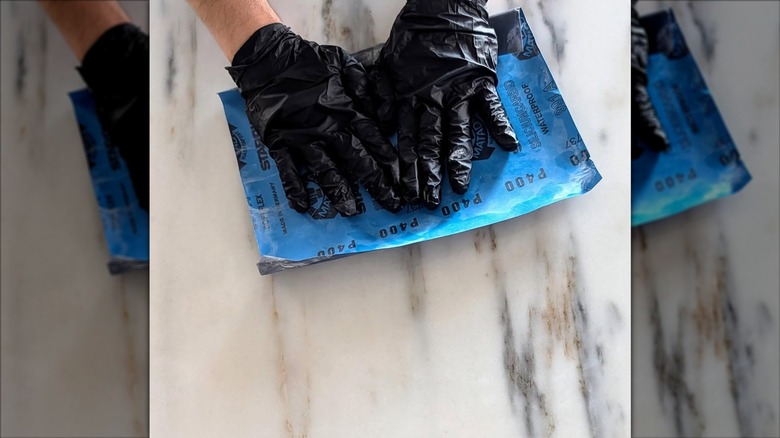
In her personal blog, the famous TV personality and businesswoman has shown readers the products and process that she and her staff use for restoring her marble kitchen counters when she notices marks and rings on the surface. The products specifically include Sunnyside Acetone (available at Walmart), StoneTech Revitalizer Cleaner and Protector (available on Amazon), and Stonetech Bulletproof Sealer (available on Amazon). Also, they wear gloves, use 400-grit sandpaper that's waterproof, and apply the cleaning and sealing products with rags.
Crediting Mark Galazzo, the owner of Precision Stone, Marble & Granite, Stewart explains that all you have to do is clear the counter and thoroughly wipe the surface with a little bit of acetone on a cloth. Pour water on the counter, and rub the marble with the sandpaper, applying just a little pressure. Doing this while it's wet will prevent scratching the stone, but remove etching marks. Next, dry the counter, apply the revitalizer with a clean cloth, and wipe it dry. Finally, wipe a light layer of the sealer over the marble to protect the surface.
Tips for keeping restored marble kitchen counters looking as nice as possible
With white marble counters, backsplashes, and floors in her Bedford home, it's obviously one of Martha Stewart's favorite kitchen countertop materials. She and her staff take special care to clean the stone since it's less durable than other types and more vulnerable to damage. While it's practically impossible to prevent wear and tear on your marble after you've restored it, you can keep damage to a minimum with proper cleaning techniques.
The best way to clean your marble countertops is with a pH-neutral soap and a non-abrasive cloth or sponge. It's important that you avoid using acidic cleaners, like lemon juice and vinegar, or bleach, because these liquids will cause damage. You should also avoid anything that has hard, abrasive bristles or pads because those will scratch the stone's surface. For a simple cleaning, mix a little bit of pH-neutral soap with warm water, dampen a microfiber cloth or soft sponge with the mixture, and gently wipe the countertop. Then, rinse and dry the surface with separate clean cloths.
If you need to get rid of stains, you can make a baking-soda-and-water paste. Spread it over the stained area, cover and seal it with some plastic, and let it sit on the marble for one or two days. Then, remove the poultice with a plastic or wooden spatula and some water. For a really stubborn stain, create the poultice with baking soda or either acetone or a mineral spirit.