

10 Meat Department Tips And Tricks That Will Save You Money
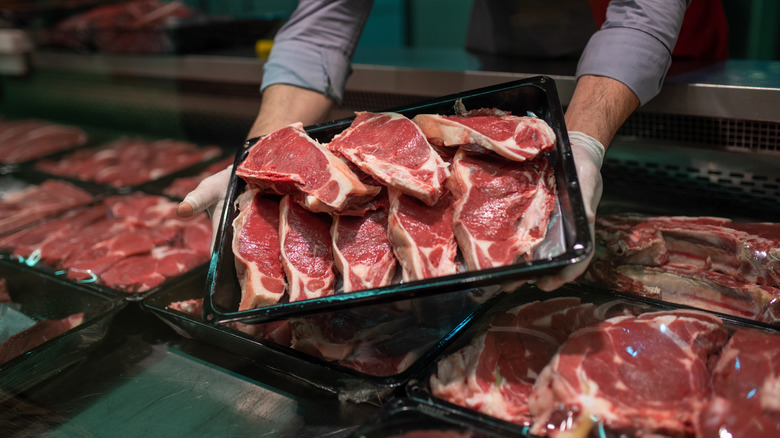
It's no secret that meat is expensive. It's not been cheap for a minute, of course, but over the last few years, the cost of beef, chicken, and pork has risen to unprecedented levels. Supermarkets have had to raise prices in response to higher demand and lower supply (particularly of beef, which has skyrocketed), and people are feeling the pinch. It feels as though you now have to give the meat department a wide berth when you're at the supermarket, out of fear of blowing your budget and coming away with not that much at all.
However, there's another way, folks. The meat department may have some items that are now eye-wateringly expensive, but it's also a place where, if you're smart, you can make some serious savings. By exercising some nifty tips and tricks, like buying whole pieces of meat and cutting them into steaks, jointing birds instead of purchasing individual pieces, or making your own deli meat, you can sidestep all of those high prices and keep costs low. You don't have to give up your protein, folks — you just have to think a little more carefully.
1. Instead of buying sliced steaks, grab a whole roast and cut them yourself

The convenience of buying a pre-sliced steak can't be understated, and not all of us want to learn how to carve an enormous roast into smaller pieces. However, if you spend a bit of time figuring it out, you can save a lot of money. The difference between a chuck steak and a chuck roast is simply that the former has been trimmed down to size. Well, actually, that's not the only difference: Chuck roasts can be over a dollar cheaper per pound at retailers like Walmart, partly because they can be cumbersome pieces of meat that are a little trickier to deal with.
To carve a chuck roast into steaks, all you need to do is first separate your meat by the seam running down the middle, and then cut each side into individual portions. Make sure you work against the grain here, so that the steaks you end up with aren't sinewy. If you're working with a three-pound piece of chuck roast, you can easily get six or eight steaks out of it, depending on how chunky you like your meat to be.
2. Buy in bulk for huge savings
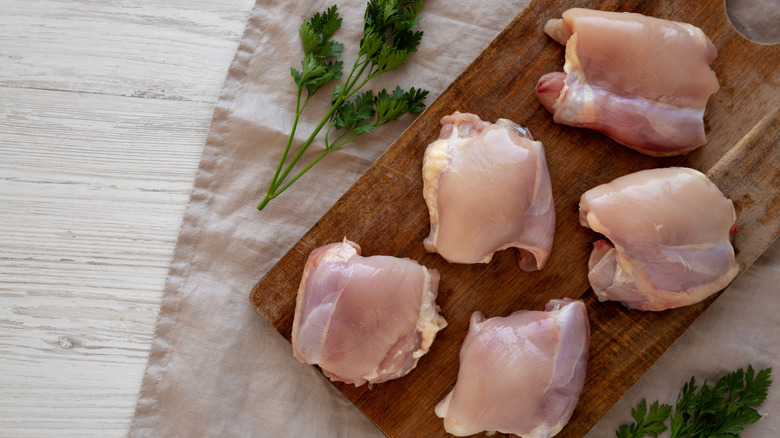
One of the most frustrating things to see is when people complain about the price of meat, but then insist on buying tiny, individual portions of it from the supermarket. When you do this, you're paying for the privilege of convenience. Supermarkets know that people generally want to deal with smaller amounts of food, particularly when they're cooking for themselves, and they have to justify all that extra packaging. As a result, smaller trays of items like chicken thighs and pork loin chops are significantly more expensive than their larger counterparts. At Walmart, chicken thighs in packs that weigh up to four pounds weigh $3.72 per pound, while its larger family packs are $3.12 per pound. Likewise, the store's smaller packs of pork chops cost $6.06 per pound, while the family packs are $5.86 per pound.
Now, it's obviously worth mentioning that this isn't an enormous saving in one go, but over time it can really add up. Next time you're in the store, grab the larger packs. There's no difference in the quality of the meat, and you can just freeze it and use it later.
3. Learn how to joint poultry, and buy the whole bird
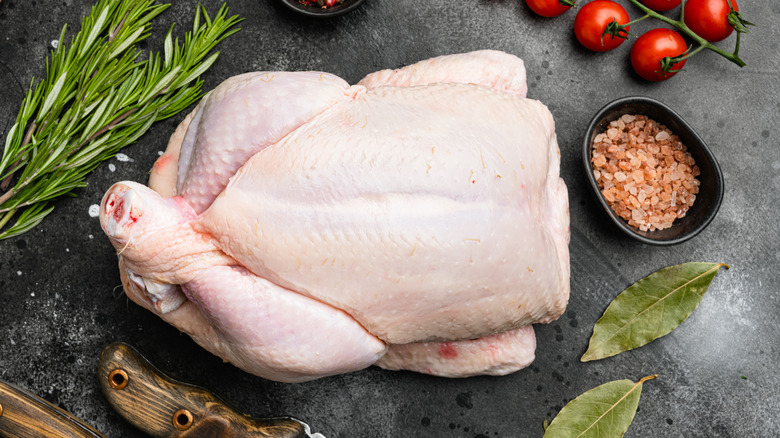
It's pretty rare to buy a full chicken or turkey unless you're roasting it. Otherwise, people tend to opt for packs of chicken thighs, breasts, or legs, comforted by the knowledge that the supermarket has done all of the jointing work for them. Well, that may be more convenient, and it allows you to make larger dishes using just one element of the poultry. On the other hand, it's a lot more expensive to buy individual cuts than the full bird.
That's why we thoroughly recommend buying full chickens or turkeys, and learning how to joint them. This can cut the cost of your meat bill considerably, and it's also a great way to get a bit more variety out of your meals, by using the available thighs and legs instead of opting for breasts every single time. It can be a little bit fiddly to learn how to joint a bird, but once you've got the hang of it, it takes just a couple of minutes. Plus, once you've cut off all the meat, you can use the carcass in a stock or broth to add way more flavor (and to cut down on having to buy store-bought options, saving even more money in the process).
4. Purchase markdown meat near its sell-by date and freeze it
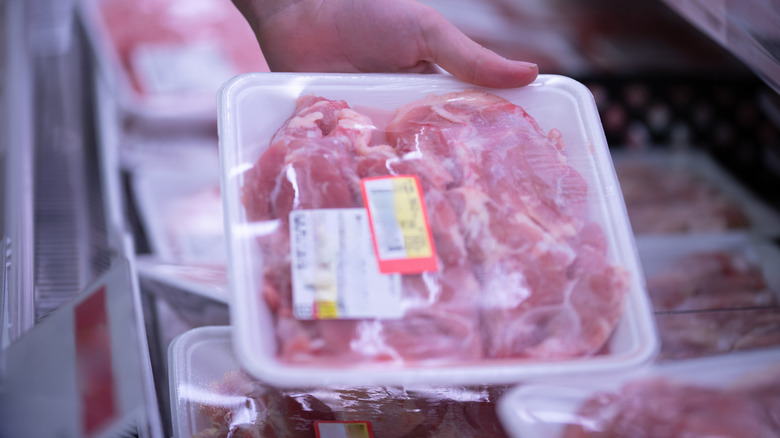
If you've ever been put off by marked-down meat, we don't blame you. Of all the items that can be reduced in a supermarket, meat feels the most worrying, and the most likely to make you ill (or at the very least, suffer a serious deterioration in quality). However, we've got some news for you, folks: Markdown meat is still perfectly edible. If something has been reduced because it's close to its "best if used by" or "use by" date, that doesn't mean that it's inedible — it just means that it's about to go past its prime. Those dates aren't there for safety, but for guidance on the meat's quality.
As a result, it's a good idea to snap up these meats when you can. If you're ready to eat it then and there, you can cook it up without any worries. If, however, you're grabbing it for a later date, then stash it in the freezer. Most types of meat are fine in the freezer for a few months, and some, like steaks and roasts, can last for up to a year if stored correctly. Freezing food prevents microorganism growth, so you don't have to worry about it going bad.
5. Rather than buying deli meat, grab it raw and make it at home
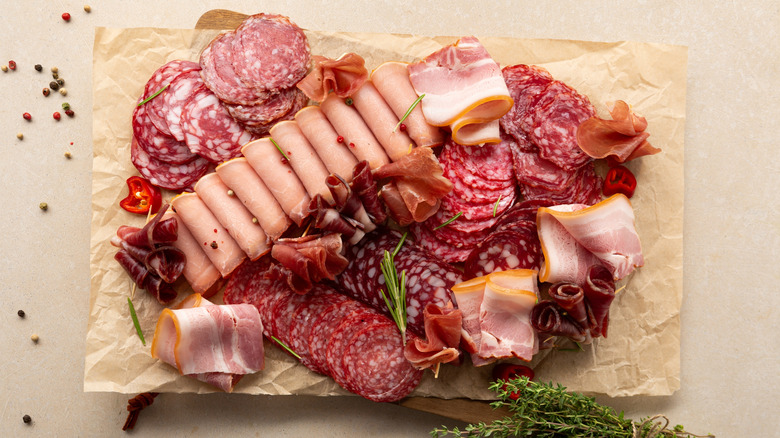
It's no great secret that deli meat is a little more expensive than other kinds, largely due to the fact that you're paying for the preparation that goes into it. Why not do that preparation yourself? It's easy enough to make deli meat at home, with a little bit of preparation, time, and attention to detail. If you're new to homemade deli meat, start small with something simple, like a brined, spiced chicken breast sliced into strips. When you get a bit more confident, you can start experimenting with curing ham joints. Trust us, it's not as difficult as it looks.
Having said this, certain deli meats are a little more complicated to make than others. While options like ham, chicken, and roast beef deli meat are relatively easy to throw together, more processed items like salami, chorizo, pepperoni, or turkey ham will need a lot more work. To avoid feeling like a total failure the first time, don't rush into things — start small and build your way up.
6. Buy bone-in cuts for more flavor and cheaper meat
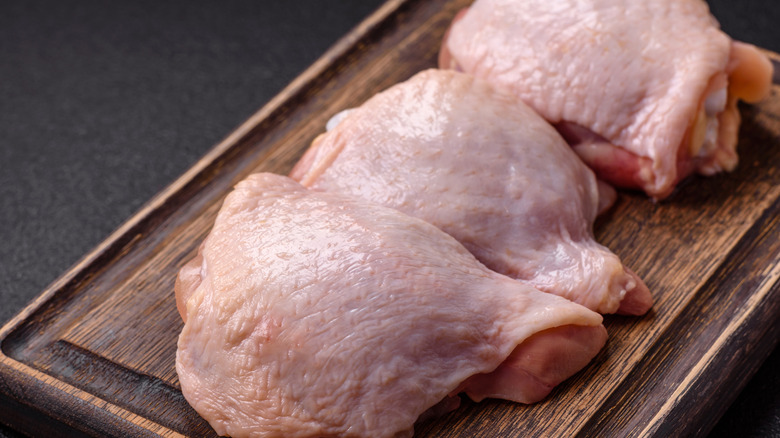
Okay, look. We know that buying meat with the bone in can feel less appealing than going for a boneless option. When you're dealing with chicken thighs or bone-in chops, it's not a lot of fun to chomp around all that hard stuff to get to the meat, and it can also feel as though you're getting less protein for your buck.
However, we'd urge you to reconsider and to switch to bone-in meat for the sake of your wallet. There can be a huge difference between the price of bone-in and boneless meat, with Tyson chicken thighs costing half the amount per pound at Target when buying the bone-in version compared to the boneless one. Plus, on the protein front, the difference between the two is minimal: Tyson's bone-in chicken thighs have 2 grams of protein less per portion than the boneless variety.
Additionally, buying bone-in meat can give you access to a brand new world of flavor. Bones in meat help to insulate it from the inside, thereby causing the fat inside to soften more slowly, creating more succulence and juiciness. You can also use the bones once you're done cooking: Remove them, roast them, and put them into bone broth.
7. Bulk-buy meat seasonally
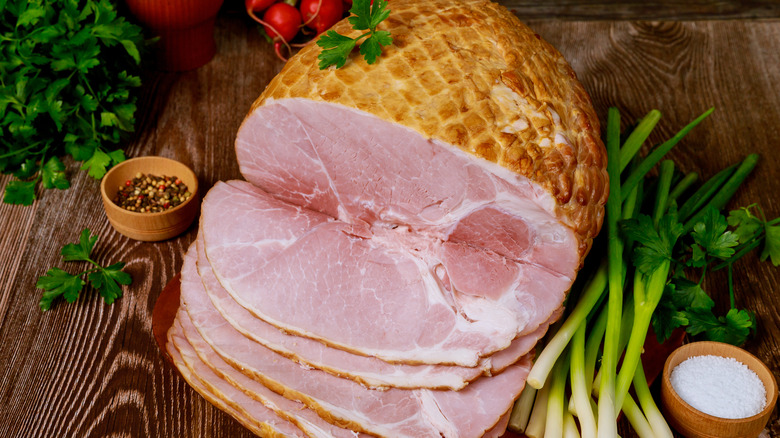
Meat prices fluctuate seasonally, but these days that's generally less to do with the breeding habits of the animals as it is with demand. During grilling season, for example, items like ribeye steaks and chicken pieces fit for the barbecue tend to get more expensive, with their prices falling after Memorial Day. Then, when Thanksgiving and Christmas roll around, you can expect to see turkey and ham become more prominent in the store, and while in 2025 turkeys are a little less expensive than in years past, they're still not cheap.
A good tip, therefore, is to think about when these kinds of items will be less in demand, and to buy them at the right time of year. Buying barbecue items out of season and freezing them until you need them is a canny move to save a couple of dollars. Furthermore, it can be a smart move to head to stores the day after Thanksgiving or Christmas to stock up. You may find that in the days after these holidays, these items are significantly cheaper, and may well be marked down in a bid for the supermarket to clear stock.
8. Instead of buying pre-marinated meat, grab leaner cuts and marinate them at home

Buying pre-marinated meat can be a shortcut to immediate flavor, but it can also cause you to spend more than you need to. The price difference between marinated and unmarinated meat in supermarkets can be pretty massive. At H-E-B, for example, opting for a marinated chicken breast as opposed to an unmarinated one can see you pay more than double the price per pound. Conversely, if you go for its marinated beef sirloin kabobs, you'll pay the same price per pound as its regular beef sirloin steaks – but the kabobs include vegetables, which are way less expensive than the meat itself. You're getting less meat for your money.
Because of this, we'd recommend skipping marinated meat entirely and just opting for the plain versions. You can easily whip up your own marinade at home: It's not difficult, and you probably have most of the ingredients needed in your pantry. Just give yourself a little bit of time to prepare everything, and you'll be laughing all the way to the bank.
9. Ask your butcher to cut your meat
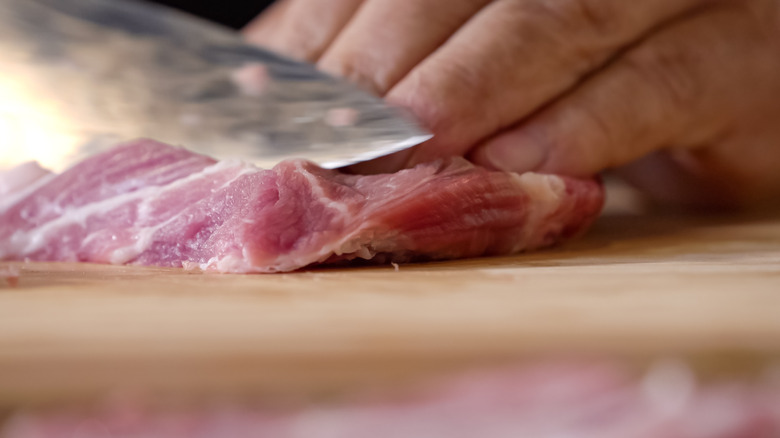
The person behind the counter at the meat department isn't just there for show. They're a trained pro who is pretty good at cutting meat, and if you ask them nicely, they may just cut your meat up for you. In some stores, like Whole Foods, this is offered as part of the package, and others may not advertise it but will be willing to carve meat up if you ask nicely.
Why is this useful? Well, because if you're not entirely comfortable with carving up a whole roast yourself, you can buy one and then ask the butcher to cut it up for you. Alternatively, you can ask your butcher for a cut that's not commonly available on shelves but may be cheaper, or to cut a piece of meat that's the exact size and specifications that you want. This can lead to less food wastage, and it allows you to tailor your budget to your meat consumption, as opposed to having to stretch it because the items you want are too expensive.
10. Learn when to shop for last-minute reductions

The best way to save money on the meat you want is to catch it just as it's reduced. If saving money is your primary goal, this is the ideal moment to strike: The meat may not be in the best condition possible, but it'll still have a good amount of time left to taste fresh, and you get your pick of the reduced items. However, to be there at the right time, you have to learn when your store's most likely to reduce things, and adjust your shopping schedule accordingly.
The annoying thing is that all stores operate slightly differently. Sundays, Mondays, Wednesdays, and Fridays are usually good days for markdowns, with Fridays often being a key day for meat reductions due to new stock coming in. At Walmart, stores usually reduce meat on Sunday evenings or Monday mornings in a bid to clear shelf space, while at Aldi, Sunday evenings and Wednesdays are a good time to try for lower meat prices. However, because all stores will have their own processes and methods, it's always worth just trying to find the manager or an employee and asking when they mark their meat down. If you're lucky, they'll spill the beans.