

How Australian Wagyu Beef Compares To Its Japanese Counterpart
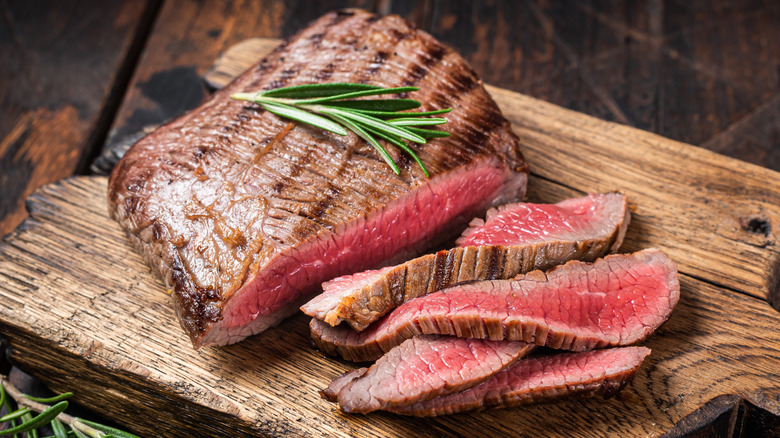
Whether you're in a supermarket, at a restaurant, or at the butcher, you have more to consider than just the cuts of beef on offer. Many steaks receive their designations from the cattle breed they come from, and Angus beef, which comes from Black (Aberdeen) Angus cattle, is the most common in the United States. While this type of beef is popular for its beefy flavor, it doesn't have the same rich marbling and tenderness as Wagyu. That said, not all Wagyu is the same, either.
Just like American Wagyu beef is different from Japanese Wagyu, Australian Wagyu is different from its Japanese counterpart. Both of these beef types originate from Japanese cattle — "Wagyu" literally means "Japanese cow" — and are notorious for their extraordinary marbling, tenderness, and flavor. However, they also differ in each of these categories, as well as in the overall dining experience they provide. To understand these differences, we first have to learn more about Japanese Wagyu.
Japanese Wagyu beef
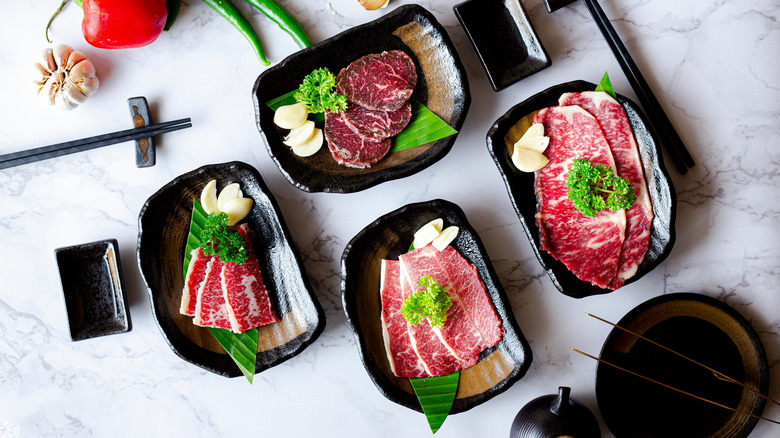
In the late 1800s, the Japanese government imported various cattle breeds in an effort to introduce its people to Western foods. This led to crossbreeding between Japanese and European cattle, but Japan prohibited this practice by 1910 to keep its cattle bloodline exclusively Wagyu. These days, only four breeds are considered Wagyu: Japanese Black, Japanese Brown, Japanese Polled, and Japanese Shorthorn. The latter two are exclusive to the country and exported elsewhere.
Each Wagyu cattle breed is raised in a specific Japanese prefecture, fed a specific diet that includes high-quality grains, and allowed to roam the land. The result is natural beef that's free of drugs, hormones, and steroids. Because of an extensive feeding period of at least 600 days (resulting in more complex marbling compared to Australian breeds), the Japanese beef has a sweeter, more earthy flavor profile and a more tender texture.
Japan also uses a sophisticated Wagyu grading system. Japanese A5 Wagyu beef receives the highest grade in its class based on its marbling, color standard, fat standard, firmness, and texture. Also of note, Kobe is considered the finest type of beef that can come from Wagyu cattle, and its limited supply is the result of restricted breeding. Its rarity gave rise to counterfeit cuts in the U.S. from the late 2000s until the early 2010s, but an official stamp has since been introduced to serve as authentication — this means that a missing stamp is a red flag indicating that the Kobe beef is fake.
Australian Wagyu beef
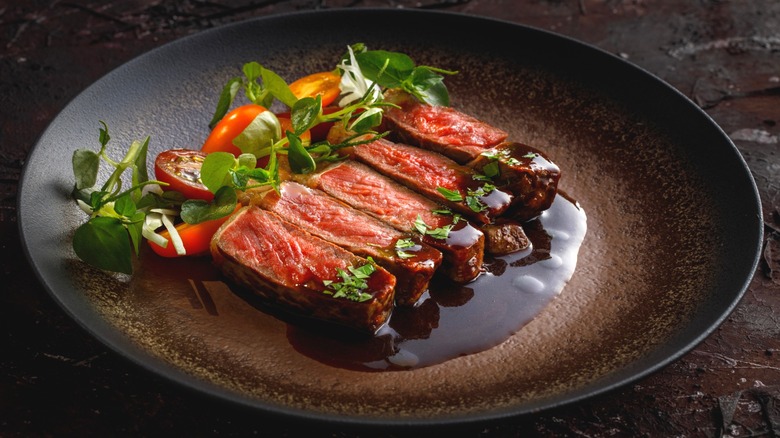
In 1990, Australia took advantage of a trade agreement between Japan and the U.S. to get its first Wagyu cattle genetics in the form of frozen samples. Restrictions on such exports were soon reinstated, though, so to expand its herd, Australia imported full-blood Wagyu cattle — which were 100% traceable to Japanese herds with no crossbreeding — from the States in 1997. Now, the island country has the world's second-largest population of this breed, second only to Japan.
So, while Australian Wagyu cattle can be traced back to the Japanese variety, they are raised in Australia on a diet of hay, grass, and grains. Despite their varied diet and access to vast land, a shorter feeding time of 350 to 450 days means these cows have less marbling, a more savory flavor profile, and a slightly firmer texture compared to the Japanese version. Fortunately, though, this beef still tastes robust and buttery.
Like Japan, Australia has its own meat-grading system, ranging from MS0 to MS9+, and only four of these grades are given to beef that's officially recognized as Wagyu. The highest rating is typically reserved only for steaks that come from full-blooded cattle. Since the U.S. imports up to 90% of its Wagyu beef from Australia (via Straits Research), many restaurants serve it. In our ranking of popular steakhouse chain Wagyu beef steaks based on reviews, we determined that Urban Farmer in Denver and Steak 48 (which has several U.S. locations) serve Australian Wagyu beef. They placed fifth and third, respectively.