

Your Copper Cookware Could Be Vintage. Here's How To Check
We may receive a commission on purchases made from links.
Beyond the shiny appearance that makes it attractive to look at, copper cookware is a standard in many restaurant kitchens for a reason. It distributes heat evenly and doesn't take as long as other materials to react to changes in temperature. Along with these reasons, such vintage French cookware can be worth a lot of money because it's becoming harder to find. Not all copper cookware you see will be vintage, though. Fortunately, you can look for a maker's mark and certain construction characteristics to determine if yours is as old as (or older than) you think.
One of the easiest ways to confirm whether or not a piece of copper cookware is vintage is to identify a maker's mark or stamp. Basically, the mark is an impression of the maker's company name and/or logo that was pressed into the metal during the manufacturing process. It may be accompanied by a series of numbers as well. If the stamp includes "Made in," that's a clear flag that it was made in a modern manufacturing facility.
While modern manufacturers generally place their marks and stamps on the bottom of copper cookware, vintage pieces may have them on the sides or even the handles. Some of them can be so small that you need a magnifying glass to make out the letters and symbols. At that point, you need to pay close attention to the exact combination and compare it to a database to confirm the details. Oldcopper.org, for instance, features an alphabetical directory of maker's marks with images, approximate dates, and other company information. The downside is that not all vintage copper cookware will have a stamp.
Identifying vintage copper cookware without a maker's mark
Having a maker's mark can provide the easiest and most credible confirmation of the vintage status of copper cookware, but it's not the only way to tell, since many pieces were never stamped. In fact, the construction itself can help you determine at least a range of years in which it was made. It's important to keep in mind, though, that observing one of these characteristics alone isn't enough. Instead, you want to see a combination of them.
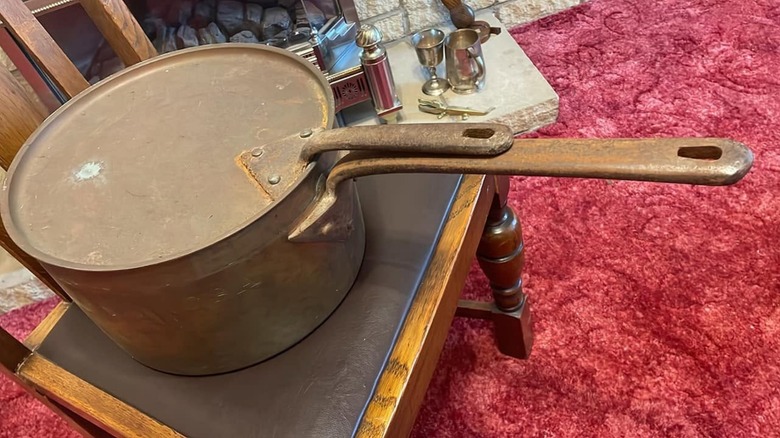
The first obvious indicator of a vintage copper piece is uneven sides (not perfectly uniform) and hammer marks, which are perfectly normal. Next, pay attention to the weight. Since truly vintage copper cookware can range from about 0.1 inches (2.5 millimeters) to 0.16 inches (4 millimeters) thick, it won't be super light but will have some weight to it. That weight actually enhances the heat control, but it's not so heavy that it's difficult to maneuver while cooking.
Thirdly, vintage copper pots and pans tend to be lined with tin (sometimes nickel or silver), whereas modern liners are stainless steel. Tin-lined copper cookware was the type Julia Child swore by for all her cooking, and she even gushed about it in her cookbook "Mastering the Art of French Cooking," noting that the tin won't discolor foods but needs to be renewed when it fades. Also, vintage copper cookware will have thick handles with arch or teardrop hanging loops. The handles will be attached to the side with large, slightly irregular rivets. Finally, you'll be able to see seams rather than the smooth weld created by modern manufacturing equipment.
How to clean vintage copper cookware for inspection and longevity
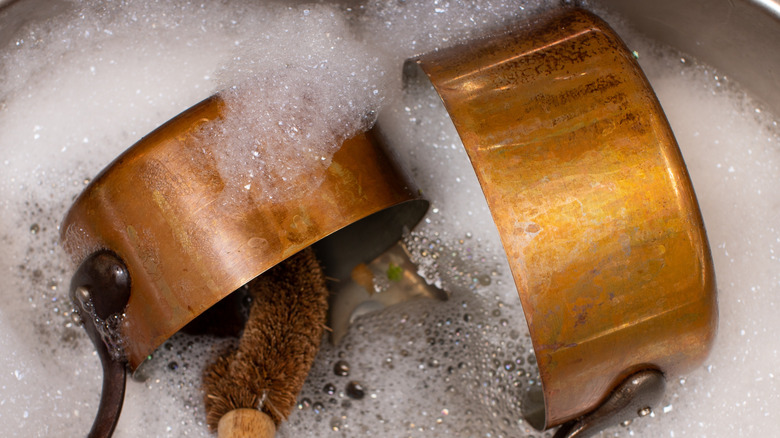
If you have trouble clearly seeing a maker's mark or the construction characteristics of copper cookware, you can clean it before fully inspecting it. You just need to do it carefully, starting with a hog-bristle brush, a common art and paint-style brush. Its fibers are resilient for removing loose debris but flexible to prevent damage. In areas where grime proves difficult to remove, especially on the tin lining, you can use hot water, liquid dish soap, and a soft cloth — nothing abrasive. You should also avoid using polish on the copper exterior before identifying the piece because it could remove what's left of the maker's mark along with tarnish.
After you've inspected and identified your copper cookware, you can leave its patina, the natural protective film that copper develops over years of exposure to the environment, if you like the look. It could even increase the value. On the other hand, you can polish the exterior to make the cookware look like new again. Wright's Copper Cream is Martha Stewart's affordable way to keep copper cookware shiny, and it's even suitable for cleaning vintage materials. You can find an 8-ounce tub on Amazon for $14.98.
The tin lining is a different story. Always wash it by hand — never in the dishwasher — and avoid using abrasive cleaning pads because they can cause damage. If you see discoloration on the tin, you can just ignore it because it won't affect your food. Trying to remove it could weaken the lining, and you'll likely end up needing to replace it sooner than usual. Additionally, let hot vintage copper cookware cool after cooking and before cleaning to prevent warping.