

Never Use These Types Of Cookware On Your Induction Stovetop
We may receive a commission on purchases made from links.
Stovetop cooking has significantly evolved since the early 1800s, when charcoal and wood were the primary fuel sources. Since the first induction ranges didn't become practical for household use until the 1970s, it's still a relatively new cooking technology for home chefs. If you don't understand how it works, it's only natural to make mistakes when cooking on an induction cooktop, such as using cookware made of certain materials and in incompatible shapes and sizes.
Unfortunately, plain aluminum, ceramic, copper, glass, stainless steel, stone, and round-bottomed pots and pans are all types of cookware you should avoid buying for an induction stove. The material matters because induction stovetops use electromagnetic fields to transfer heat (created by the copper coils inside) directly to your cookware instead of to the surface of the glass cooktop. In order for that technology to work properly, your pots and pans need to be constructed with materials that are attracted to magnets, such as the iron in cast iron.
The upside is that some manufacturers make hybrid cookware so that it's compatible with induction technology. For instance, stainless steel pots and pans could have a high enough concentration of iron to be magnetic. Others may be designed with a magnetic base so that you can use them with induction, which is usually noted in the product description. If you already have an induction-incompatible cookware set and don't want to purchase a new one, though, you could use an induction adapter, like the Bialetti plate on Amazon.
Why the shape and size of your cookware matters with an induction stovetop
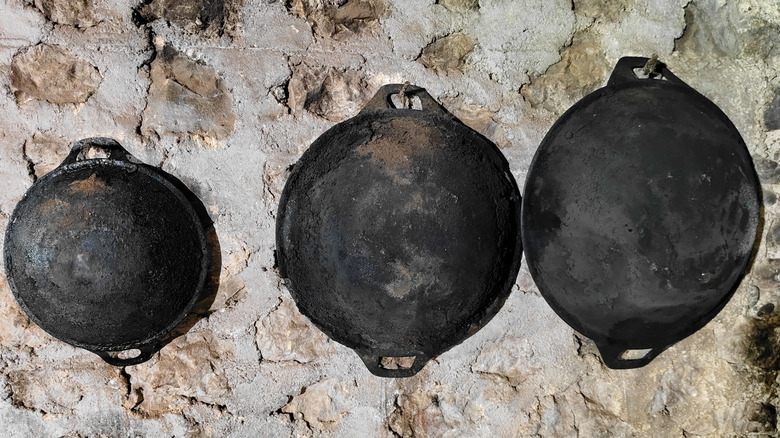
The material of your cookware is only one piece of the puzzle. The shape and size of the pots and pans make a difference, too. Since induction stoves rely on electromagnetic fields to heat your cookware, you should never use pots and pans with curved or rounded bottoms. That's because the heat transfer is strongest and performs best when the bottoms sit flat on the stovetop surface.
The magnetic field can still transfer if there's distance between them, but you'll get optimal performance with full contact. That's why the only type of wok you should use on an induction stove is one with a flat bottom rather than the traditionally curved or rounded bottom. For example, the Circulon A1 Series on Amazon has a flat, induction-compatible plate on the underside. It's also worth noting that, while square-shaped cookware will work, round pans are ideal for a more even distribution of heat.
Cookware size also makes a difference. If your induction burner is 7 inches, for instance, it may not turn on to full power for cookware with a 5-inch diameter, resulting in longer cook times even on the high setting. The cooktop may even fail to turn on if the diameter is so small that the sensors under the glass are unable to detect the cookware above them. On the other hand, you could experience uneven heating if you use pots and pans with diameters larger than the burner. That's because the heat is only generated and transferred within the area of the induction coils. To get the best results, make sure that the flat base of magnetic cookware or plates matches the burner size.