

9 Fruits That Are Rare In The US But Worth Trying If You Find Them
If you had to say what the most popular fruits in the United States were, your guesses would probably be pretty spot-on. Bananas, oranges, mangoes, and strawberries still reign supreme as the people's favorite fruits in the U.S., according to data collected by Gourmet Gift Baskets, which analyzed which produce is most searched for in each state. Peaches and cherries are also up there, and the dominance of all of these fruits is perhaps no surprise, given their availability and prominence in countless popular dishes.
However, the world of fruit doesn't stop with these. There are plenty of fruits in the world that you may not have even heard of, which are fairly hard to come by in stores in the U.S. Fruits like longan and durian, which are common in parts of Asia, are a rarity in North America. Others, like cherimoya, may be found in South and Central America, but struggle to grow in slightly colder climates, making them way less widespread in American retailers. That doesn't mean you shouldn't try them if you find them, though, and stumbling across any of these fruits will provide you with a unique culinary experience.
Mangosteen

Mangosteen is fairly difficult to find in the U.S., which is probably no surprise — especially given that until fairly recently, they weren't allowed to be imported at all. This Southeast Asian fruit was banned from the U.S. until 2007, amid fears that shipping it would introduce the Asian fruit fly to the country, a pest that still poses a significant threat to U.S. agriculture and its ecosystem. Although they can now be found in stores across America, they're still far from common, and you're far more likely to find them in specialty supermarkets than anywhere mainstream.
That's sad, because they're pretty darn delicious. Mangosteen has a complex flavor, with a combination of sweetness, creaminess, and tartness that makes it multifaceted and lively. It's all balanced by a floral scent, which some have compared to rose water, and which speaks to its tropical origins. Mangosteen fruit looks sort of like a white orange, and its segments can be peeled off one by one and eaten without any significant preparation. Its aromatic nature and full flavor, though, make it an excellent addition to fruit salads or cocktails.
Feijoa
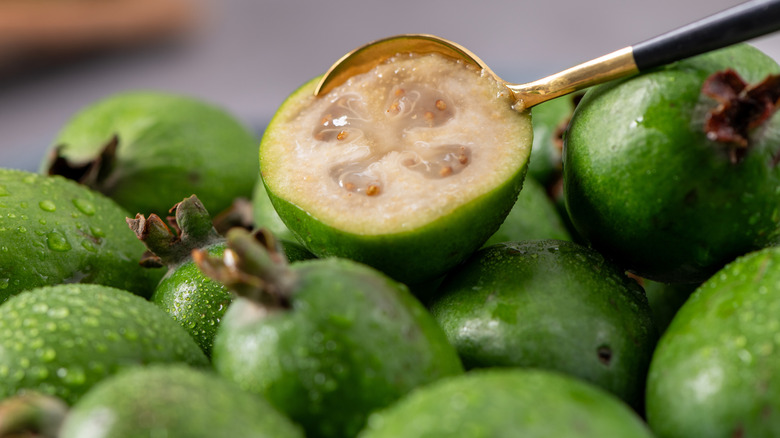
If you've never heard of feijoa, we wouldn't blame you. This fruit is primarily grown and consumed in South America, and while it's been cultivated in parts of California for over a century, it's primarily been treated as an ornamental plant with limited culinary value. We can understand why, as the feijoa plant produces large, attractive bushes and pink-red flowers that look very attractive.
However, it's the fruit that we care about. Feijoa has a slightly tropical taste, with a brightness that's reminiscent of pineapples, quince, and apples. There's a herbal note to it, too, which stops it from being purely sweet, and a tartness that balances everything out. Appearance-wise, feijoa almost looks like an unripe mango on the outside, with a green skin that gives way to pale flesh. Its sweet-sour nature makes it an excellent addition to salsas and salads, or you can even fry it up into fruity fritters. Alternatively, just eat it raw and enjoy all of its refreshing nature.
Lingonberries
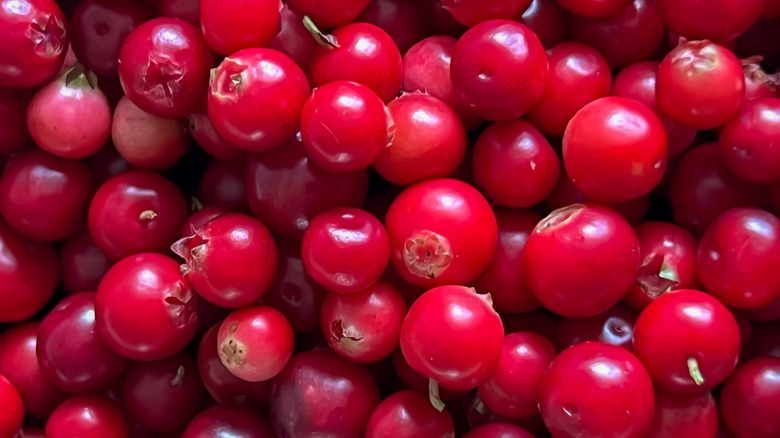
We can understand why the lingonberry never quite took off in the U.S. Although this berry does grow in North America, it's typically only found in cooler forest areas, like the Upper Midwest and Pacific Northwest. The bigger problem, however, is that they're just that bit too close to cranberries to stand out on their own. Lingonberries have a similar appearance to the more dominant berry, and a sourness that doesn't lend well to eating them on their own.
With that said, lingonberries are popular in Scandinavian countries, where they can be found cooked into jams or sauces. If you've been to IKEA recently, that's why their name might be familiar: The Swedish home store offers lingonberry products in its food section, giving customers a taste of its flavor (which is, of course, heavily perked up with sugar in its items). If you do find raw lingonberries anywhere and want to try cooking with them, you can try your hand at a lingonberry jam, or else throw them into dishes like hotpots, where they can give a touch of brightness.
Durian
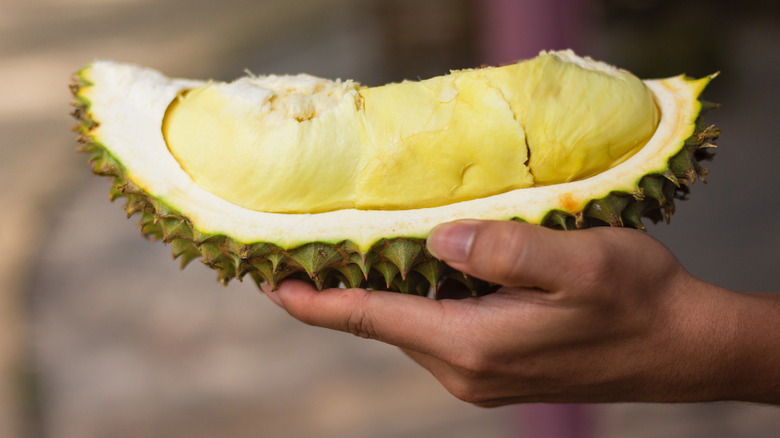
If you know anything about durian, you'll be well aware of why it isn't very popular in the U.S. This fruit is infamous for its pungent smell, which has variously been compared to sewage, rotting onions, and honey. Its scent can be so intense and offensive that several countries have banned the eating of it on public transport. It's not exactly a trait that endears people to it, right?
Yet, despite all of this, durian remains very popular in Asia, and in China, it's recently boomed in popularity. Some people also predict that durian will eventually take hold of the U.S., and it has a fair few devoted fans across the country and closer to home. Once you get past its smell, durian has an incredibly smooth flavor, with vanilla and custard notes that sit on your palate long after you eat it. The duality of taste and smell is partly what makes it so exciting, and it's a fruit that inspires devotion — but you have to get past that scent beforehand, and it's a big stumbling block for a lot of people.
Longan fruit
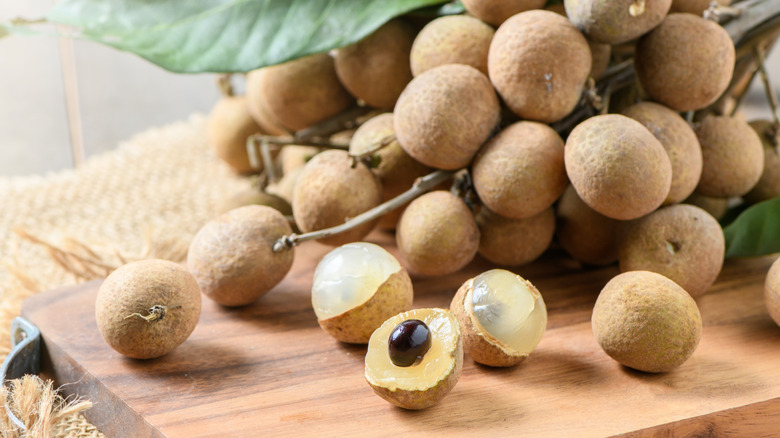
These days, it's fairly easy to find lychees across America — but longan fruit is a lot rarer. Longan is related to the lychee, and at first glance, you can definitely see the resemblance. The plant (which is also known as "dragon's eye") has a smooth exterior, but cutting into it reveals a smooth fruit, which looks similar to a lychee but is way darker in appearance. Taste-wise, it has a sweet, slightly tart flavor, and a strong floral aroma that announces itself before you bite into it.
Although longan fruit isn't widely found in the U.S., it is, in fact, cultivated in the country, and has been for a while. Longan arrived from Southeast Asia in the early 1900s, and it's grown commercially in South Florida, with producers doing so since the 1990s. The climate of the southern parts of the state suits longan fruit, which thrives in subtropical and tropical temperatures and conditions. However, despite this small domestic industry, longan just hasn't gotten a foothold in the American market. You may well be able to find it in specialty stores or farmers' markets, but don't expect to see it in Walmart any time soon.
Horned melon
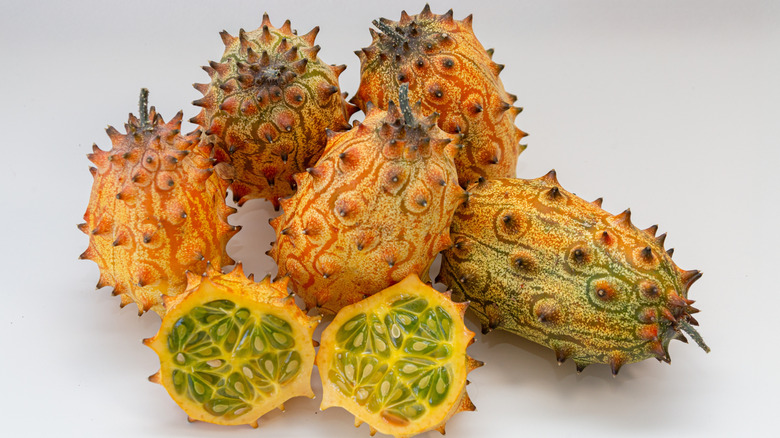
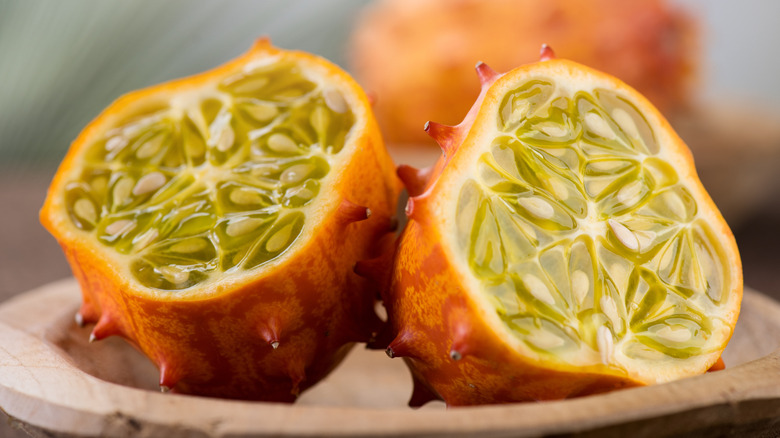
The horned melon certainly lives up to its name. This fruit can be identified by its spiky exterior, which gives it a somewhat imposing appearance. You might not even know that it's a fruit at all, judging by the outside. Slice inside, though, and it reveals itself to be a real delicacy, with the seeded flesh inside sitting somewhere in between a kiwi, a cucumber, and a banana in terms of flavor. Both its seeds and its flesh can be eaten straight out of the skin, giving you an instant burst of refreshment, or it can be used to make a sweet, bright chopped salad. You can even pile said salad into the horned melon skin, to give it a bit of visual flair.
Horned melons (also known as Kiwano melons) are native to Africa, and it likely won't surprise you that they need heat and a lot of sun to grow. As a result, they're not particularly well-suited to a lot of U.S. state climates, and production has never quite taken off in the country as it has elsewhere. If you do manage to find it, though, it's definitely worth a try — it's way more interesting than a boring old apple.
Sapodilla

It's amazing how some fruits can be incredibly popular in certain parts of the world, yet just a relatively short distance away, they can be hard to find anywhere. This is definitely true of the sapodilla, a fruit that's commonly found in Central America and other tropical areas around the globe, but which in North America is relatively unknown. In fact, in the U.S., the sapodilla tree is likely better known than the fruit it produces, due to it being the basis of chewing gum. The Aztec and Mayan people had long taken the sap of the sapodilla tree, known as chicle, and processed it into gum to freshen their breath and improve dental hygiene. In the mid-1800s, Thomas Adams, a businessman from New York, was introduced to chicle and created the earliest form of commercial gum.
How could the fruit compete with a story like that? It's a shame, because sapodillas are pretty tasty. When they're perfectly ripe, they taste like pears and have a caramelized note that some people have compared to molasses. Sapodillas have a juiciness to them that also makes them very refreshing. Sadly, though, the climate they thrive in prohibits them from being more widespread in the U.S., and for now, they remain fairly uncommon.
Cloudberries
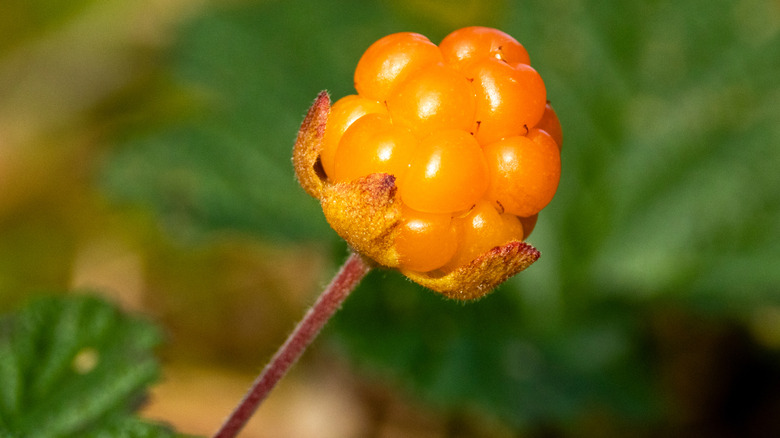
Few fruits have the mystique that cloudberries do. These whimsical berries are not just rare across the U.S., but across the whole world, and they've long been prized in Scandinavian cuisine for both their appearance and their flavor. Cloudberries get their adorable name from their appearance: When they're unripe, they look like little white clusters, before they gradually darken into a golden-amber hue. Once they're ripe, they have a balance of tartness and sweetness that's to die for, and they can be transformed into unique condiments or ice creams.
Cloudberries grow in the U.S., but only in regions like New Hampshire and Alaska, where the climate is cool and boggy enough to accommodate them. They're far more likely to be found in Northern Europe, parts of Russia, and Canada. However, because they're such a rarity and so prized in culinary settings, demand can often outpace supply, making them both difficult to track down and very expensive. You can find commercial versions of cloudberry products in places like IKEA, but they somewhat pale in comparison to foods made with them by professional chefs.
Cherimoya
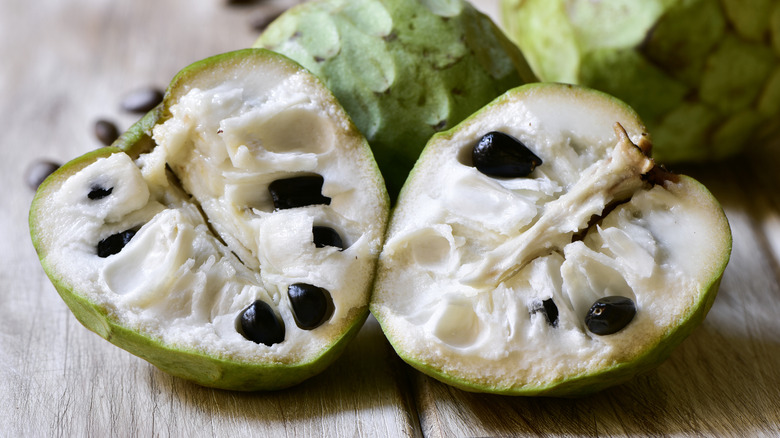
If you ever find a cherimoya, you should buy it without hesitating — but honestly, you'll be lucky if you do. Cherimoyas are a rare find in the U.S., primarily because their climate needs are pretty specific. As a result, they're only suited for growth in a relatively small part of California, where a micro-industry has popped up, although people have also seen some success in growing them in Hawai'i. They're more commonly found in Peru, Ecuador, Colombia, or Chile, and while they can be imported into North America, it's usually by way of specialty suppliers that trade in tropical fruits.
Folks who have tried cherimoya, however, can attest to how delicious it is. It's got a smooth, creamy flavor that makes it somewhat reminiscent of ice cream, but in fruit form. Need we say more? This creamy note has contributed to its alternative name, the "custard apple." It's funny, because from the outside, cherimoya definitely doesn't look like it'd have such a delectable flavor: It almost looks like an artichoke, with a leathery, ruffled green skin. Appearances can be deceiving, folks.
It's also worth noting that parts of the cherimoya are toxic. Though unlikely you'd want to eat them in the first place, take care to remove the seeds from the fruit without crushing them. Ingesting the seeds can cause stomach issues like vomiting as well as dry mouth.The fruit has also been linked to Parkinson's disease, with the seeds and skin containing high levels of annonacin, which can affect the nervous system. However, consuming the flesh of cherimoya in normal amounts should be safe, provided you remove the skin and seeds properly.