

The 1940s Kitchen Thrift Collectibles That Could Be Worth $500

Tiffany dishware isn't the only iconic option hiding in thrift stores that's worth a high price. Tucked between chipped teacups and forgotten Pyrex, you might spot the telltale milky green of jadeite, the kitchen glassware that once defined 1940s America. A pale mint blended with cream, smooth to the touch with a soft, light-catching glow, it is a color that somehow makes even ordinary shelves look special. At the time, brands like Fire-King and McKee turned out dinner sets in that cheerful green hue, bringing a little optimism to wartime kitchens. Eight decades later, those same plates and bowls can command up to $500 in antique shops and online marketplaces.
The glass was sturdy, affordable, and bright enough to make even meatloaf Mondays feel elegant. It was the everywoman's answer to fine china, a durable stand-in that still looked good stacked on open shelves. Patterns like Philbe and Jane Ray became household staples, instantly recognizable by their soft glow and gently ribbed texture. Just like that, jadeite has come full circle. The same pastel tones have become a favorite in Martha Stewart dinnerware sets and modern farmhouse kitchens alike, showing that what once brightened 1940s tables still fits right in today — and that the next $500 treasure might be hiding in plain sight on a thrift-store shelf.
Value, rarity, and the art of authentic Jadeite
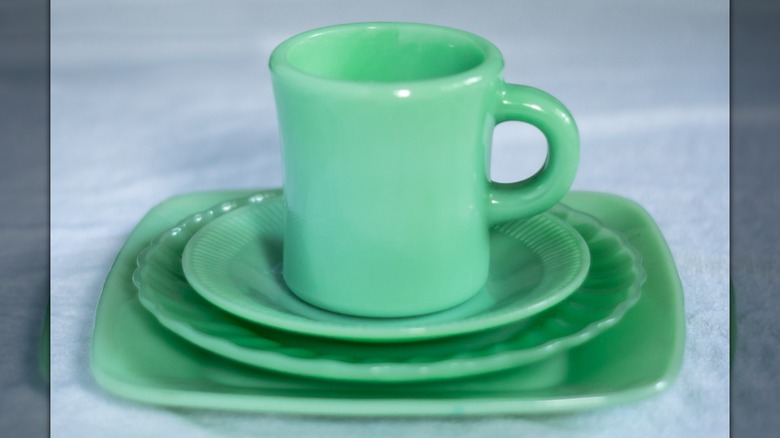
When it comes to jadeite, a $5 find and a $500 one can look almost identical to the untrained eye. Anchor Hocking's Fire-King division launched the glassware in 1945, turning out patterns like Alice, Jane Ray, and Restaurant Ware that quickly filled American cupboards. Authentic pieces usually carry some variation of the Fire-King logo, but reproductions — from later decades and even today's farmhouse brands — blur the line between vintage and remake. Condition makes all the difference: Pieces still bearing their foil stickers or nestled in original boxes tend to draw the highest bids, while those dulled by dishwashers or covered in utensil marks rarely reach collector value.
Rarity matters just as much. Jadeite is prized for its vivid color and impossibly rare formation. In nature, only a small fraction of jadeite ever reaches that level of quality, and collectors of the glassware have always chased that same sense of perfection. Only a few American brands — Fire-King, McKee, and Jeannette Glass — ever made true jadeite pieces, and those lines disappeared decades ago. With production long gone and surviving sets aging fast, the best examples are getting harder to find. Imperial Green remains the most coveted, while lavender, yellow, and black pieces appear less often but still catch collectors' attention when they surface.
Some enthusiasts even go as far as testing density or hardness to confirm authenticity since genuine jadeite glass has a distinct weight and cool smoothness that copies cannot replicate. That heft — subtle but unmistakable — often separates a thrift-store score from a museum-worthy piece. Even now, jadeite finds its place at the table. Whether it ends up on a display shelf or piled with stuffing, it's the perfect dish to hold all your unexpected holiday sides.