

Massive Egg Recall Not Just For One Brand: What To Know
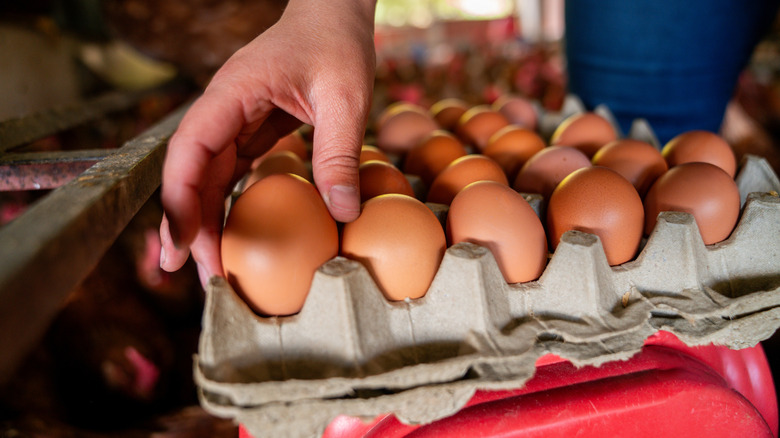
Houstonians should be careful with their eggs. The Food and Drug Administration has announced a recall of Kenz Henz 12-count Grade AA Large Pasture Raised Eggs for potential salmonella contamination. The affected cartons were only sold in Houston, Texas, with UPC code 86949400030. Check for Julian dates of 241-246 (August 30 to September 2) and 246-247 (September 4-5), and best by dates of 10/11-14 and 10/16-17. The good news is that no illnesses have been reported. The bad news is the possible contamination may be much bigger than this.
The Kenz Henz egg recall is an extension of an earlier recall of Black Sheep Egg Company eggs, in which an FDA inspection of its Arkansas facility revealed seven different salmonella strains, some of which are known to make humans sick. This has so far affected six million eggs.
Black Sheep recalled 12 and 18-count cartons of Free Range Large Grade A Brown Eggs sold at retail and wholesale outlets in Arkansas and Missouri, as well as wholesalers and brokers in Indiana, Texas, California, and Mississippi. Cartons that are known to be a risk have best by dates between August 22 and November 31, and UPC codes of 860010568507 and 860010568538.
How big is this egg recall?

Unfortunately, the size of this broader egg recall is not yet known. Black Sheep's eggs were widely distributed and may have been repackaged, similar to the Milo's eggs Class I recall last year, where sales to foodservice companies spread the eggs far and wide. For known potential contamination, the FDA recommends disposing of the eggs and washing any surface they may have touched with hot water and soap, then sanitizing with a bleach solution. But that doesn't help for as-yet undiscovered problem cartons.
However, there is good news, too. Many grocery stores also sell pasteurized eggs that are subjected to a brief heating process that kills any bacteria — including salmonella — without cooking the eggs. These are typically marked with a P on the shells. You can also pasteurize eggs at home with an immersion circulator, sometimes known as a sous vide cooker. It's not guaranteed protection, but after 60 minutes in 135 degree Fahrenheit water, the bacterial risk should be substantially reduced.
With millions of eggs already affected and an unknown amount of potentially contaminated product still out there, this broader recall has the potential to join Milo's as one of the absolute worst egg recalls to hit America.