

Korean Vs Japanese Vs Chinese Matcha: How They All Differ
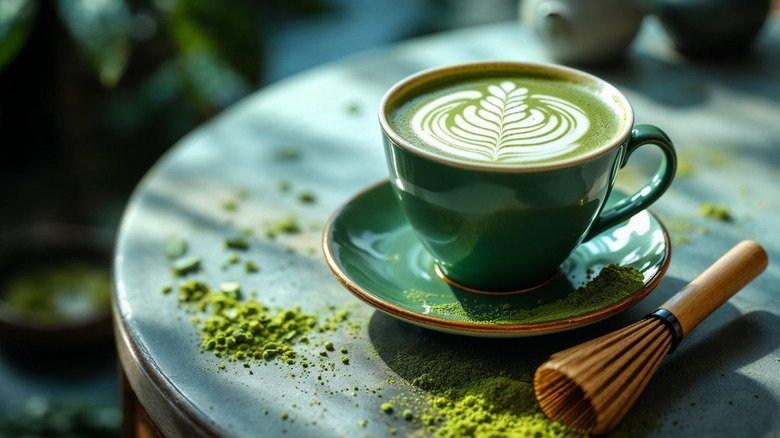
Matcha has been buzzing all over the internet. The popularity of this frothy, Grinch-green powdered tea, with ancient Buddhist roots, has grown so much that it is outpacing supply. Japan, famed for its high-quality matcha, can't keep up with demand. Sales of the beverage have jumped 86% in the U.S. alone over the past three years, according to market research firm NIQ (via Sky News). Fortunately, it isn't just Japan where the tradition of consuming this ceremonial drink exists. Korea and China have the grassy notes of matcha deeply ingrained in their tea cultures as well. That's why, beyond the Japanese version, the world is also getting a taste of Korean and Chinese matcha. The question is, can you substitute one for the other? It really depends on whether you have a preference for a certain type of flavor profile.
Just like there are different types in the wide world of coffee beans, there is a whole society around matcha. Typically, the tea is categorized as ceremonial, premium, or culinary. When it comes to Japanese, Korean, and Chinese iterations, this subdivide is already present within them. They differ in texture, color, and flavor because of the way they're made. To understand how and why, it's essential to first know what the specialty drink is and how it differs from ordinary green tea. Matcha comes from the same plant as green tea, known as Camellia sinensis. Essentially, it is a type of green tea leaf called tencha. Unlike green tea, it's grown in shaded areas. After harvesting, the tencha leaves are steamed, dried, and then whisked into a fine powder. That green powder is what we know as matcha.
Japanese matcha

Even though China is the largest producer of green tea, there are more takers of Japanese matcha than any other variety when it comes to quality. What sets it apart is the soil it's grown in, which differs greatly from those of China and Korea. Those regions can come close to replicating Japanese matcha, but any true aficionado will argue (and win) that the Japanese version is the real deal. If you're asked to tell one from the other, the Japanese iteration catches the eye even before you can tell the difference on your tongue. It is brighter, almost neon in its green tinge. The Japanese take on the beverage is more intense but smoother compared to other varieties, as the flavor is more concentrated. It has a tinge of umami and sweet undertones, though they are extremely subtle.
Japanese matcha is typically cultivated from traditional tea cultivars, many of which have been used for generations, including samidori, okumidori, and yabukita. Each cultivar produces a distinct flavor profile, meaning there are sub-categories even within Japanese matcha itself. Most of the famed tea produced in Japan is also destemmed and deveined before being steamed, which gives it a cleaner flavor. Another reason behind its superior quality is that much of Japanese matcha is still traditionally ground with millstones.
Korean matcha

Korean matcha, or malcha, is a little different from its Japanese cousin. It doesn't have that vivid green color, full-bodied punch, or umami-laced undertones you get with the Japanese version. Instead, it's more balanced and earthier compared with the mildly bitter taste of its Japanese relative. It's often sweeter than the Japanese green tea. That sweetness you get in the Starbucks iteration? Totally not because of Korean methods. The matcha at Starbucks is far from the real thing. Authentic Korean green tea is not as bright as compared to Japan's take. It has a soft, grassy green tinge, which results from the varying environmental conditions it is harvested in. Japanese tencha leaves are shaded on purpose for a few weeks before harvest, which cranks up the chlorophyll and l-theanine (an amino acid), giving the beverage that punchy green color. The tencha leaves used to make Korean malcha are grown in a subtropical climate where the tea plants get their shade naturally, from the mountains and mist, rather than the engineered shading used in Japan.
Chinese matcha

The Chinese powdered green tea, in contrast to Japanese and Korean varieties, is largely mass-produced. The tencha leaves for Chinese matcha are often grown in the open and pan-fried to halt oxidation, unlike their Japanese (and, at times, Korean) counterparts, which are steamed. Pan-frying dulls both the color and flavor of the beverage, lending it a greener-brown, and sometimes even a yellowish hue. The step massively alters the flavor as well, which is why Chinese matcha often has a more astringent, roasted, and grassy taste. This is why most industrial and culinary matcha comes from China, while the ceremonial version is primarily sourced from Japan. China's take on the tea is not replete with the complexity of Japan's or Korea's, but whether you're making cappuccinos and smoothies, or just cafe-hopping for the creamiest matcha latte, it's probably Chinese tea you're tasting. While Chinese matcha is the perfect fit for practical, everyday use, Japanese matcha remains unmatched if you're someone chasing the real experience, or hosting a tea ceremony. Korean matcha can be a softer, more approachable alternative, though.