

The Mysterious Origin Story Of Donut Holes (And Where Dunkin' Fits In)
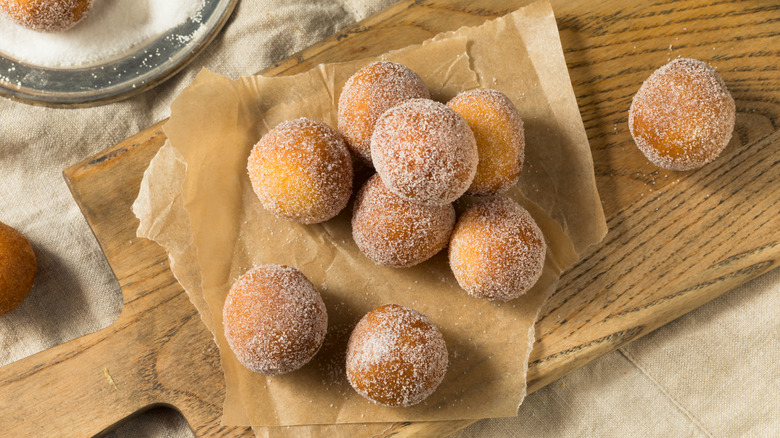
The donut hole has always been more than a neat little circle of missing dough — it's a mystery with multiple claimants to its invention. Dutch settlers brought olykoek, or oily cakes, to early America, but they were heavy, round pastries without holes. The more familiar ring shape is usually credited to a 19th-century sailor named Hanson Gregory, who supposedly cut out the soggy centers with a blade while at sea. However it happened, that missing middle gave donuts their signature look and set the stage for what came next.
By the 1920s, Adolph Levitt's donut-making machine transformed the treat from small-batch novelty into mass-market snack food. His invention cranked out golden rings for soldiers, city-dwellers, and eventually visitors at the 1934 Chicago World's Fair, where donuts were literally marketed as food of the future. That mass production meant more donuts than ever before.
And that's where Dunkin' comes in. The Massachusetts chain turned donuts into an everyday ritual, cementing itself as the most recognizable name in fried dough. Now that we know where Dunkin' gets its donuts from — fresh, shipped in, or finished from frozen — it's clear the missing center was never just a byproduct. Dunkin' would soon find a way to make the hole itself part of the story.
The history of Dunkin' Munchkins
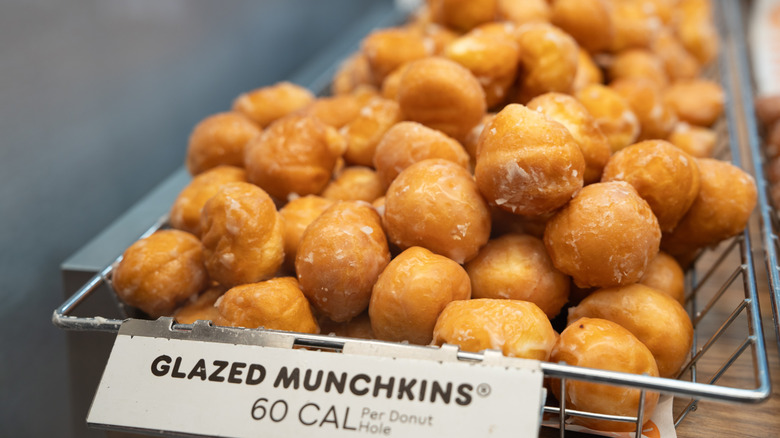
By the early 1970s, Dunkin' had found a way to turn donut holes from leftovers into a brand of its own. Instead of tossing the dough cut from the centers, bakers rolled it into small rounds and fried them up. The result was the Munchkin, a bite-sized spin on the classic donut that quickly became a hit. Customers loved the smaller portions, and the company soon developed special tools to make them consistently — no longer just scraps, but a product designed for sharing.
What started as a thrifty fix has since become a juggernaut. Dunkin' now sells hundreds of millions of Munchkins each year, and the format has inspired copycats across bakeries and grocery shelves. The appeal is obvious: small, shareable bites that can be boxed, flavored, and marketed in ways a full-sized donut can't.
That popularity hasn't stopped the disagreements. Online, the bite-sized treats go by many names — Munchkins, doughnut centers, even Timbits in Canada — with Twitter debates regarding what to call donut holes flaring up every few years. Beyond the naming squabbles, bakers keep pushing the concept further — from brownie-filled donut holes to seasonal riffs and beyond. What began as scraps has become a canvas for creativity, proving the donut hole is no longer an accident but a category all its own.