

Does Your Vintage Pyrex Contain Lead? Here's How To Check
We may receive a commission on purchases made from links.
Vintage Pyrex holds a strong appeal among collectors for its irresistibly nostalgic midcentury vibes. But a lot has changed in the decades since these pieces were made, including the beginning of lead safety regulations in the early 1970s. They were considered safe in the past, but are vintage Pyrex pieces still safe by modern standards?
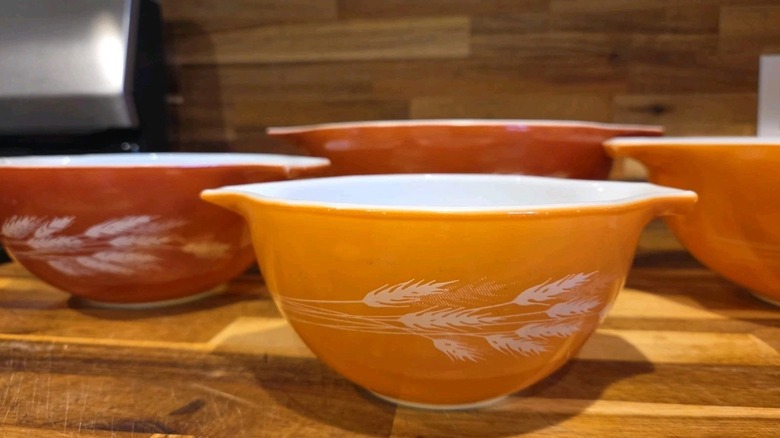
Unfortunately, the answer is probably not. Whatever decorations are on your vintage Pyrex — including solid colors — these are usually painted on, and it's likely to be lead paint. Clear Pyrex devoid of decoration seems to be fine, and some vintage patterns like Autumn Harvest or Spring Blossom are known to be lead-contaminated. But the only way to be certain is to test your Pyrex for lead.
Swab-based home testing kits are inexpensive and readily available from retailers like Amazon, but results may be inconsistent or skewed by coating materials. X-ray fluorescence (XRF) testing is more expensive but also faster, and with more accurate results that cover other heavy metals, not just lead. It also may be more reliable on cooking surfaces like vintage Pyrex.
Navigating lead hazards with vintage kitchenware
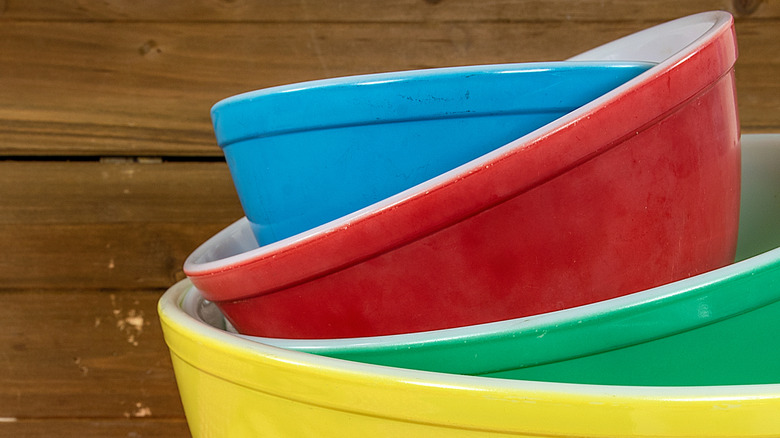
The prevalence of lead is one of the major downsides of using vintage china, Pyrex, or any sufficiently old dishware. And no, a vintage dish is not safe just because all the lead paint is on the outside. Look at a faded piece and you can clearly see that the lead paint is slowly wearing off. A little bit comes off every single time it's touched, washed, or dried — lead residue that can get on ovens, dishwashers, countertops, and hands. And any surface with lead on it can spread the poisonous metal to anything it touches.
While dishware is one of the best kitchen items to thrift instead of buying new, it's important to be wary of lead content in dishes made before the early 1970s. Anything older than that is best avoided for food use (arguably at all), but especially try to avoid vintage crystal, pottery, and bright or deep colors – all three of these commonly contained lead in the past.
Baking with vintage Pyrex probably won't cause immediate problems, but there's no reason to consciously risk ingesting lead. If you must keep that suspiciously colorful casserole dish, consider recycling your vintage Pyrex into a trendy flower pot. It's great for low-maintenance succulents, and lets you display a gorgeous piece without having to move it (and its lead particles) around too much.