

The Old-School Kitchen Tool From The 1800s Is Still Around Today
We may receive a commission on purchases made from links.
It's safe to say that kitchens have undergone a fair amount of innovation in the last couple of centuries. For example, the widespread use of electricity made a pretty big difference. And while some once-popular kitchen tools like the cake breaker have fallen out of fashion, other devices are still in use today. This is certainly the case with manual, crank egg beaters. This invention, in which the user turns a handle to power gears which move the beaters, can trace its roots to the 1800s. Despite its age, it's still in regular rotation (so to speak) today.
While the electric version may be more common, handheld mixers have some downsides. Some people prefer the analog version because it's more lightweight and simple than the alternative, and of course it doesn't require electricity. It can also just be more fun, providing a tactile sensation you won't get from the electric mixer.
In a review of the Oxo Good Grip Egg Beater, a customer noted, "I hate messing with the stand mixer and the electric beater is a pain to get out [and] plug in. This? No plugs to mess with, lightweight, and does the job ... Now I can cook like it's 1899 with my non-electric beater." A review of a different manual beater from The Vermont Country Store highlights the nostalgia factor: "This egg beater is a classic ... I think I bought it partly because it reminds me of cooking in my Mom's kitchen. This beater fits into your hand[,] is easy to manipulate and easy to clean."
History of the hand-crank beater
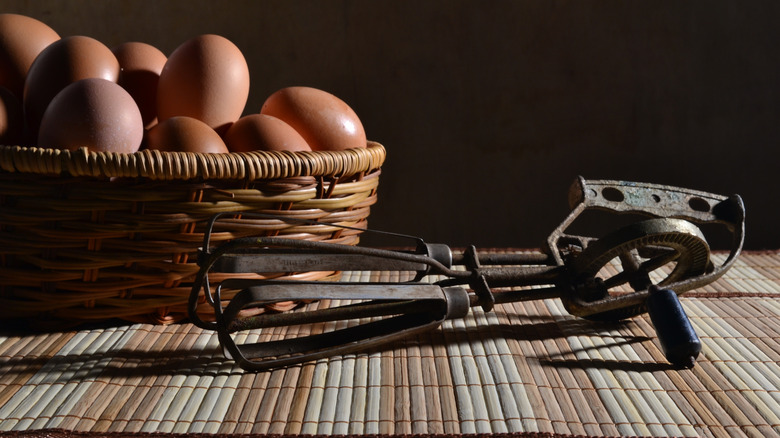
So what exactly is the origin of this still-extant device? Prior to the invention of whisks in the 1800s, people used branches to fluff egg whites or whip cream. Whisks provided an easier method for mixing, but it was still labor-intensive and could take over an hour to turn eggs into a meringue, for example. Things began to change in 1857, when the first mechanical egg beater was introduced in the U.S. However, this clamp-on device had a design that did not prove popular.
Over the next several decades, different models of beaters were attempted to varying degrees of success. One of the major ones was introduced in the 1870s by the Dover company, and was popular enough that "Dover" became the generic term people used for egg beaters. Another notable innovation came in 1884, when a Willis Johnson, a former slave, patented his design for an improved mechanical mixer with a rotating axis.
The first electric mixer was invented by engineer Herbert Johnson in 1914, which spelled the beginning of the end of the crank-style egg beater's prominence. But while the crank beater may not be as popular as it once was, it still has its worthy place amongst the newfangled kitchen appliances of today.