

The Difference Between Sea Salt And Kosher Salt
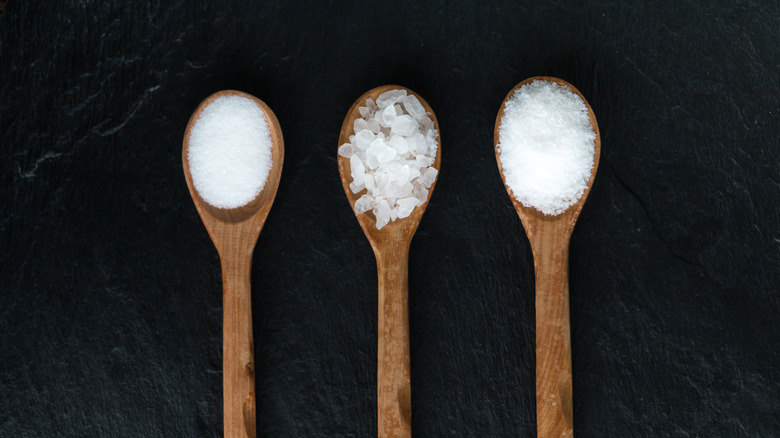
A multitude of different types of salt are found on grocery store shelves in a cacophony of colors, shapes, and flavors. Because of all these options, shoppers can get confused on which to choose for a particular recipe or to fit their personal taste preferences. Some are best for cooking while others are ideal for salting a prepared dish. Most home chefs know you don't skip salt since it's the most important ingredient, but two types happen to be the most popular in households around the globe: sea salt and kosher salt.
While a few factors differentiate the two, the primary difference is how they're harvested. Sea salt is obtained by evaporating briny ocean or lake water until all that remains are salt crystals. This salt water is contained within shallow salt flats where it can be naturally processed by the sun until the salt has dried enough that it can be removed and eventually placed on our food.
Conversely, kosher salt is mined from salt deposits found underground. It has a relatively coarse grain, making it easier to pick up and season with compared to fine-grained alternatives. For generations, kosher salt has been used in koshering meat, which requires the removal of all the blood from meat or fowl prior to preparation.
Other differentiating factors
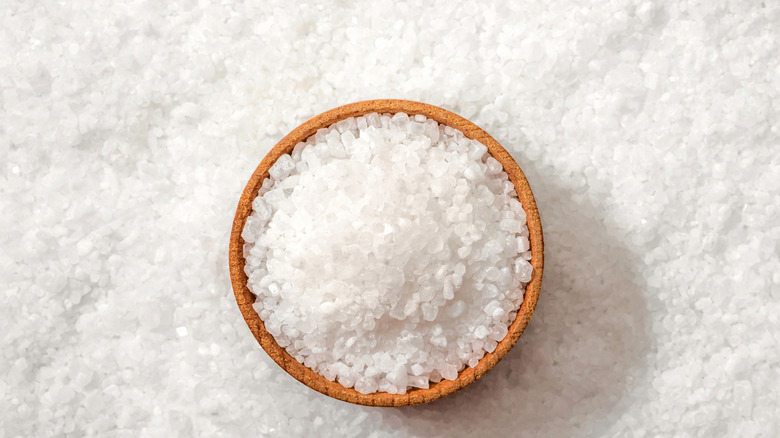
Certain elements define what makes kosher salt different from sea salt when cooking. Since it's industrially processed, kosher salt is generally more uniform in size than naturally formed sea salt. However, in regards to texture, both are coarsely grained, making them somewhat interchangeable. Kosher salt happens to be more affordable than the water-derived alternative, which is more labor-intensive to harvest. For instance, kosher salt at Target can run $0.07 to $0.09 per ounce while sea salt costs closer to $0.13 per ounce (Target's Good & Gather Sea Salt costs $1.23 per ounce).
Kosher salt is comprised of sodium chloride that's been purified and doesn't have iodine or anti-caking agents. Sea salt, formed solely by Mother Nature, generally contains trace amounts of other minerals in addition to sodium chloride, such as potassium and magnesium. Chefs are fairly adept at knowing which one will affect flavor profiles in which ways. Because kosher salt is free from additives and minerals it simply enhances existing flavors, whereas sea salt can add a hint of flavor itself, depending on where it was sourced.
Kosher salt can be used in day-to-day salting of foods and offers the seasoner more placement control than fine table salt. Sea salt is often sprinkled atop an entrée or dessert, adding texture and making the food's flavors pop. (Topping sweet treats with flaky sea salt is actually one of the most flavorful ways to use salt in desserts.) While both can be used to finish a dish by adding it after cooking, people watching their sodium intake may want to consider that ¼ teaspoon of kosher salt has 480 milligrams of sodium versus sea salt's 580 milligrams.