
Dutch Oven Vs Slow Cooker: Which Is Best For A Tender Pot Roast?
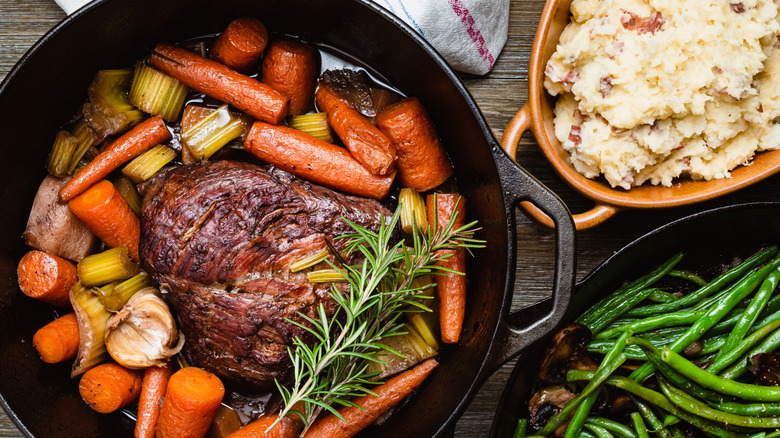
There are lots of differences between a Dutch oven versus a slow cooker. However, it's tricky to decide which one is better for making a tender pot roast because it very much depends on your culinary needs and time constraints. Do you prefer the set-it-and-forget-it vibe of a slow cooker or do you love the control that comes with searing a large hunk of beef in a Dutch oven on the stovetop? Let's get into it.
The USP of a classic slow cooker is its ability to free up your time. Simply add your meat, veggies, and broth to the pot, turn it on, and allow it to simmer unmonitored all day until deliciously tender. As the lid on a slow cooker prevents the steam from escaping and evaporating, it condenses and remains inside, which means you won't have to return to it during the cooking time to replenish the liquid. Moreover, it guarantees that the pot roast develops a tender and succulent consistency.
That said, if you add too much water or broth to begin with, your pot roast gravy will be thin and soupy instead of thick and gravy-like. The other downside to using a slow cooker is, of course, the lengthy cook-time. Plus, many models don't have a sear function to caramelize the roast at the very start. If you want to make a faster pot roast with more caramelization, you might prefer using a Dutch oven.
Dutch ovens are awesome for searing a pot roast
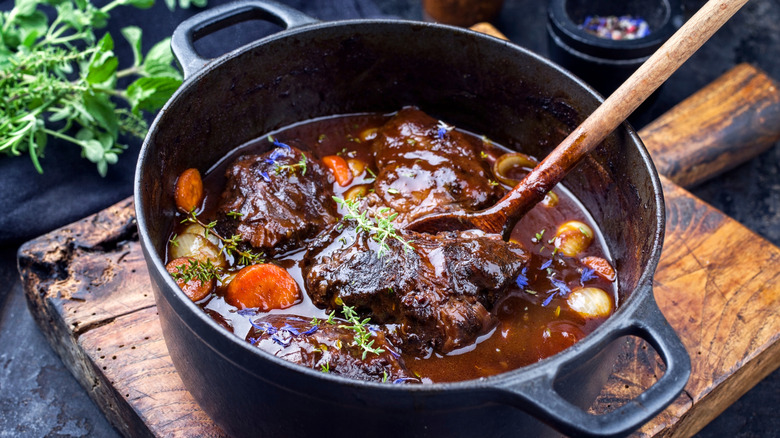
While a slow cooker takes up prime real estate on the counter, a Dutch oven is a free agent and can be used in the oven or on the stovetop, as well as packed into a cabinet when not in use. Its top perk is that it retains heat well, making it incredible for searing cuts of meats for a pot roast, which maximizes the umami flavor of the dish (the caramelized, sticky fond at the bottom of the pot is deglazed with cooking liquid to form the basis of a complex and concentrated gravy). Searing the beef first also gives the meat more structure so it doesn't fall apart completely after it's finished simmering.
The problem? You will have to return to a Dutch oven to check whether there's enough liquid inside to prevent scorching. Nevertheless, you can add plenty of liquid at the very start to avoid this issue. Then, if there's too much broth at the bottom of the pot, take the lid off and oven-bake for longer to allow the sauce to thicken (pot roast is a forgiving dish and the meat will become more tender if cooked for longer — but you might want to liberate first the veggies to avoid mushiness). Alternatively, for greater control, remove the meat and veggies and simmer the pot on the stovetop where you can keep a watchful eye on it. The upshot? The slow cooker is the most convenient but the Dutch oven wins on flavor.