

How King-Sized Candy Bars Got Their Name Begins With Cigarettes
If you went trick-or-treating when you were a kid, you may have had one house in your neighborhood that was that house. It always had the best decorations, threw extravagant Halloween parties, or gave out those old-school Halloween candies you don't see anymore. Whatever the gimmick was, we all knew and loved that house. Maybe you saved it for last on your trick-or-treating route, or maybe you rushed to get there as soon as you could, but you never missed it.
No matter how long it's been since you eagerly rushed out with your friends, you probably still remember the gleaming array of king-sized candy bars you hoped would lie behind every door. That is, if you were trick-or-treating before 2013, when king-sized bars were phased out by some candy companies. Though the gigantic sweets are gone, nostalgia for the words "king-sized" remains, but how did candy end up with a label that originated with cigarettes? The answer lies in the booming tobacco business of the 20th century, and like many modern-day advertising terms, it owes its popularity to the mighty marketing campaigns of 1950s, "Mad Men"-style America.
Advertising royalty and post-war abundance in chocolate-crazed america
Long before glossy magazine advertisements and global marketing schemes, consumers associated words like "royalty" with products of the highest quality. However, the term "king-sized" didn't take off until 1939, when Pall-Mall released its king-sized cigarette, which, in part, owed its popularity to a nationwide marketing campaign. The campaign was more than successful, spawning a dozen copycat cigarette labels and solidifying the term "king-sized" as meaning "bigger and better". Soda giant Coca-Cola leaped on the advertising phrase in 1953, with a new 10-ounce king-sized bottle, just one of many times Coca-Cola changed its iconic look.
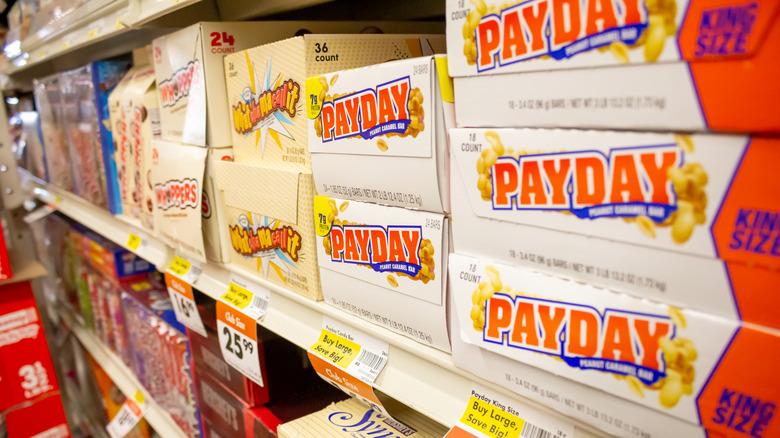
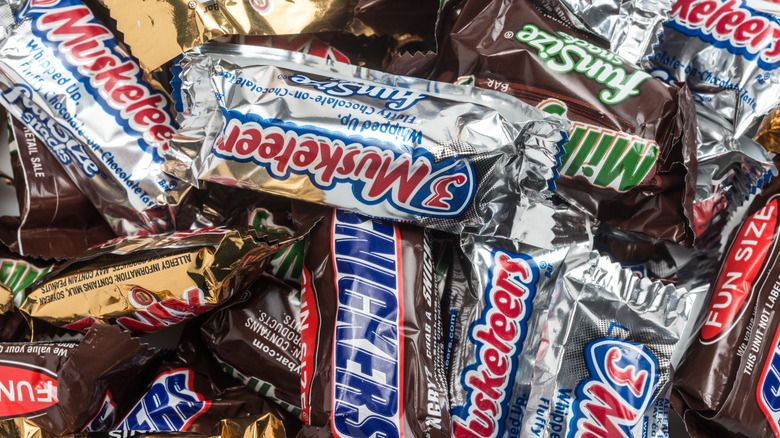
Despite the now-common usage of the term, it wasn't until 1980 that the first king-sized candy bar hit the shelves, in the form of the Hershey's Big Block (also called king-size). By that time, candy companies helped kickstart trick-or-treating, and it had reached the height of its popularity. Throughout the 1980s, rival candy companies phased in larger bars, such as king-sized Kit Kat bars in 1988, and by 1990 "king-sized" candy was the crown jewel of Halloween. These iconic, eye-popping products didn't last long, though; Mars, parent company for Snickers, Twix, and M&M's, announced the end of king-size candy in 2012. This was part of an effort to lower the calorie content of its products.
Almost 50 years in the making, the term "king-sized" has faded from the present-day candy world, and now it's primarily associated with the mattress industry. Even as we mourn the loss of king-sized candy bars, king-sized cigarettes are still available in many markets today. Pretty funny to think that longer cigarettes have outlasted higher-calorie candy bars.