

The Retro Kitchen Appliance Brand To Look For At Thrift Stores

Step into a thrift store and you'll find plenty of retro kitchen items that are cool again, from copper cookware and cast iron skillets to patterned dish sets and vintage pie dishes. However, if you keep your eyes peeled, you might even be able to find some neat kitchen appliances from a retro brand called Mary Proctor that was popular in the 1960s.
Along with Coldspot and Tappan, Mary Proctor is one of the retro kitchen appliance brands that totally vanished over the years as new labels hit the market. However, these old-school appliances have come full circle and become trendy again among homeowners looking to give their kitchens a considered but kitschy aesthetic with their sleek design, futuristic appearance, and cool features.
The Mary Proctor line first included ironing boards and steam irons but later grew to include kitchen items, such as toasters, blenders, and automatic juicers. The thing that made them so special back then (and eye-catching now) was the range of fun designs that married practicality with beauty. For instance, the brand produced light-up coffee percolators, which had a geometric pattern or a burst of atomic stars printed on the glass surface. The bulb at the bottom was the coolest feature because it illuminated the transparent body of the percolator while it brewed coffee, so consumers could see it in action.
The Mary Proctor Starflite toaster has a cool vintage vibe
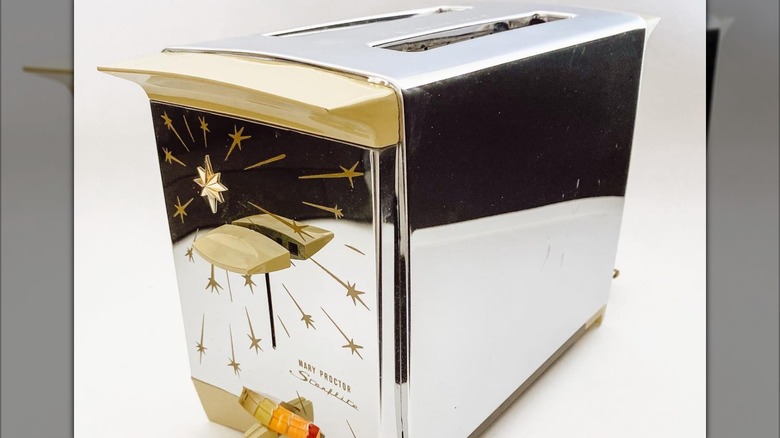
If you spot a Mary Proctor Starflite toaster at your local thrift store, snap it up if you're itching to give your kitchen a retro makeover. You might even be able to find one at a yard sale or in your grandparents' basement. One Redditor posted a picture of the Starlite and described it as an "[a]mazing looking toaster I found in my grandma's closet". The appliance has a whimsical shooting star design across its chrome surface and includes a color-coded dial on the bottom that correlates to the desired level of doneness: white for just barely warmed to red for super-toasty.
This feature triggered one Redditor to ask, "Why can't modern toasters have color coding for the toastiness instead of some random arbitrary numbers which are not necessarily the minutes of toasting as the internet would have you believe?" Meanwhile, another said, "Love the design, wished they made more like that today."
A later 1966 Mary Proctor model of a four-slice toaster had a dial, known as a 'color tuner', on the bottom that allowed users to adjust the range of toastiness to correspond to the colors on the front. The brand name was also written on the front in cursive, lending it an old-school charm.