

How In-Flight Dining Has Changed Since The '50s
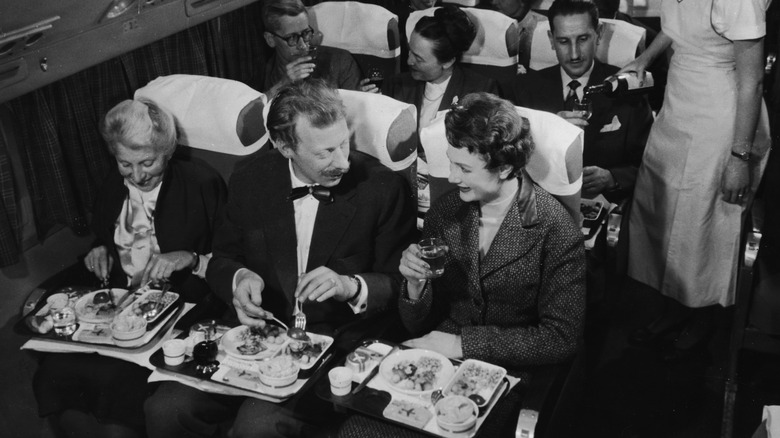
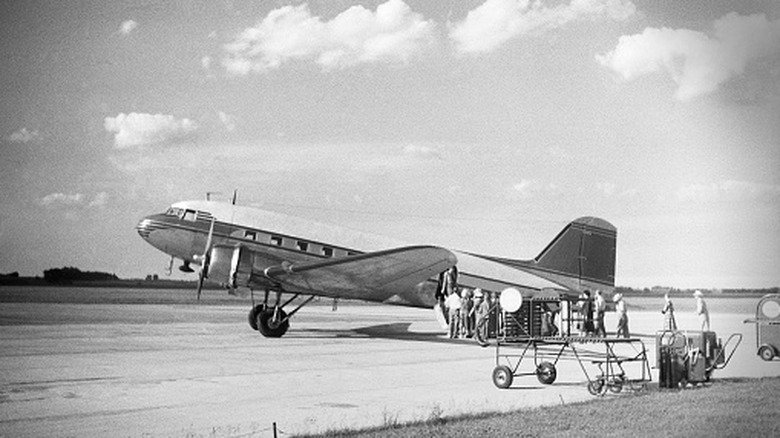
In the present day, airplane food is weirdly portioned, dull, and expensive — and many passengers prefer to bring their own food. Those little packets of pretzels or cookies are nice, but they don't exactly effectuate a sense of romanticism about flying. Yet in-flight dining wasn't always this way — many passengers look back on the flights they took as kids and wonder what's changed. In the '50s, there was a golden age of airplane food where full meals were served on every domestic flight, and the in-flight dining was treated as a key element of the overall experience.
Food is our forte, so we went to the experts to learn what it was like to dine on an airplane 75 years ago, and what caused the industry to change. Dr. Guillaume de Syon is a professor of history at Albright College, who has done research into technology and aviation history. Shea Oakley is an aviation historian who formerly worked as the executive director of the Aviation Hall of Fame and Museum of New Jersey.
Throughout the 112 year history of commercial flight there have been ups and downs (pun intended). Regulation, security changes, and technological developments are just a few of the factors that have caused in-flight dining to go from golden-age to a multi-billion dollar catering industry known for being, well, pretty bad. Oakley reflects on a time gone by, saying, "Flying in the '50s was an adventure." So let's find out what made the journey so memorable.
In-flight dining was a form of entertainment
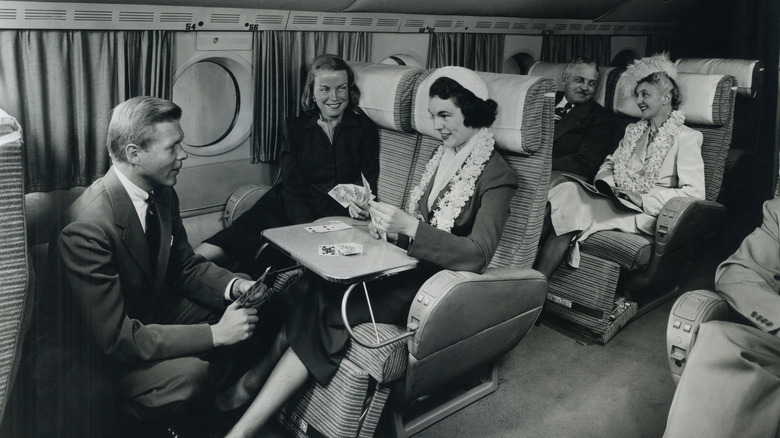
Where flying today is treated like a chore passengers are trying to get through, in the '50s the journey itself was like a special occasion, and one made all the more glamorous by the food served on the way. Dr. Guillaume de Syon, Albright College, says, "In-flight dining was initially a form of entertainment intended to keep passengers busy (and happy) over journeys long and small. By focusing their attention on food and drink, airlines hoped that their nervousness about flying (especially pre-WWII, when airplanes were not pressurized) would subside."
While flying was still novel in the '50s, it was also a much bumpier ride than what passengers are accustomed to now. In the '50s, "... everything we were flying was piston powered," says Shea Oakley, aviation historian. "These prop planes had internal combustion engines driving the pistons, so noise and vibration was much greater. You also flew lower, which meant they often encountered more weather."
Anyone who's been on a flight with turbulence and loud noise knows that the aura of the cabin can quickly turn sour. But delicious food is a great distraction, and airlines were well aware of this, ensuring that meal service was an event potent enough to put passengers in a good mood. Oakley adds, "Getting there was half the fun, food service was a part of that."
Coach meals were complementary
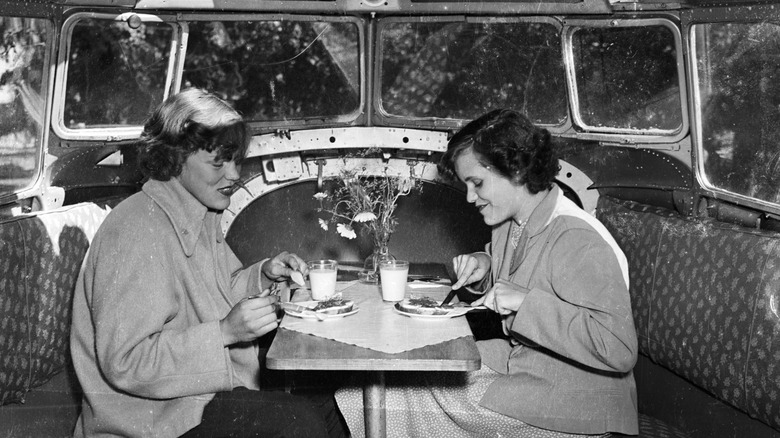
The best tasting meals are often the ones you don't have to pay for. The higher the price, the more critical you're likely to be, and coach meals in the '50s were entirely free. Aviation historian, Shea Oakley, says, "Today, $10 for a box of a few little snacks is what you're looking at. In the '50s, you got a meal with an entree, a salad, a roll, a little dessert and your complementary drinks."
Of course, the price of an airplane ticket in the '50s was so high, it was still an experience only enjoyed by the wealthy. Airlines had to cater to the customer's wants, and providing a meal was the best way to do just that. Oakley adds, "In those days, fares were high, even in coach. Airline deregulation came along in the late '70s, and that's when you began to see the decline in in-flight service, including food service."
Once airlines were able to set their own fares unchecked by the government, complementary services were among the first costs to be cut. But while the free airplane snacks offered today may not be as gratifying as a multi-course meal, it is still amazing that you can purchase an airplane ticket for relatively minimal expense. Flying may be less of an experience now, but at least it's more accessible.
Food was heated in ovens
While there are now countless brands of great microwaves on the market, this piece of equipment has not always been the go-to method for reheating plane food. The discovery of microwaves was made entirely by accident during World War II, when a scientist named Percy Spencer was working on radar technology for aircraft, and observed a chocolate bar he'd brought with him melting nearby.
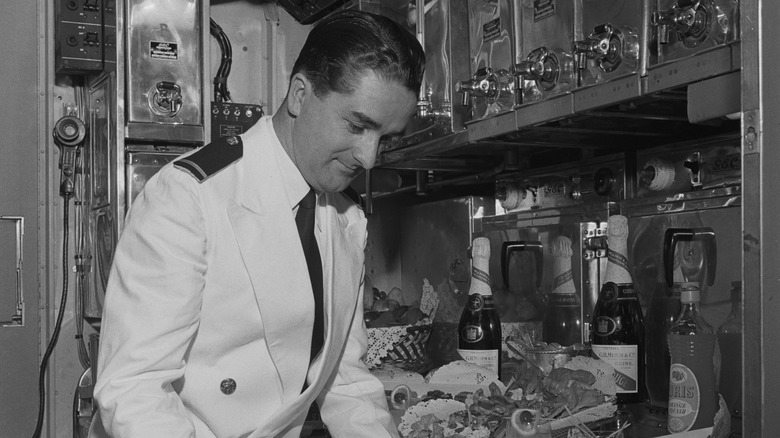
Before then, ovens were the reheating-method of choice for in-flight meal service, which nowadays seems almost unthinkable. The concept of having a smoky, flammable piece of kitchen equipment squeezed into the confined walls of a plane may cause people to wonder if this ever proposed safety dilemmas. However, Shea Oakley, aviation historian and former executive director of the Aviation Hall of Fame and Museum of New Jersey, disagrees. "From a safety perspective, I never have heard of a galley fire in the 1950s causing an accident. [Although] it was more primitive, cumbersome, and probably more difficult for stewardesses."
The first microwave ovens were unveiled in 1946, and while they were marketed for use in restaurants and on planes, they were still bulky, impractical pieces of equipment. It took many more years for them to become small and streamlined enough to replace the pre-existing oven in plane galleys.
Multi-course meals featured heavy, luxurious food
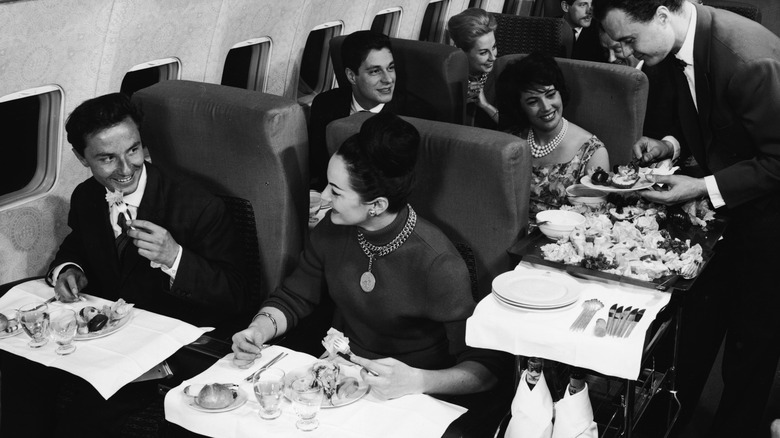
In the modern age, first-class service on airlines is still a multi-course event, although the meals that are served do look a bit different. The food that characterized post-war America was ... interesting, to say the least. Some meals we're glad to have moved on from, while others inspire nostalgia. Shea Oakley, aviation historian, says of the meals served on planes at the time, "The primary difference in first class meals between then and now is that they were very heavy, very unhealthy, 1950s type-food. Whereas today, first class meals tend to be healthier and lighter, but no less impressive."
Food follows trends, just like fashion or music, so whether the airline menus of the time inspire your mouth to water is a subjective matter. But one thing remains true — the meals were characterized by many courses, with drinks flowing freely in between. Dr. Guillaume de Syon, professor of history at Albright College, adds, "Meals were multicourse on all airlines, a way of passing time. It included aperitifs with light fare, followed by the hors d'oeuvre, one or two main courses, added drinks, a dessert, coffee, and a pousse-café (liqueur)."
In the '50s, the goal was to keep passengers entertained, appeased, and willing to fly with the same airline again, which meant providing top notch service. De Syon adds that at the end of the meal, to the undoubted relief of the stewardesses, "The heat would be turned up to put the passengers to sleep."
Silverware and glassware were common
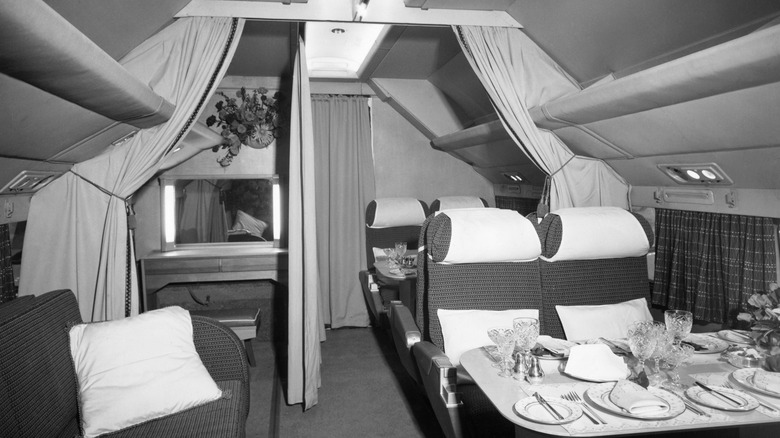
Ask any chef, and they'll tell you plating is as important to food as what you're actually eating. Eating off of a real plate can elevate even a fast food burger to feel more refined. It brings significance to the meal (albeit along with some extra cleanup), which is perhaps one more reason why airplane food now feels so insignificant, served as it is in a disposable container.
Aviation historian Shea Oakley says of in-flight dining in the '50s, "There were menus and there was silver service. Everything was silver, real silver. [The cups] were crystal, expensive glassware." Even the saddest meal of pre-cooked, soggy ingredients would be received much better when served on fine China with a real fork; it at least gives the impression of elegance and significance. Of course, it also requires vastly more storage, expense, and work for the airline, which is why plane meals now come in drab, disposable containers sealed with plastic. Not quite the same ambiance as the golden age.
Drinks used to flow freely
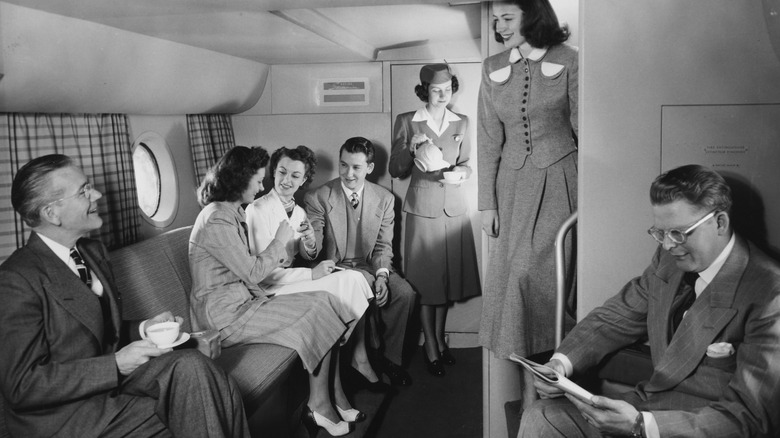
The fact that the '50s are regarded as the golden age of in-flight dining, at a time when planes were noisier, bumpier, slower, and more expensive, truly says a lot about just how good the meal service was. But perhaps these fond memories passengers in the '50s have are tinted rose-colored from the abundance of alcohol, which was provided both liberally, and at no extra cost.
Nowadays, the idea of getting a free glass of wine in a domestic economy seat is almost laughable, and some airlines have even gone so far as to restrict your ability to drink duty-free liquor onboard. In the '50s, Shea Oakley, aviation historian, says, "In first class, drinks were completely free." On many flights there were even cocktail bars where you could pass the time with other patrons over a complementary drink.
Dr. Guillaume de Syon, professor of history at Albright College, adds, "Before movies became a standard form of entertainment, drinking was common, and it was not surprising to see passengers get off a plane and looking like they had gone a few rounds too far." While it may sound like a good time, there's no doubt that unruly crowds caused quite a bit of trouble for flight attendants after one too many drinks, and we might all be better off with the more sober cabin atmosphere now.
Galleys on board were larger
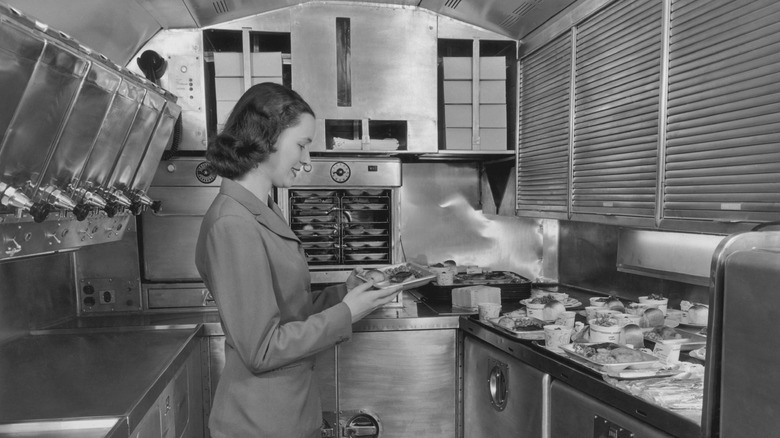
Given that ovens were still the primary method of reheating food, more meals were being served on aircraft, and cutlery, glassware, and real plates were still being used, galleys on planes were much larger than the small cubbies we see now. They looked like actual kitchens, and the space was indicative of the priorities of that day and age. Seating was spacious and comfortable, and the in-flight meal service was an important part of the journey.
When it came down to maximizing profits in the post-deregulation world, squeezing as many seats as possible into a plane became the name of the game, which also meant shrinking the kitchen space and removing bars. Shea Oakley, former executive director of the Aviation Hall of Fame and Museum of New Jersey, says, "We have miniaturization that has happened since then, along with the advent of things like the microwave oven. So today, you can [prepare] more food in a smaller galley."
Menus were taken as souvenirs
The eulogistic reflection on flying in the '50s is characterized by a general feeling that it was an experience, an event that broke from routine. The drinks, the food, and the presentation were all factors, but no experience is complete without a bit of memorabilia to take with you. Aviation historian, Shea Oakley, says, "Every seatbag pocket had a flight pack in it that had postcards and stationary with the airline logo on it and a root map ... and people took these home with them."
These paper items also included a copy of the menu from the flight, an item that passengers could show off to their friends when asked about their journey, and keep as memorabilia. Dr. Guillaume de Syon, professor of history at Albright College, says, "The menu was considered a souvenir that people took with them, in the same manner that fine [dining] restaurant menus are given to guests."
Today, this practice is entirely foreign, as many airlines have eliminated the use of paper, even removing the once common SkyMall magazines which were full of useless gadgets no one needed. Oakley says, "The only collectible [now] is something you're not supposed to take from an airplane, and that's the safety card." But for collectors, those paper menus from the '50s are still very much appreciated, being traded at collector's events around the country.