

5 Disadvantages To Having A Sam's Club Membership
There are a lot of benefits to a Sam's Club membership, the most obvious being access to its low prices on bulk goods. But just as every rose has its thorns, there are some disadvantages to a Sam's Club membership that are worth considering before making the commitment. And gaining access to these deals is a financial commitment in itself.
Not only does a prospective Sam's Club member have to pay for an annual membership at one of two pricing tiers, but buying in bulk runs up its own immediate costs. And if something you bought isn't up to snuff, the return policy at Sam's Club isn't quite as generous as its biggest competitor.
There are other potential shortfalls too: try as it might, Sam's Club isn't quite as popular as some of its competitors, forcing shoppers to rely less on word of mouth for new products and deals. And for those with specific dietary needs and restrictions, you may find that other grocery stores have a wider selection of foods.
Upfront membership price
Most grocery stores don't charge you before you even walk through the door, but that's not the case at Sam's Club. If you want to stroll the aisles yourself, you'll have to pay for the privilege: $60 per year for the basic membership, or $120 for a premium tier with a few bonuses, notably including free shipping for online shopping. From time to time, the store might also offer temporary discounts on new member signups.
This business model is common to big-box warehouse clubs, and compared to the competition, this price isn't terrible. BJ's Wholesale Club has the same prices for its membership tiers, and Costco is $5 more for one year and $10 more for the premium. And a membership price hike was one of the ways Sam's Club memberships changed in 2026, suggesting that further price increases are likely not coming soon.
Though it may be on the more affordable end of the spectrum and it does unlock considerable savings potential, for some people, that recurring $60 or $120 annual bill could disrupt their usual spending habits. Non-members can shop online, but at the cost of a 10% surcharge cutting into your grocery savings. It's best to just get the membership if you can.
Sam's Club has a quieter fandom
Frugal grocery shoppers have likely noticed that all their peers seem to talk about online is how great Costco is, or how wonderful Costco did that; Costco, Costco, Costco. That store's fervent fanbase loves to talk about any good sales happening now or soon, and gossip about new products coming to the aisles — a word-of-mouth that keeps shoppers informed. You'll find substantially less of that about Sam's Club.
Looking at the subreddits focused on these stores, r/samsclub has 91,000 weekly visitors and 1,200 weekly contributions. Compare this to r/costco, with 1.2 million weekly visitors and nearly 10,000 weekly contributions. Non-membership big-box stores tell a similar story, with r/Target and r/walmart both being substantially more active than the Sam's Club subreddit.
Sam's Club shoppers are less likely to encounter a rave product review in the wild, like you might overhear a stranger talking about a Kirkland Signature item. With emails, push notifications, and flyers, Sam's Club deals and new products are still fairly easy to come by. They might just take a little more work to find than at its biggest competitor.
Economics of bulk buying

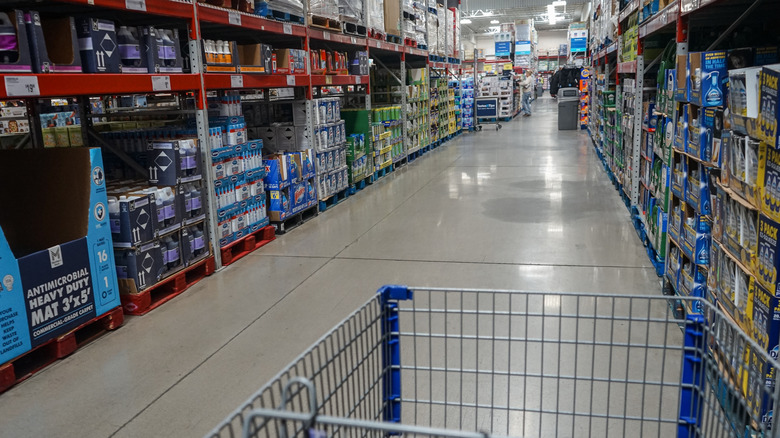
The single biggest draw of warehouse clubs like Sam's Club is the savings that are possible with smart shopping in bulk. But the thing about shopping in bulk is that, even if it is ultimately more economical (sometimes by a lot), the purchase price can still cause sticker shock.
According to data compiled by MNCG Invest, the average Sam's Club shopper spends just under $1,600 a year at the store across 20 shopping trips. That averages out to a relatively modest $80 per trip. But with a common pack of toilet paper costing around $30, shoppers may not always be getting that many different items for their $80. And the customers who do get a wider variety of things could be spending hundreds of dollars at once.
But there are some useful tips for shopping at Sam's Club on a budget. Try to buy the store's Member's Mark brand where possible, as it will likely be the least expensive option. Look for Sam's Club Instant Savings. Also, be sure to peruse your store's under-$5 finds — like the highly-rated rotisserie chicken.
Less friendly for specialty diets

According to CDC data from 2018, approximately 1 in 6 Americans were on some kind of special diet, including, but not limited to, low sodium, gluten-free, and low or no lactose. Data is scant, but the percentage of people with dietary restrictions and preferences may have grown since then. And depending on the restriction or preference, there may be better places to shop than Sam's Club.
Shoppers have observed that Costco generally has a superior selection of organic foods, gluten-free items, and keto- or paleo-friendly foods compared to Sam's Club. Sam's does have a wellness page on its website with links to high-protein, organic, and low-additive foods, but this doesn't match the product variety or organization at more traditional grocery stores.
Target, for example, has a vast selection of gluten-free items and flours, which also requires some smart shopping to suss out. But Whole Foods has the best of both worlds, with impressive variety and an entire website section dedicated to special diets, with diet-specific advice, generic shopping lists, and recipes to try. Sam's Club will make you work harder to find fewer products, though they may be more affordable.
Return policy restrictions
Sam's Club has a fairly generous return policy. Most items can be returned at any time, with some exceptions, including a 90-day window for electronics and major appliances and 14 days for cell phones. A receipt is not needed, though it will make the process easier. One thing that is often required, however, is the original packaging.
This is the main reason that rival Costco has a better return policy than Sam's Club. Specific item restrictions are similar across the board, but Costco does not require the original packaging to accept a return. It's a lot easier to change your mind on a purchase weeks (or more) later and still get your money back.
But Costco's return policy has been strained by abuse of its permissiveness in a way that Sam's Club seemingly has not. It's likely that Sam's requirement for original packaging significantly reduces the number of people who return worn-out couches, desiccated Christmas trees, and other fraudulent returns, in turn making the whole business run more smoothly.