

The Origins Of Pyrex Began In This US State
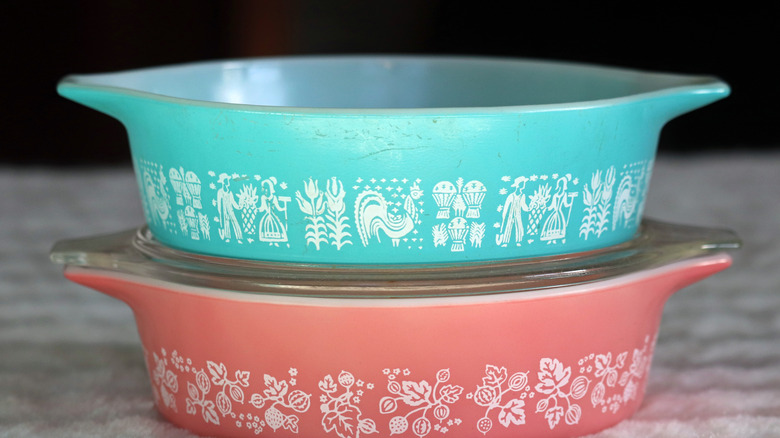
Long before Pyrex was a popular collector's treasure, and before it held tuna casseroles and leftovers, it was a scientific breakthrough born in New York. Corning Glass Works, a Corning, New York-based manufacturer of light bulbs and battery glass jars, is behind one of the most beloved, successful, and collected pieces of cookware of all time. In fact, a scientist's wife at the company helped with the discovery. In 1913, Corning was fresh off the success of its Nonex glass, a heat-resistant glass it had developed for railway lanterns. And they were looking for other ways to use Nonex.
A year later, physicist Jesse Littleton's wife, Bessie, had the idea of taking a Nonex battery jar to bake a sponge cake, as her current ceramic casserole dish shattered after just a few uses. The cake not only cooked faster, but she could monitor how it was doing on all sides and easily remove it. After experimenting with different recipes and glass products, Bessie knew they had stumbled onto something. Corning scientists took her discovery and continued experimenting and changed the Nonex formula to remove the lead. Once they had it down, the company developed the cookware line and introduced the first 12-piece Pyrex line just a year after Bessie's experiment.
From lab experiment to kitchen icon
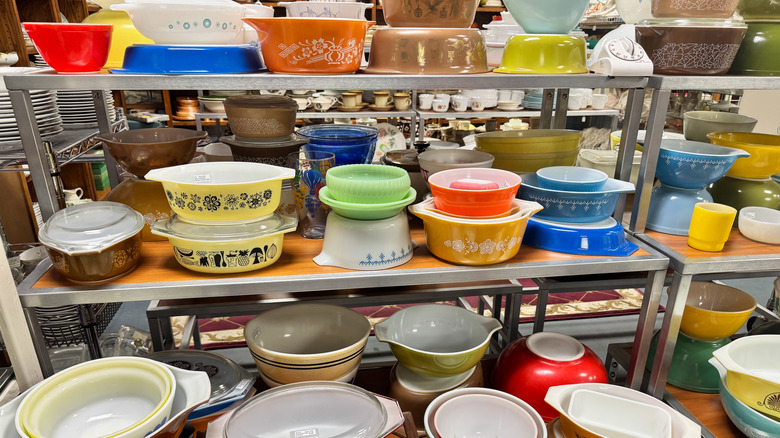
The bakeware, named Pyrex to rhyme with Nonex, was first sold at hardware stores, then at department stores. The company partnered with home economists and publishers of women's publications to persuade home cooks to trust the new glass bakeware over the metal and ceramic products of the time. Despite glassware being an initial hard sell to the public, Corning had sold more than 4 million Pyrex cookware products by 1919 and became a staple in American households.
To switch up the plain glass design and improve sales, Corning introduced opal glass and a range of colors, shapes, and decorative icons to the Pyrex line in the 1940s. The "Atomic Eyes" pattern, displaying turquoise diamonds with continuous white circles and turquoise crosses, was one of the first designs and among the rarest and most sought-after patterns for modern collectors. That Post-War period was also when Corning shifted the Pyrex formula from the original borosilicate glass to tempered soda lime glass. From then on, well into the '80s, Pyrex introduced a variety of sets, seasonal items, promotional pieces, and specialty gift cookware that helped the brand sustain its success.
In the late '80s, Pyrex's opal was discontinued, and in 1998, Corning spun off its entire consumer kitchenware line to what would become Corelle Brands. Corelle still manufactures the Pyrex line. While Corning Glass Works, now Corning Incorporated, is still headquartered in Corning, New York, it shifted its focus back to technology and scientific research after the division sale.