

The Classic Japanese Chocolate Bar Brand That's Been Around Since The 1920s
Walking down the candy aisle of a grocery store in another country can tell the traveler a lot. Different flavor combinations than what you would find at home point to the local tastes. Even foods that are missing, like peanut butter and chocolate, are a peek into a country's palate. You will also discover what companies dominate around the world. The United States has Hershey's, the United Kingdom has Cadbury, and a trip to Japan's candy section will reveal bar upon bar made by Meiji.
Started in 1916 as a sugar refiner, Meiji soon added dairy products to its lineup. The company's stated goal was "making people healthier and happier." Chocolate first came to Japan via Dutch traders introducing it in drink form in 1797. The first mass-produced chocolate bar was introduced in 1918 by Taichiro Morinaga (famous for making HI-CHEW). Chocolate took off from there and became popular all over Japan in the 1920s. Meiji released its first milk chocolate bar in 1926, taking the treat to a higher level. The company now makes over 20 different chocolate brands for sale across Asia and in the United States, through Meiji America.
What Meiji chocolate tastes like and how to find it
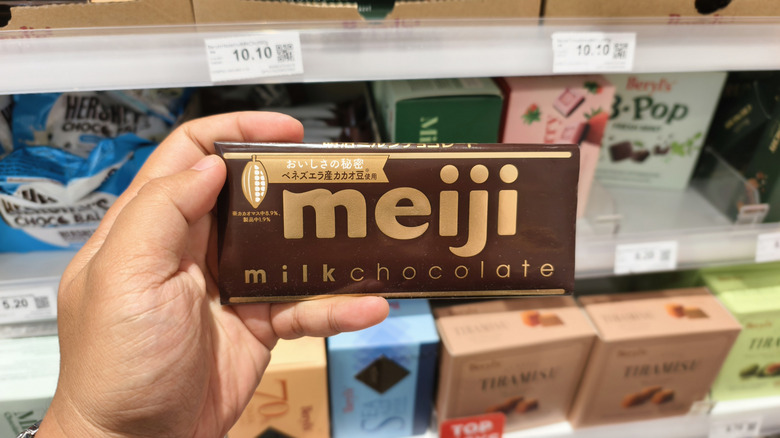
On my first trip to Japan, I tried all the Japanese candies I could. I love to wander grocery stores in other countries, and Japan's candy aisles are among my favorites. Japanese candies tend to be less sweet, and chocolate is no exception. I found Meiji chocolate to have a good balance of chocolate flavor, sweetness, and subtle creaminess. The rich cacao and Madagascar vanilla flavors are more prominent. The experience ruined chocolate back home in the U.S. for me. Per 100 grams of chocolate, Meiji's standard bar has 49 grams of sugar, compared to 56 grams of sugar per 100 grams of Hershey's chocolate.
If you want to try Meiji chocolate, search your local Asian grocery store. Mitsuwa Marketplace is a U.S.-based store that sells Japanese products, including Meiji chocolates. Costco sells a solid selection of international foods, including Meiji Chocorooms. Compared to the version sold in Japan, the Chocorooms at Costco have roughly the same amount of carbohydrates (the Japanese version doesn't break out the sugar from the different types of carbohydrates).