

American Vs British Chocolate Bars: Is There A Difference?

The first time I traveled to the United Kingdom, my eyes were opened to a different world of chocolate. I was warned this would happen. Before I left, people told me to make sure I tried chocolate in Britain. The store-bought bar of Cadbury milk chocolate with fruit and nuts was actually chocolatey, creamy, and smooth. I had given up on most chocolate in the United States, finding it to be chemical-tasting, overly sugary, and thin on chocolate flavor. The difference in taste has several specific reasons, some of them regulatory. For U.S. milk chocolate, the FDA allows products to be labeled as chocolate if they are made up of at least 10% cocoa solids. In comparison, U.K. milk chocolate must have at least 25% cocoa solids, or 20% for bars considered family milk chocolate (as long as there is a minimum of 20% milk solids. Even the U.K.'s allowance for "cheaper" chocolate has a higher standard than ours.
The U.S.' leading chocolate maker, Hershey's Chocolates (which owns the permanent U.S. licensing rights to Cadbury), may also process its milk differently. Only the people working at the chocolate maker know for sure what's going on, as the process is proprietary, but the presence of butyric acid gives it an off-taste. Butyric acid is not a listed ingredient, and Hershey's told Huffpost in 2023 that it is not added to the chocolate. Hershey's started off using soured milk to ensure that the chocolate tastes the same no matter what time of year the company acquired milk. This resulted in a tang from the butyric acid common in fermented dairy products, helping explain why so many of your favorite chocolate bars taste totally different in other countries. The problem many Brits have with this inclusion is the other common source of butyric acid: Vomit.
There are some similarities between chocolate bars in the U.S. and U.K.
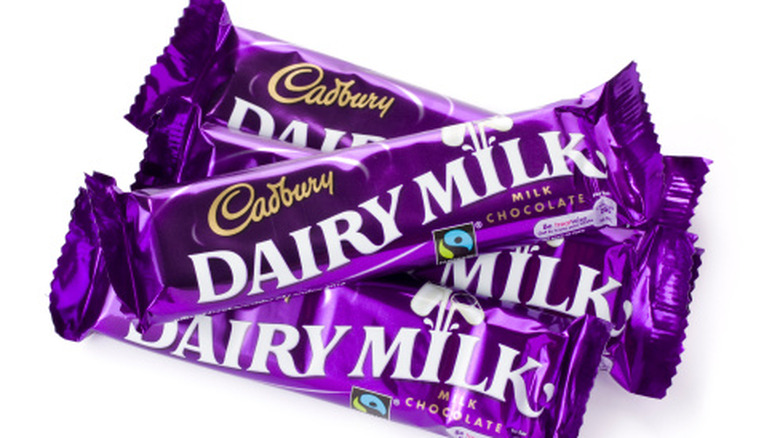
People will often point to the sugar content of a Hershey's bar as being excessively high. However, if you compare the nutrition labels of a British Cadbury Dairy Milk bar to a Hershey's Milk Chocolate bar, both contain about 56 grams of sugar per 100 grams of chocolate. Even when we compared Cadbury chocolate made for the U.K. market to the bars made for the U.S., the sugar content was the same. That being said, I always found the sugar to stand out more in Hershey's, perhaps due to a perceived lack of creaminess.
British Cadbury has another similarity with the Hershey company, and one that is controversial with parts of the E.U.: Instances of vegetable oil use in addition to cocoa butter. Ever the chocolate purists, Belgium and France argued that Cadbury is not real chocolate and should be sold under a different name because it includes smaller amounts of vegetable oils, like palm and shea, which are cheaper than just using cocoa butter, the most expensive ingredient in chocolate. While the United Kingdom was a part of the E.U., the governing body made an allowance for member states to use up to five percent of other fats in chocolate without losing the legal chocolate label. Even with this bending over backward to allow "adulterated" chocolate, the United Kingdom still voted for Brexit!