

9 Food And Drink Commercials From The '70s That Still Hold Up
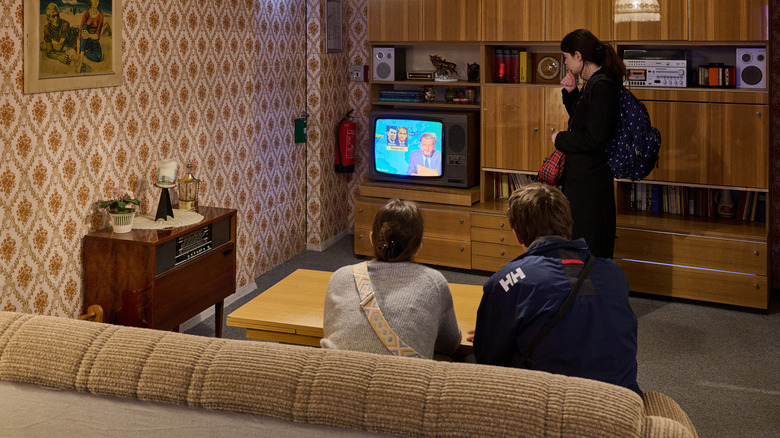
The very first television commercial hit the airwaves in 1941. It was a black-and-white, 10-second blip for Bulova watches. There was no music or jingles. By the '50s, TV ads were a tad more interesting, but it really wasn't until the 1970s that commercials became the kind of marketing that really got into people's minds. By this, we mean product pushers discovered the power of jingles or humor that Americans regularly quoted or sang. We think that nine of them were so brilliant that many still quote them today, or at least remember them fondly.
From candy to lunchmeat and fast food to booze, these commercials reached across several categories of foods and drinks and tempted millions to experience them. Part of this was the fact that more households than ever before had color television sets, and advertising execs discovered the influence of 30-second ads over long 60-second ones. These minds also found the power of mascots, or characters that made the ads memorable. To look back on them and rediscover their charm is refreshing, especially in a time when every other television commercial today is a long one about one medication or another, complete with an exhaustive list of potential (and terrifying) side effects. So, enjoy this look back on commercials of yore, even if they're not in 4K.
Tootsie Pops (1970)
The biggest testament to this genius Tootsie Pops ad is that it is occasionally still shown on television in a shortened version. It features an animated boy approaching several animals, asking, "How many licks does it take to get to the Tootsie Roll center of a Tootsie Pop?" He finally gets an answer (sort of) from Mr. Owl, who gives the lollipop three licks before biting and swallowing the entire treat. It's simple, catchy, and completely memorable for generations of people.
Oscar Mayer Bologna (1973)
If you put a group of Baby Boomers and Gen Xers in a room and start singing, "My bologna has a first name, it's O-S-C-A-R..." we can almost guarantee everyone would be able to finish the jingle. This charming ad showed a young boy sitting on a dock, with one hand holding a fishing rod and another holding half of a bologna sandwich as he's singing the timeless tune. No special effects, no AI, just pure innocence and a heck of a commercial.
McDonald's Big Mac (1974)
The Big Mac, which cost 45 cents when it debuted, is arguably the most recognizable item at McDonald's. Introduced in 1967, the sandwich really skyrocketed with a now-iconic ad from 1974, which musicalized the elements of the burger. "Two all-beef patties, special sauce, lettuce, cheese, pickles, and onions on a sesame seed bun" is sung while a young boy tries to repeat the mouthful of words unsuccessfully. While the Big Mac has undergone several tweaks since it was first released, the basic elements remain the same, so the 1974 commercial still rings true today.
Coca Cola (1971)
Some call the legendary 1971 ad, "I'd like to buy the world a Coke," one of the greatest commercials of all time. It was even immortalized in the final episode of "Mad Men" as an idea of the main character and anti-hero, Don Draper. In the ad, a large number of young people of all races stand on a grassy hill, hold bottles of Coke, and sing of peace and harmony. They even tie in the catchphrase, "It's the real thing," which has been a motto of Coca-Cola for decades.
Life Cereal (1972)
In 1972, Life Cereal debuted a commercial about a topic that millions of families could relate to: picky eaters. In it, two young brothers argue over who's going to taste the new cereal, which they agree looks "healthy." Sliding it over to the pickiest of them — their younger brother, Mikey — the tot takes a bite and, to the brothers' shock, likes it. It features the line, "He likes it! Hey Mikey!" which became one of the most famous food and drink slogans of all time.
Suntory Whiskey (1974)
In the '70s, Rat Pack member Sammy Davis Jr. joined forces with Suntory whiskey for its ad campaign. While liquor ads were banned in America at the time, what he filmed for Japan became well known due to the musician's natural talent. Remarkably, there's no music or singing in the ad, but Davis Jr., rather, participates in scat singing, which is basically beat-boxing. It is filmed in one long shot with no edits, as a lit cigarette smolders in the frame. It's relatable: He's doing what a lot of people do when they're making their own drinks. That, along with David Jr.'s lifelong celebrity, might be why it's so fondly remembered.
Alka-Seltzer (1976)
Heartburn and acid indigestion aren't fun symptoms to experience, and there's not really an endearing way to talk about it. But Alka-Seltzer actually figured out how to do just that in 1976. In the now-famous ad, a Claymation character named "Speedy" sings about overindulging in food before he gets to the tagline, "Plop, plop, fizz, fizz, oh what a relief it is," as two Alka-Seltzer tablets are placed in a glass of water and begin to dissolve. It's a jingle that millions still recognize today.
Dr. Pepper (1977)
The king of soft drinks is unequivocally Coca-Cola, but Dr. Pepper is a major contender, thanks in part to decades of clever marketing. In a 1977 campaign, actor David Naughton sings, "I'm a pepper, he's a pepper, she's a pepper, we're a pepper, wouldn't you like to be a pepper, too?" (For reference, a "pepper" is anyone who likes Dr. Pepper.) Naughton went on to star in the cult classic horror film, "An American Werewolf in London," in 1981, while Dr. Pepper skyrocketed in popularity in the United States.
Burger King (1974)
The middle of the 20th century saw an explosion of fast food restaurants that went on to become huge corporations. Competition could be fierce, so these giants had to differentiate themselves. In a famous Burger King commercial from 1974, a man and his wife order Whoppers with customizations, while the Burger King employee sings the order back to him, which is totally awkward, but birthed the famous phrase "Have it your way." It was revolutionary in a time when most fast food restaurants didn't accommodate customizations, so people took notice, and the company still uses the slogan today.