

5 Kitchen Appliances To Never Plug Into A Power Strip
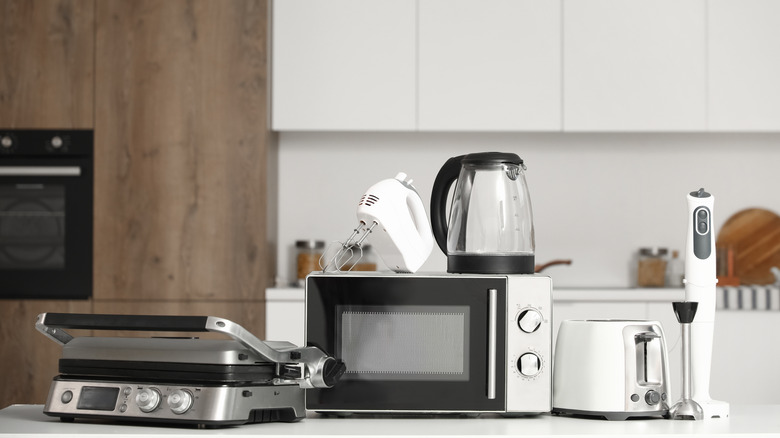
A power strip can be a convenient addition to a kitchen. Some kitchens have a shortage of outlets, or poorly placed ones, and a power strip's extra functionality and flexibility can go a long way to fix that. But it can't do it all; there are several common kitchen appliances that should never be plugged into a power strip.
The reason for this comes down to wattage, a measurement of the power used by an electronic device, like a kitchen appliance. Most power strips are designed for a maximum wattage between 1,800 W and 2,400 W. That may sound like enough, but it's actually not recommended to exceed 980 W at any given time, regardless of the power strip's stated capacity. Considering that power strips often have multiple things plugged in at once, this limit is easy to accidentally exceed. Appliances like microwaves, electric kettles, and air fryers can melt power strips with their intensive energy needs, especially if they're sharing the power load with other devices. Blenders and refrigerators are also problems for power strips, due to the very nature of how each machine works.
Microwaves
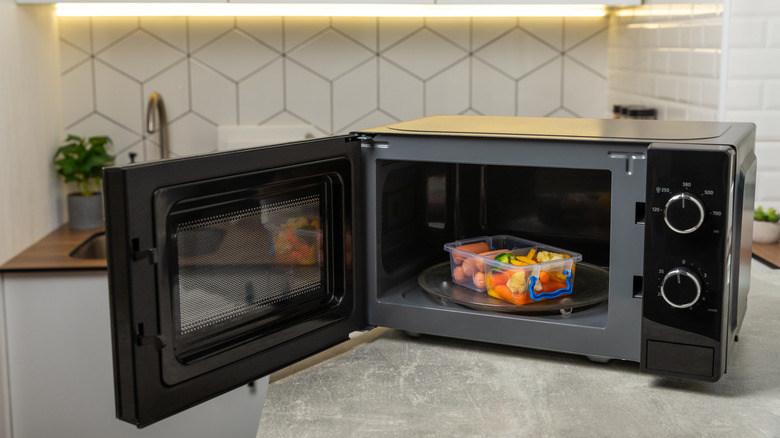
You've likely looked at the microwave directions for frozen food before, and possibly noticed that the recommended cook times are based on what the package might describe as a standard 1,000W microwave. This is an attempt to quantify the average microwave's electricity use on high power, already in excess of the recommended 980W power strip limit. Some consumer-grade microwaves are even more powerful.
There are also microwaves that use less than 980W, but these tend to be smaller models designed for tight spaces. And even if it only draws 800W, that doesn't account for anything else that might be plugged into the power strip. If you have to unplug four other items every time you use the microwave, it begins to defeat the convenience.
You may be thinking that older models might draw less power, but while a working vintage microwave is safe to use, they don't actually draw less power than modern units. Rather, they use the power less efficiently due to aging internal components. In every case, a microwave should be plugged directly into a grounded wall outlet (the one with three holes).
Refrigerators

The problem with refrigerators and power strips is less about their actual power load, and more about the machine's daily functioning. The average refrigerator uses somewhere between 300W and 800W, potentially far below a power strip's recommended limit. But it's the mechanized components that pose a problem.
Refrigerators use compressors to keep the air cold, and at least two different fans to cool the compressor and circulate cold air inside. All of these components cycle on and off constantly throughout the refrigerator's life, and therein lies the issue. The never-ending power cycles will strain a power strip over time, and ultimately lead to its failure.
Plugging a refrigerator into a power strip will not only break the power strip, it could damage internal fridge components as well. At that point, whether you repair or replace the refrigerator, you're in the tank for hundreds if not thousands of dollars. There's a reason that most home kitchens have a grounded wall outlet in a dedicated refrigerator space.
Air fryers
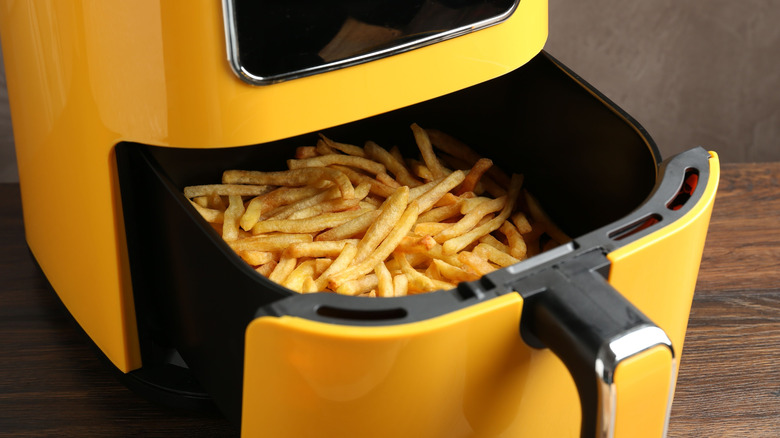
The biggest downside to air fryers is their small size, which is also what makes them work so well, and may lead one to believe that something so relatively small can surely be plugged into a power strip. Unfortunately, the truth is anything but. Depending on the size, model, and function used, air fryers can demand anywhere between 800W and 2,000W each time they're turned on.
The lower limit is too close to a power strip's recommended capacity, especially with other items also plugged in, and the higher limit may rapidly fry the power strip instead of your food — which could include a potential fire risk. Both devices are meant for convenience, but not in conjunction with each other. An air fryer — or, generally, anything that generates heat — should never be plugged into a power strip, only into a grounded wall outlet.
Blenders

When you think about the energy required to grind, puree, or liquefy the myriad ingredients that can go into a blender, it might become obvious that this is another appliance to avoid plugging into a power strip. Some blenders and blender-like devices can be as low-wattage as 300W, which may sound safe enough, but it's the motor itself that can cause problems. Blenders and other electronic devices with motorized parts require an intense jolt of electricity to start, up to 5-10 times their normal power needs. The common power strip is not equipped to handle these energy demands. And even if it does survive that intense power burst, most blenders use 1,000W for regular functions, further exceeding the recommended limit. Professional-grade blenders exacerbate this over-wattage, drawing up to 1,500W per use on top of the electricity spike from starting their motors. Just don't do it, unless you want to risk an electrical fire.
Electric kettles
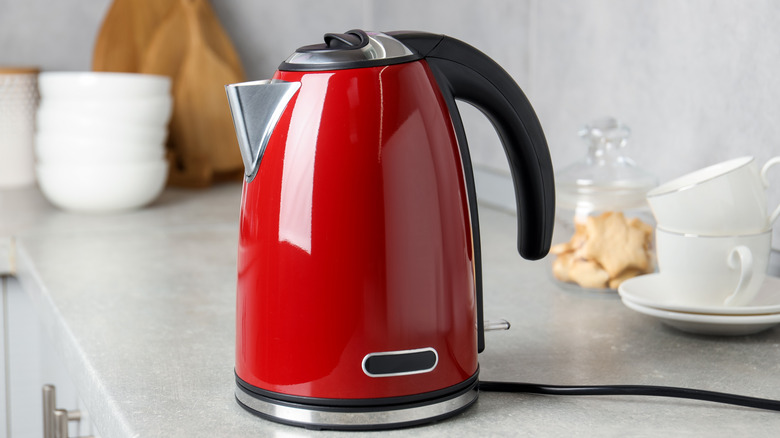
A gooseneck electric kettle can greatly improve your morning tea or coffee simply because its elegant spout allows for more exacting pours of hot water, and thus more precise flavors. But your morning will probably be ruined if you plug it into a power strip. Recalling the rule of thumb that no heating device should ever be plugged into a power strip, electric kettles clearly fit the bill.
To boil water so rapidly, these machines draw a lot of power. Different brands and models have different needs, but most household electric kettles use between 1,200W and 1,500W. Some of the quicker-boiling models can reach 3,000W of electricity. And kettles use all of that power the entire time they're on, in order to bring the water to temperature as fast as possible. No matter which way you cut it, this is far too much stress to put on a power strip. Nobody wants to start their day with an electrical fire in the kitchen.