

Take Store-Bought Steaks To The Next Level And Do This At Home
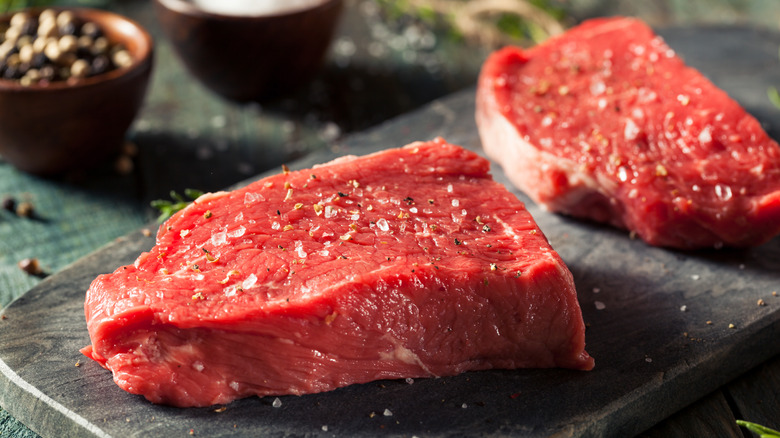
If you've ever wondered how steakhouses or even skilled home cooks can imbue a steak with such complicated flavor beyond its natural beefiness, the answer is essentially that the meat is kind of old. Not in a bad way, though: aging a steak is one of the best ways to improve the overall experience of eating it — all beef needs a minimum of 3 weeks from slaughter to begin tenderizing. But the flavors unlocked by these extra steps are incomparable to skipping either.
While both methods are essentially a form of controlled decomposition, they yield different results. Dry-aged steaks are often the purview of high-end steakhouses, the result of a longer aging technique using cold air exposure that yields a concentrated and funky (in a good way) flavor — to a point.
Wet aging, on the other hand, is so easy to do that most grocery store steaks are wet aged even if they're not advertised as such. This method yields a bloodier, slightly tangy taste with broader appeal. Unlike dry aging, it is very easy to do at home, though it also has its limits.
Dry aged steaks are a luxury steakhouse standard
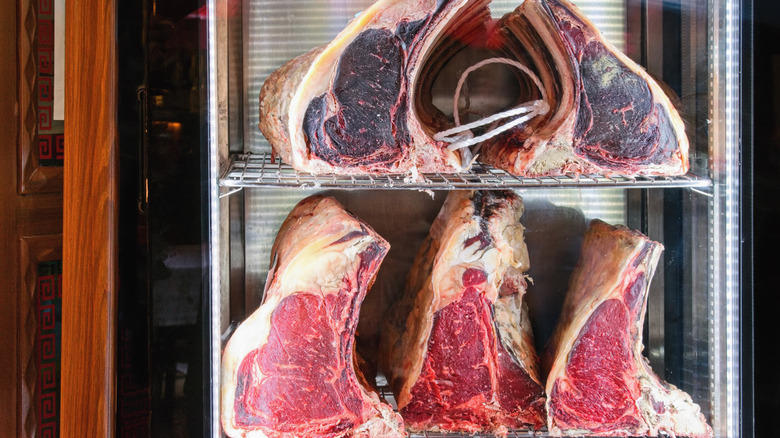
Dry-aging beef involves keeping the meat in a refrigerated, humidity-controlled environment for several weeks. As the cold, dry air dehydrates the steak, it often loses over half of its size, greatly concentrating flavors. The steak also grows a thin layer of food-safe mold, which typically darkens the meat and imparts a distinct nuttiness to each bite.
While dry aging can be done carefully at home, the time and equipment required are the main reasons why grocery store steaks are almost never dry-aged. Some customers might sometimes pay a premium for it, but the average consumer will likely go for something less expensive, making the investment unwise for most retailers — but a premium draw for high-end restaurants.
Not every dry-aged steak is worth it, though. According to Carversteak corporate executive chef Daniel Ontiveros, "Anything that is dry aged over 28 days max is overrated. After 28 days, you don't really taste the flavor of the meat but rather too much funk." So if a menu brags about steaks aged 40 days and up, you're probably better off ordering something else — but that sweet spot around four weeks or less might be one of your most memorable meals.
Wet aged steaks make complex flavors easy
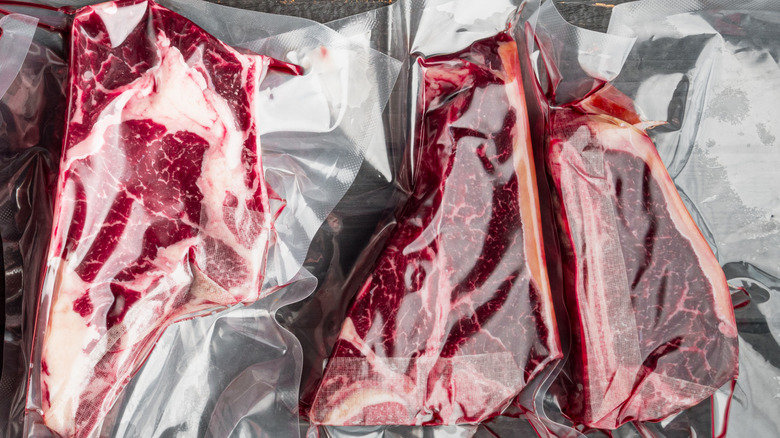
As opposed to dry aging, which is best done by professionals but can be done at home with careful monitoring and a refrigerator free of any smells, wet aging is practically as easy as tossing the meat in a sealed bag. Indeed, what it means to wet-age meat is allowing the steak to marinate in its own juices inside a vacuum-sealed bag.
Most commercially available raw steaks are wet-aged during production, as they are shipped and sold in vacuum bags. To maximize the flavor from this aging process, leave the steaks in their refrigerated vacuum bags for another week or two after purchase. The results are good — and fast — enough that steakhouses also commonly use wet-aged steaks.
Unlike dry aging, where mold is essential, the vacuum seal will protect the meat from any bacterial growth as it tenderizes in its own juices, hence the term. Wet-aged steaks have a significantly milder flavor than dry-aged, with a bloodier tang to each bite. And perhaps obviously, the steaks retain more of their natural moisture, making them easier to cook without drying out too.