

This Failed Steakhouse Chain Walked So Texas Roadhouse Could Run
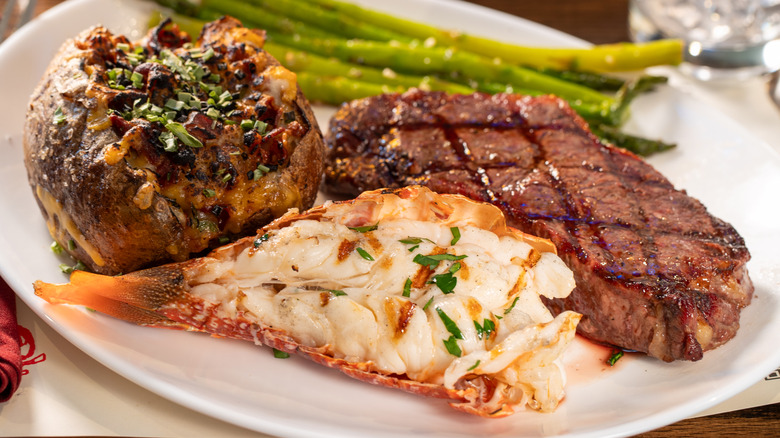
The market for steakhouse restaurants has always been competitive. Texas Roadhouse is currently winning the steak wars against LongHorn and Outback, reporting $5.49 million in U.S. sales for 2024 compared to $3.01 million and $2.72 million, respectively (per Restaurant Business Magazine). These sales are even more impressive considering that it even placed the chain ahead of Olive Garden, which held the top spot in the overall casual-dining market for six years straight. In order for Texas Roadhouse to reach the top, though, others had to become steakhouses that time forgot. Lone Star Steakhouse & Saloon is one of those.
Featuring a Wild West theme, the Lone Star chain began as a prototype that opened in Winston-Salem, North Carolina in 1989 — four years before competitor Texas Roadhouse. The company behind the mesquite-grill prototype was Creative Culinary Concepts, which enlisted the help of Coulter Enterprises, headed by entrepreneur Jamie B. Coulter, in 1991. In just seven months, he opened four Lone Star units, each with 6,000 square feet of space and lots of Texas paraphernalia. They all featured an affordable menu complete with baby back ribs, chicken, fish, and steaks.
Coulter took Lone Star public in March 1992. The initial public offering (IPO) raised $91 million, and the chain grew to 11 locations by the end of that year. With a second IPO raising an additional $41 million in November 1992, another 24 units came down the pipeline throughout 1994. Coulter closely watched costs and operating efficiency while pushing an aggressive expansion plan, and by the end of the '90s, more than 260 Lone Star locations littered the map. Unfortunately, its success was already starting to crumble.
Success turned to bankruptcy at Lone Star Steakhouse & Saloon
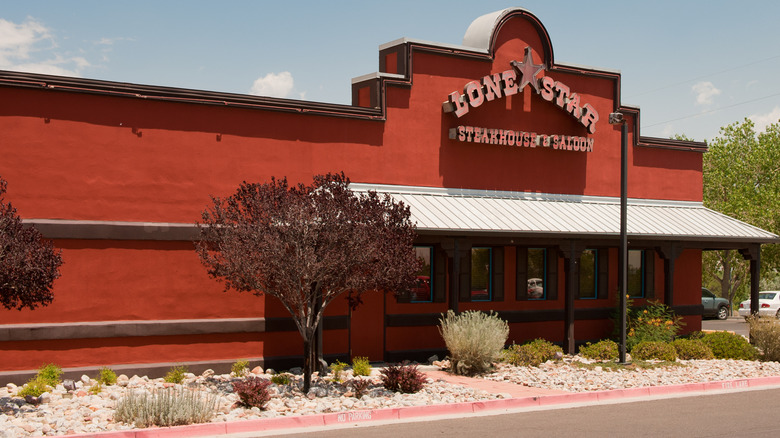
Several factors contributed to Lone Star Steakhouse & Saloon taking a nose dive. Despite the brand seeing increased profits and expanding in the mid 1990s, the U.S. was still recovering from the 1992–93 recession, resulting in a sharp rise in food and labor costs. Still, chairman, chief executive, and president Jamie B. Coulter diversified his restaurant operations, adding two new brands — Sullivan's and Del Frisco's Double Eagle Steak House — to the Lone Star portfolio.
Meanwhile, the steakhouse market was growing as Logan's Roadhouse, LongHorn Steakhouse, Outback Steakhouse, and other small concepts joined in. Any faltering operations at Lone Star restaurants simply sent unhappy customers running to competing brands. The restaurant tried to cope with that (and its plummeting stock price) by making its heavy Texas theme more sophisticated, but to no avail. In 2006, following a minority shareholder's failed scheme to oust Coulter from the company, Lone Star agreed to sell to Dallas-based private equity business Lone Star Funds.
Lone Star restaurant shutdowns rapidly increased during the 2008–09 Great Recession. There were 152 left by February 2009, and by September 2010, only 112 locations were open. Still struggling, the company was sold to Day Star Restaurant Group in December 2013, when only 78 restaurants remained. By the time it filed for bankruptcy in early 2017, only about 16 stores were left. That tally shrunk even further before the pandemic hit in January 2020, making Lone Star one of the '90s restaurant chains that totally vanished from the States, though it remains barely visible with one location still open in Guam.