
10 Classic Dining Etiquette Rules That Everyone Breaks Now
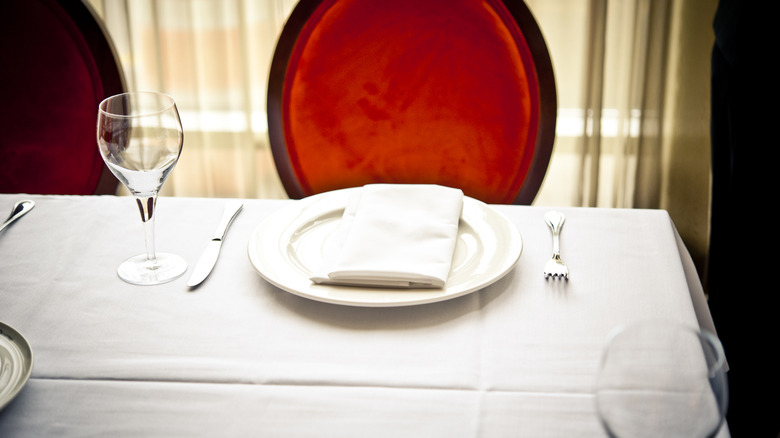
Ever heard of table manners? Of course you have — but the manners you've heard of may have changed over the years. The concept of table etiquette stretches back over several centuries, first evolving into a formalized system during the 17th and 18th centuries across Europe and the U.K., and gradually making its way across the Western world. Culture started to move away from the comparatively loose table manners that diners had before, and towards a more refined, formal way of behaving when sitting around a table. A lot of those quirks and habits were passed down from generation to generation, with parents teaching children how to hold knives and forks, where to place their napkins, and even how to eat bread.
That being said, we're well into the 21st century at this point, and things are feeling a lot more loose. Sure, a few of the rules have stood the test of time, and some restaurant etiquette is worth knowing, but many others now just seem a little bit staid and stuffy. As a result, table manners have lost their way a little, and there are a host of rules and quirks that most of us now don't pay any attention to, even if we're aware of them.
1. Passing dishes to the right

You probably don't put much thought into it these days, but the act of passing side dishes around a dinner table used to be quite the topic of conversation. According to traditional dining etiquette rules, it's correct and proper to only pass food to the right, instead of it zigzagging around the table or going in the opposite direction. The thought behind this rule is that it creates a sense of logic and order to the way that dishes move from person to person. If you start going in the opposite direction, then platters and bowls will start clattering into each other. Furthermore, because the majority of people are right-handed, a rightward direction is considered more accommodating than a leftward one.
Now, this all makes sense, but when was the last time you actually thought about which way you're passing plates? Nowadays, most people have a looser approach to how they give others food, and simply make a beeline for the person who's asked for it. Even The Emily Post Institute, one of the most prominent etiquette organizations around, says that it's fine to pass to the left on occasion. We think you don't need to be strict with this one, folks.
2. Placing your napkin on the chair when you leave the table
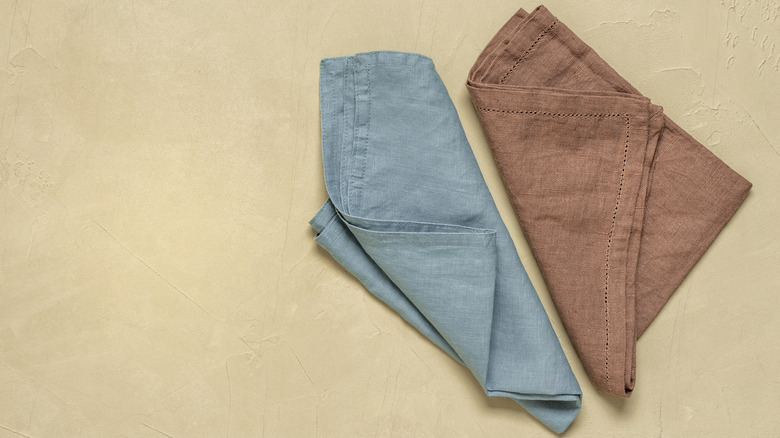
It seems that we've lost the art of how to handle our napkins without even realizing it. You may not even be aware, but there's a rather formalized system of how you should treat your napkin when dining, according to old-school etiquette rules. Napkins should go on your lap when you sit down, and if you need to excuse yourself from the table temporarily, you should place your napkin on your chair, and not on the table in front of you. Instead, your napkin should only go back on the table when you've finished your meal, to the left of your plate.
Now, we don't know about you, but we just kinda put it wherever it lands, y'all. Unless your napkin is visibly stained and dirty, most people will find putting it on the table when you go to the bathroom acceptable by today's standards. Indeed, some people may not take it off the table at all, given that the practice of putting it on your lap (and then waiting for your server to lay it out flat for you) has also gone out of fashion somewhat. A lot of folks don't reach for their napkin at all these days, unless they need to wipe their mouth or hands — and a lot of restaurants simply make do with paper napkins, instead of cloth ones.
3. Laying a full table setting
If you've ever watched more than 10 minutes of "Downton Abbey," you'll know how much care the staff in the show put into making sure that the house's dining table looks top-notch. That's not just Mr. Carson being stuck in his fussy ways: The art of laying a table used to be highly established, with full table settings the standard at formal dinners and in restaurants. It was (and in some settings, still is) considered proper to place the dining plate in the middle, with the bread plate to its upper left and the various glasses needed to its upper right. Knives and forks are placed on either side of the plate and in the order in which you'll use them, according to your courses: So, the knives and forks for your appetizers are on the outside, followed by the cutlery for your main course.
Your napkin, meanwhile, is to the left of everything, while your dessert cutlery is above the plate. Sounds like a lot, right? That's because ... it is. Formal table settings may still be used at events like banquets and weddings, but even most restaurants these days will keep things way more casual. You might even find that your cutlery and napkins are in a pot on the table, which, to be honest, makes things slightly more easygoing. Plus, at home, you're likely not going all-out with your table settings.
4. Holding knives, forks, and spoons the right way
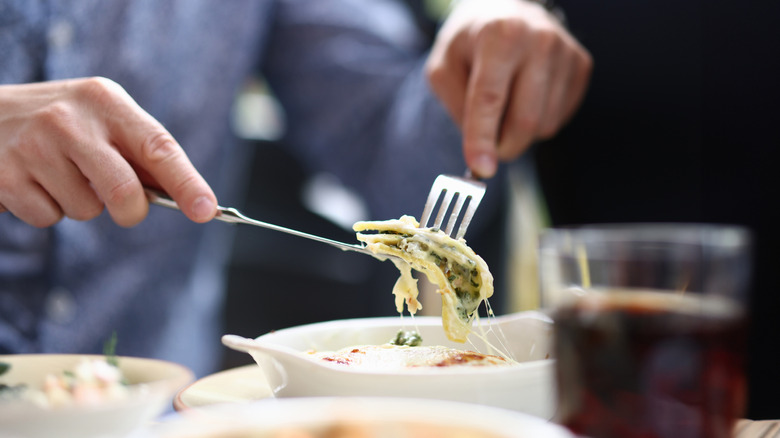
The way in which one is meant to hold cutlery has been much-discussed over the years, and etiquette experts have long been at pains to tell us that we're doing it wrong. To start with, it's considered proper to hold your fork in the left hand and your knife in the right. You should then position the handle of your knife and fork so that it's running alongside your index finger, with the fork tines facing downward, instead of upward like a spoon. Your dessert spoon should also always go in your right hand, held in the same way but with it facing the opposite direction (i.e., up). If you're eating soup, though, you should hold your spoon in your dominant hand.
Do you have time for all of that? Honestly, neither do we — nor do the vast majority of people. These days, everyone's a lot looser than they used to be about how they hold their cutlery, and generally go for what's best for them. Importantly, too, these etiquette rules apply to Western cultures only, and other cultures around the world can have totally different systems. In Thailand, for example, it's traditional to use a fork and a spoon when eating (as opposed to chopsticks, which can be a Thai restaurant red flag), both facing up, with the spoon in the dominant hand.
5. Tearing off (and buttering) bite-sized bread pieces
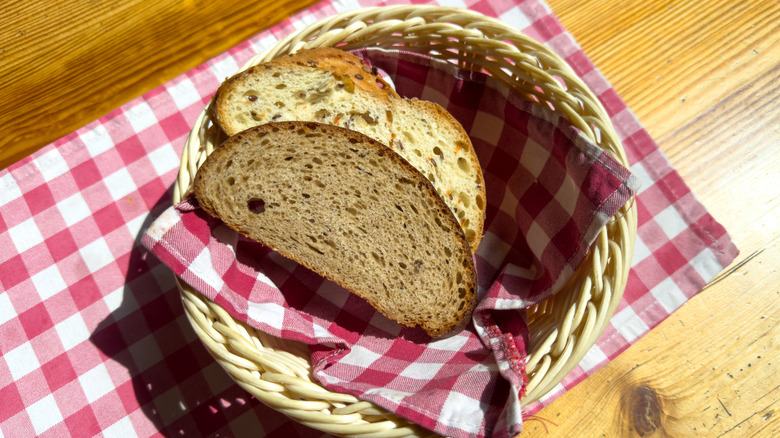
The bread basket that comes with your food is often the best part of the meal, in our opinion. There are even restaurants that put the bread and butter center stage. There's nothing like buttering up a slice and biting into it to sate your appetite. But wait! Turns out, doing that may be a major faux pas, at least by classic dining etiquette standards. It's actually considered proper to only butter your bread a bite at a time. You take your piece of bread and put it on your bread plate, followed by a pat of butter, which is placed to the side. Then, you tear off a bite-sized piece, butter it, and then pop it in your mouth.
@williamhansonetiquette Definitely don't bite into the entire piece of bread! #dining #etiquette #williamhanson
The thought behind this is that it prevents you from getting butter all over your mouth as you munch into your bread, but isn't that all part of the fun? Etiquette rules also advise that you should never eat bread between courses, and instead should wait for your food to arrive before doing so. We're not sure if that works for us, and honestly, it probably doesn't sound that appealing to most people. We're not surprised that this one has died out.
6. Leaving a gap between eating and drinking

The drink that accompanies a meal can provide both enjoyment and hydration, but it can also be used to help wash down dry or awkward pieces of food. Apparently, though, it shouldn't. According to old-school restaurant etiquette, you should never use your water to wash food down or take big old gulps while doing so. Food and drink should be treated almost separately at the dinner table, and you should finish your mouthful before taking a sip. Sip is the keyword here, too: Big swallows are considered rude.
We guess we understand why this might be a problem for some particularly sensitive diners, but if you ask us, this one exists on a scale. Sure, downing an entire glass of water and spilling it all over the table while eating isn't great manners, but taking a big sip if you're struggling with a mouthful of food? We think that's fine. Plus, when it comes to wine, its flavor can help to augment certain foods, and you don't want to treat them so separately that you don't enjoy that effect.
7. Passing and sprinkling your salt correctly

Passing the salt seems like a simple thing to do, but according to etiquette experts, there's a right and a wrong way to do it. First off, traditional rules dictate that you should never pass salt without pepper. The two are intended to come as a pair, and so if someone asks you to pass the salt, you should ask them if they'd like the other one, too. You should also never place the salt and pepper shakers directly into someone's hands, but instead, leave them on the table in front of them. Oh, and if you're the one asking, you shouldn't be putting your salt and pepper on your food without tasting it first.
If you're using a salt cellar instead of a shaker, there are other rules you should follow. You should never take a pinch of salt if you're sharing the cellar: Instead, you should use the salt spoon, and if you don't have a salt spoon, you can use the tip of your knife. Excess salt, meanwhile, should go on your bread plate. It's a lot to remember, isn't it? No wonder most of us just go with what we feel like these days, provided that we're not being impolite — honestly, it may be good etiquette, but it also feels a little fussy.
8. Resting your utensils properly
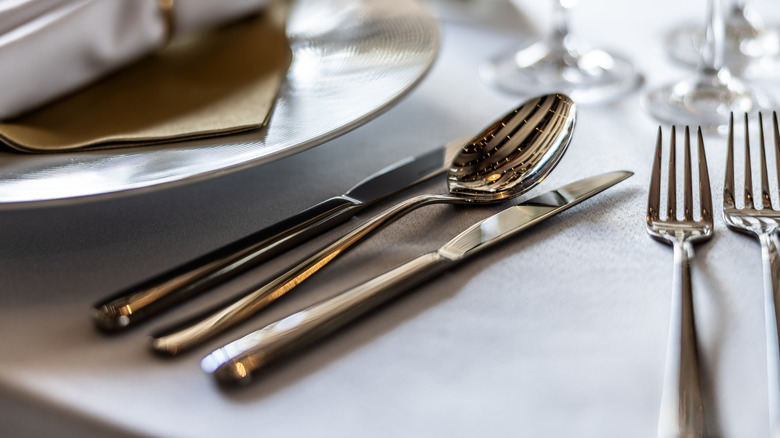
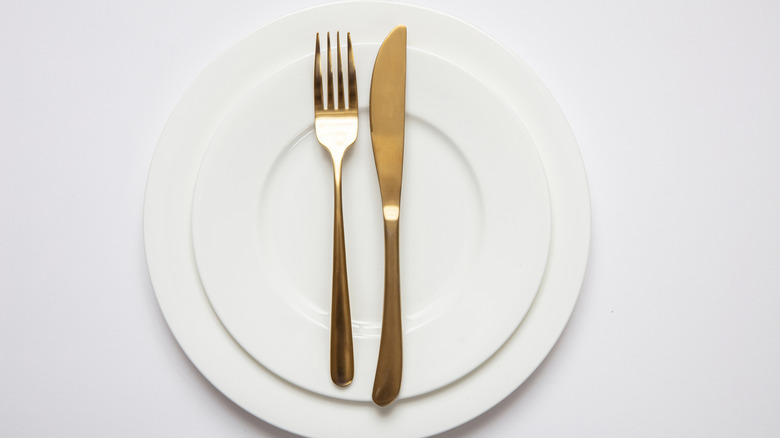
There's a lot to know about cutlery, but who'd have thought that where you place it could have so many rules attached? If you're thinking in classic dining etiquette terms, though, that's definitely the case — and these are terms that the vast majority of us don't consider today. Where you place cutlery on your plate as you eat serves as a language, and a way to communicate between you and the servers. According to etiquette, if you place your knife and fork in a cross on your plate, it means that you're ready for the next course; If you place them at a right angle to each other without touching, you're just taking a break. If you're using a spoon, you indicate this by placing it in the three o'clock position.
To flag that you're finished, meanwhile, you should place your knife and fork parallel to each other, facing upward. If you love your meal, you can do the same, but horizontally. It all sounds quite stressful, if you ask us, so it's no surprise that most people just, y'know ... talk to their servers about what's going on with their meal.
9. Holding your wine glass by the stem
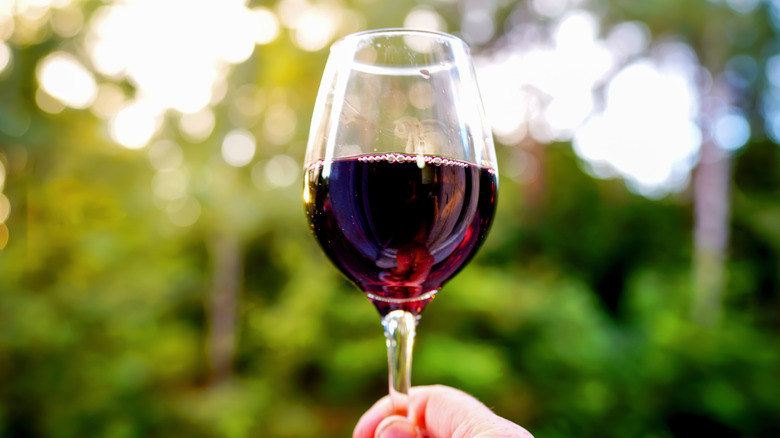
When you drink wine from a glass, we're guessing that you just grab it by the widest, most convenient part — which is the bowl, right? Well, apparently, you shouldn't. The reason why wine glasses have the design they do isn't just because it looks good, but so that you can hold the glass by the stem. This prevents the warmth of your hand from heating up the wine in the glass, which can be a particular issue when it comes to chilled white wine. The warmer the wine gets, the more its flavor will change.
This etiquette rule definitely makes sense on a practical level, which therefore makes it a little more understandable to us. However, it's also one that most people just forget about. Instead, people usually just hold their wine glass however they want to. That's typically by the bowl, which is by far the easiest way to do so. Sure, it may not make your wine taste the best it could, but it's warming up to ambient temperature just by being on the table anyway, so you can't fight it that much.
10. Eating with your elbows on the table

This etiquette rule is perhaps one of the most famous ones out there. Apparently, keeping your elbows off the table while eating emerged as a way for folks to remain civil and polite while eating, and to avoid any sense of threat or violence. Over time, it became a signal that you were refined and proper, and aware of the standards expected of you when dining. Having your elbows on the table became seen as uncouth, and you may well remember your grandparents telling you off for placing them there.
Keeping your elbows off the table definitely has its positives, the main one being that it helps to create space for your other diners. However, these days, we just don't think it's that big of a deal. Sure, if you're slouching over your food with both elbows propped next to it at a fancy dinner party, it might seem a little rude, but if your elbows are lightly touching the table to help you get to your plate, it's probably fine.