

11 Best Grocery Store Scenes In Movie History
In some form or fashion, humans have been making shopping trips for their food for centuries. Whether taking a horse and cart to the fish market or buying canned goods under fluorescent lights, grocery shopping has been a necessary mundane activity for quite some time. Grocery stores and supermarkets rose to prominence in the 20th century at the same time that movies were becoming the main form of entertainment so it makes sense that these community meeting places have often been used as a setting for everything from slapstick comedy to heartfelt conversation.
Films can ground us in reality by balancing cinematic moments in ordinary, everyday places like the grocery store, a place that is often the setting of our own lives. On average, Americans spend about 63 hours per year in the grocery store, according to Capital One Shopping Research. Considering the average lifespan is a little over 78 years, you can figure most of us are spending over 6 months of our lives in the aisles of a grocery store, shopping for the weekly items that will nourish us. If it's true that art imitates life, then no wonder that some of the best movies ever made include a scene that takes place in a grocery store.
Double Indemnity (1944)
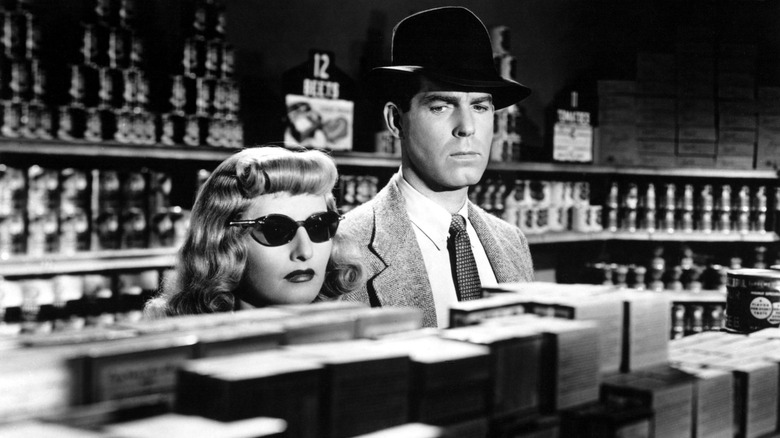
In this noir classic, Phyllis, played by Barbara Stanwyck, plots to kill her husband with an insurance agent, Walter, played by Fred MacMurray, who has fallen in love with her. Their plan involves tricking her husband into signing up for an accident insurance plan that will pay "double indemnity" if the policy holder dies in a train incident, a clause they intend to exploit with their plot. Naturally Phyllis and Walter have to be super careful not to be seen with one another. Insert the supermarket where the aisles of the grocery store become their secret meeting place to plan their scheme.
A grocery store isn't exactly the most discreet meeting place and more than once their secret conversation is interrupted by shoppers simply trying to get the items they need. Within the context of the dark, murderous plot, the juxtaposition of the main characters talking in low, suspicious whispers while an ordinary shopper stomps away and complains "I don't know why they always put what I want on the top shelf" provides a hint of comic relief in an otherwise solemn tale (41:14). The backdrop of these scenes give contemporary viewers a nostalgic glimpse of foods that were popular during World War II. Due to wartime rations at the time, police were hired to keep guard of the canned goods on set.
Big Lebowski (1998)
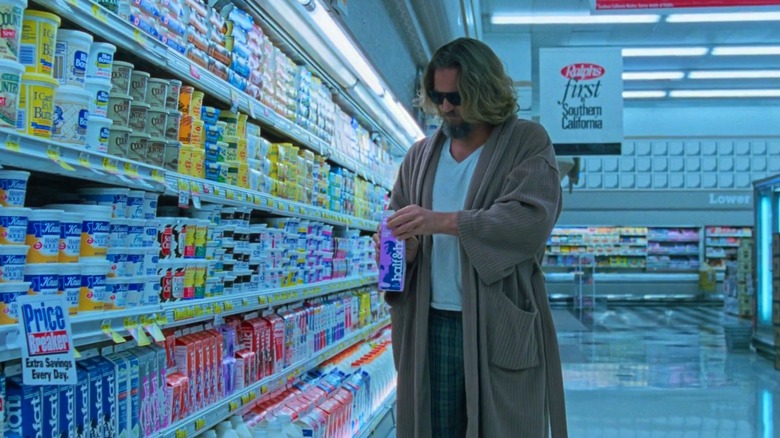
Probably one of the most memorable grocery store scenes in the history of cinema is the first time we see Jeff "The Dude" Lebowski portrayed by Jeff Bridges in the 1998 film "The Big Lebowski." The offbeat crime comedy about mistaken identity (and a damaged rug) centers around a self-proclaimed-deadbeat character. The story takes place in Los Angeles so it's fitting that this grocery store scene takes place in the original location of Ralph's, a favorite supermarket chain of Southern Californians like The Dude.
The first shot of the character depicts him turning the corner of an aisle at the famous grocery store, wearing a bathrobe, sandals, and sunglasses. He heads for the dairy section and takes two cartons of half and half off the shelf, inspects them, puts one back, and then opens the carton and sniffs the contents. At the checkout, he writes a check for the $0.69 half-in-half, with cream on his upper lift (he clearly taste-tested it too), while a small television plays news footage of George H.W. Bush in a press conference. This scene not only brilliantly establishes the character's lackadaisical attitude, but it also establishes the time period as the early 1990s and the location as the less-than-glamorous side of Los Angeles.
White Noise (2022)
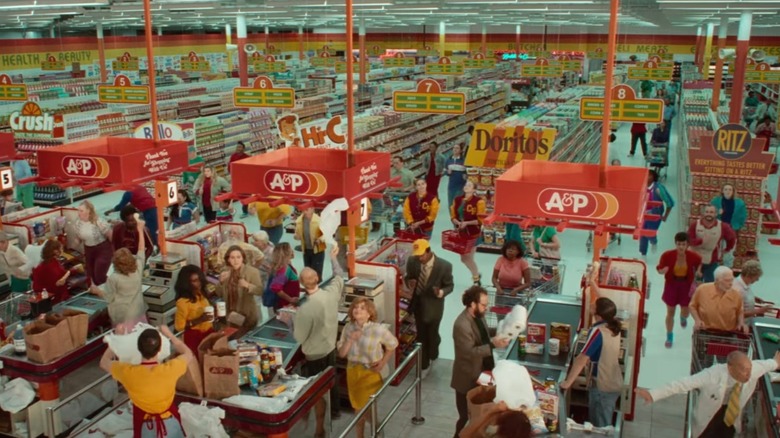
Noah Baumbach's dark comedy "White Noise" based on the 1985 satirical novel of the same name is largely concerned with Americans' fear of mortality and how many of us attempt to quiet that fear with consumerism. The movie ends with a modern dance number in the aisles of a grocery store set to LCD Soundsystem's "New Body Rhumba." David Neumann, known for his work in the Tony-winning broadway show "Hadestown," choreographed the scene. Using the setting of the grocery store in an entrancing way, the characters weave in and out of each other, pushing their shopping carts and pulling items off the shelf to incorporate into their dance of daily life.
The supermarket used for the scene was built from scratch which took about six months and because the film takes place in the 1980s, every shelf had to be stocked with vintage-labeled products. The feat was worth it as the beautifully strange dance number turns out to be the perfect absurd ending for the offbeat film. "I suppose one way of looking at the end of the book — and of the movie — is that we're all just shopping until it's over and we die. So it's a dance of life, which is also a dance of death," director Baumbach told the Los Angeles Times.
Father of the Bride (1991)
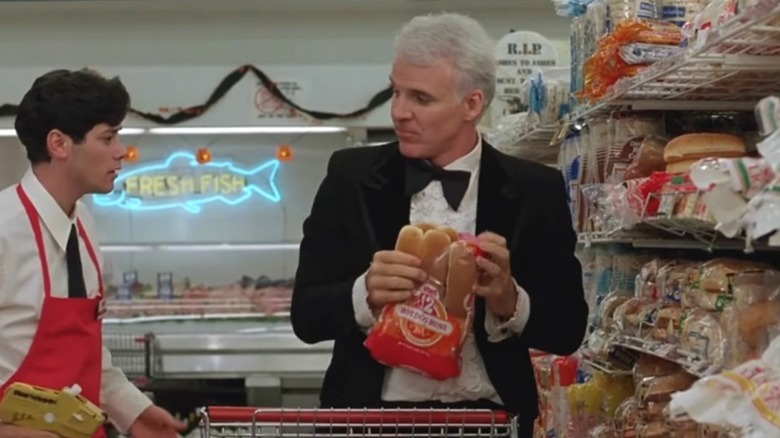
The "superfluous buns" scene in the 1991 comedy "Father of the Bride" is one of the most comedic grocery store scenes in movie history. In the film, wedding planning is starting to get to Steve Martin's character, George Banks. In a torn tuxedo, he escapes the house where his family and the planners have become too much for him to handle, but as he leaves, his wife asks him to pick up dinner. Stressed at the rising costs of his daughter's wedding, George is at his breaking point at the grocery store and decides he doesn't want to pay for 12 hot dog buns when he only needs 8, so he tears open the package and removes 4 of the buns.
A grocery store employee catches him and tells him to stop, leading to a dramatic argument and George's unhinged rant in which he explains, "Some big shot over at the weiner company got together with some big shot over at the bun company and decided to rip off the American public because they think the American public is a bunch of trusting nitwits who'll pay for things they don't need rather than make a stink ... I'm not paying for one more thing I don't need!" The conflict leads to the character's arrest and he is forced to recognize he's hit his lowest point. He then agrees to his wife's request to be more accepting of his daughter's looming marriage.
Home Alone (1990)
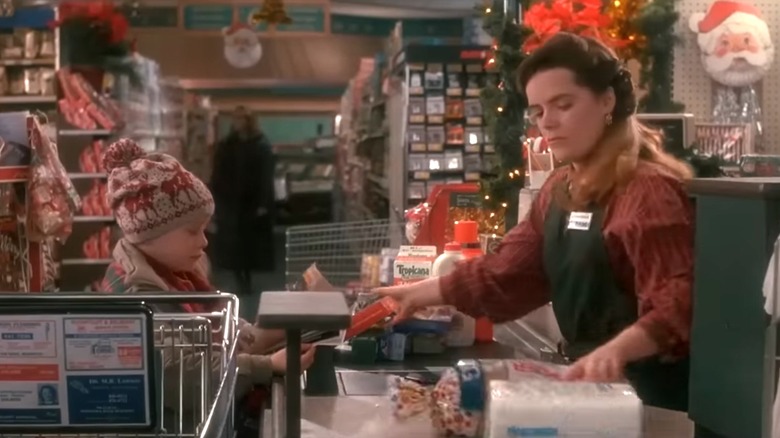
In this holiday classic, Kevin, portrayed by Macaulay Culkin, is left behind by his family and must protect his home from thieves. But first, he has to make a market run. After filling the shopping cart that he's barely tall enough to push, he dodges questions from a concerned grocery store employee while she rings up his paper towels, milk, laundry detergent, bread, orange juice, and mac and cheese.
This scene reveals a lot about Kevin's character. He doesn't want to get caught; he's clearly enjoying playing adult and being independent. Aside from the pack of army men, his choices of items are oddly practical for a kid. Most kids might have gone wild in the grocery store if left to their own devices, but not Kevin: he's studied adults and seems to understand that the autonomy and freedom adults experience is balanced with mundane responsibilities like going to the grocery store and making practical purchases over indulgent ones. One can also imagine that Kevin got a glimpse of how frustrating adult life can be at times when the bags of his groceries broke on his walk back home.
Fantastic Mr. Fox (2009)
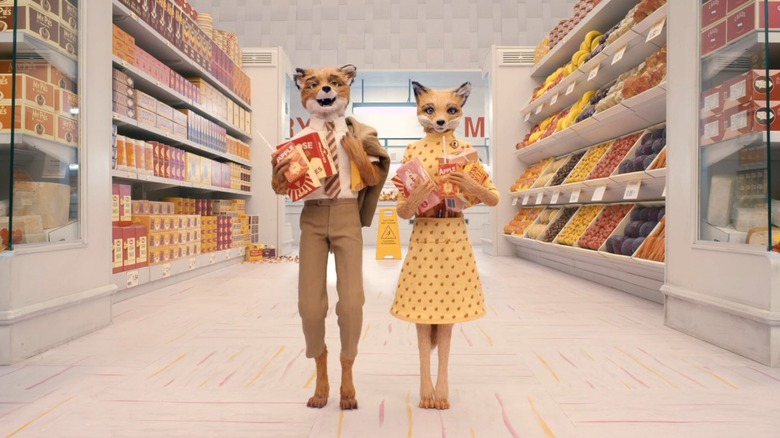
Wes Anderson's 2009 stop-motion animated film based on the Roald Dahl story of the same name centers around a fox, his family, and other animal friends being hunted by 3 farming tycoons named Boggis, Bunce, and Bean. Without spoiling too much of the plot, "Fantastic Mr. Fox" ends with the hungry, exiled creatures finding a tunnel to a grocery store owned by the farmers.
The raiding of the grocery store is their final victory and culminates in a heartfelt, optimistic speech delivered in one of the aisles. In this grocery store scene, the well-dressed Mr. Fox, voiced by George Clooney, stands on a detergent box and holds artificial products in his arms as he assures his friends and family, "We'll eat tonight and we'll eat together and even in this not particularly flattering light, you are, without a doubt, the five and a half most wonderful wild animals I've ever met in my."
When the speech is done, they raise their juice boxes for a toast and dance to Bobby Fuller Four's "Let Her Dance" in the empty supermarket in celebration of their future endless food supply. Funnily enough, the screenplay for Fantastic Mr. Fox was co-written by Noah Baumbach who is responsible for another supermarket dance number finale on this list ("White Noise").
Steel Magnolias (1989)
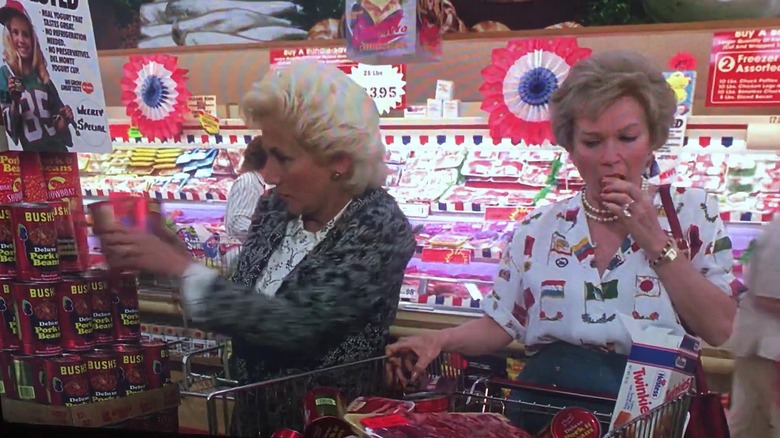
Steel Magnolias is arguably one of the most memorable portrayals of Southern women in cinema. Of course food is a huge aspect of Southern culture so naturally the film features plenty of scenes incorporating cuisine, including Dolly Parton's "cuppa cuppa cuppa" cake and the infamous bleeding armadillo groom's cake. But it's the grocery store that acts as a backdrop for a subtle, yet meaningful, character interaction. While shopping for meat and Twinkies, Shirley Maclaine's grumpy character, Ouiser, has a rare moment of vulnerability and admits to Clairee, played by Olympia Dukakis, that she regrets some things she said during a bad-tempered rant earlier in the film.
In the scene, Ousier seeks reassurance from her best friend. "I'm a terrible person," she says. Clairee gets serious for a moment and argues, "No, you're not," before adding, "You'd give your dog a kidney if he needed one." We only see a glimpse of vulnerability before the characters snap back into wittily teasing one another again. But the brief interaction demonstrates that the friendship between Ouiser and Clairee is a lot deeper than it initially seems. It provides a depth and complexity that had previously not been revealed, subtly showing us that Ouiser is more than a caricature. All that while filling a shopping cart with a ridiculous amount of canned pork and beans.
You've Got Mail (1998)
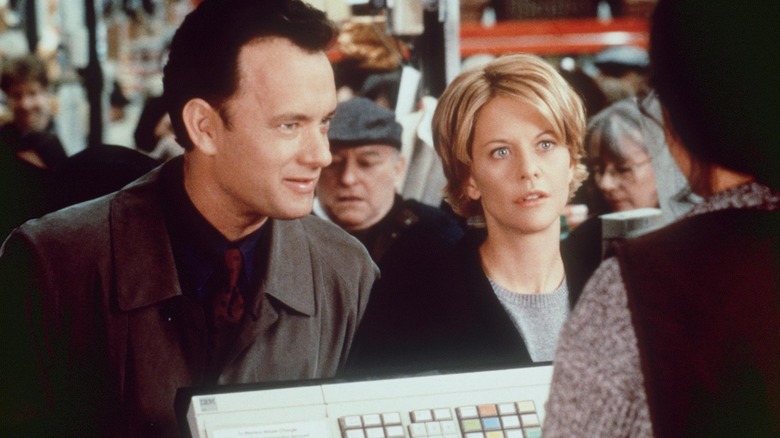
Nora Ephron's classic '90s rom-com "You've Got Mail" is a secret-admirer/enemies-to-lovers plotline partially inspired by the 1940 film "Shop Around the Corner." Kathleen, who owns a small children's bookstore, and Joe, who owns a chain of big box bookstores, are unaware they are each other's email pen pals and Kathleen develops a disdain for Joe's business tactics and pompous personality.
That's precisely why when she sees him in line at the grocery store, she becomes anxious and hopes to go unnoticed. However, she fails to realize she's in the "cash only" checkout line and only has a credit card in her wallet. Because she's holding up the line and other customers are making a fuss, Joe sees her and swoops in to save the day with his apparent charm, somehow convincing the cashier to make an exception for her. His actions only make Kathleen more annoyed with him and the rivalry further deepens after this scene.
Another reason this grocery store scene is so iconic is because it was shot in the iconic Upper West Side market and Jewish deli, Zabar's. According to E! News, it's the only film that's ever been allowed to shoot in the aisles of the famous landmark, making the cinematic glimpse inside a particularly special part of the film's New York City landscape.
Raising Arizona (1987)
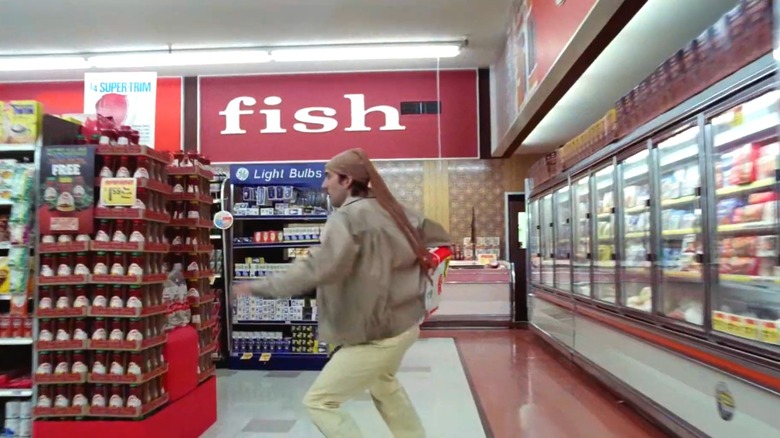
In this 1987 Coen Brothers comedy, a reformed robber, Hi, portrayed by Nicolas Cage, marries Ed, a former police officer portrayed by Holly Hunter. The two want children but are unable to conceive or adopt (the latter due to his criminal record) so Hi kidnaps a baby. What follows is a hilarious Southwestern farce that includes what is arguably the best grocery store shootout in movie history.
When Hi goes into a convenience store to buy diapers, he decides to return to his old ways and attempt to rob the cashier. The cashier, however, calls the police and a cartoonishly funny chase ensues as Hi is being hunted by a police officer, the cashier he tried to rob, and a pack of dogs. Still carrying the pack of diapers through most of the chase, he loses them in the middle of the road. Eventually, the chase culminates in a supermarket where he runs through the aisles to grab more diapers as the police officer and grocery store employee shoot at him, the dogs bark, and housewives in curlers scream. He gets away thanks to his wife who reluctantly rescues him with their stolen baby by her side.
Yours, Mine, and Ours (1968)
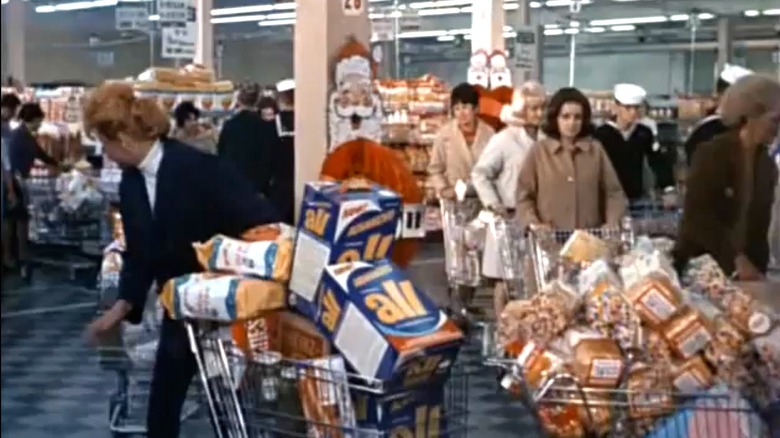
The 1968 comedy "Yours, Mine, and Ours" stars Lucille Ball and Henry Fonda as Helen and Frank Beardsley, a widow and a widower who each have huge families from their previous marriages. The two fall in love and get married, creating a chaotic family of 18. The grocery store scene in this movie is a visual display of the challenges the two characters are facing in their new personal life, particularly with money troubles. Though groceries were cheaper in 1968 than they are now due to inflation and consistently rising food prices, a market run for a comically large family meant running up a comically large bill.
The couple's carts are so full that the cashier has to call for backup to help ring out their large amount of groceries. In the midst of the chaos of the checkout line, Helen and Frank are having a conversation about budgeting in order to save enough money to adopt each other's children. Frank agrees to Helen's suggestion of cutting back on unnecessary purchases and reluctantly removes his Busch beer out of the cart and asks an employee to put it back. Sans the beer, their total comes to $126.63 which would be $1,213.97 today according to a food price inflation calculator.
Punch Drunk Love (2002)
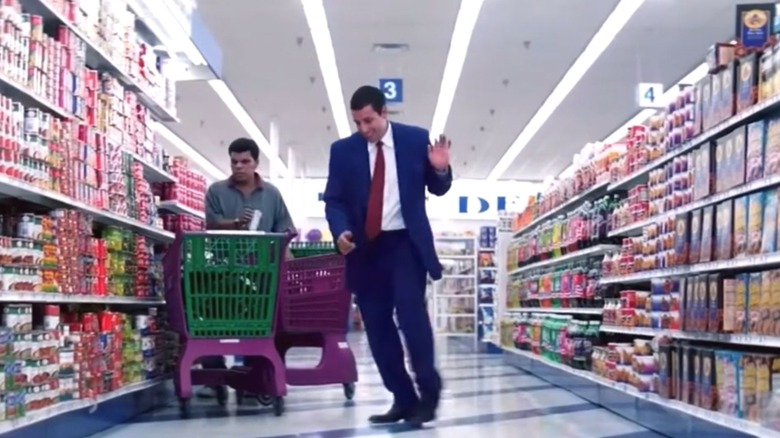
While the main plot of Paul Thomas Anderson's "Punch Drunk Love" has little to do with groceries, one of the subplots of the movie that helps establish Adam Sandler's character, Barry Egan, includes a supermarket pudding scheme that was based on a true story.
In this grocery store scene, we see Barry and his friend, Lance, played by Luis Guzmán, filling shopping carts full of pudding in an effort to take advantage of a loophole that will get him large amounts of frequent flyer miles. Barry paces back and forth in the aisle as his friend fills the cart before breaking into an unexpected joyful tap dance. Fans on Reddit theorize that this scene emphasizes the character's deep longing to escape his current life and could represent the hope he holds onto for his future.
The strange subplot was inspired by a real man, David Phillips, who bought $3000 worth of pudding cups to earn 1.2 million airline miles in 1999. He became known as "The Pudding Guy" and the story was picked up by most major media outlets at the time. So, while the grocery store scene in "Punch Drunk Love" may serve a specific character development purpose, it also connects the film to the pop culture of the era and ties the film to reality.