
9 Comfort Foods You Ate If You Grew Up On The West Coast
Everyone, no matter where they are in the world, has their own form of comfort food. Foods that go by this term, which are often fairly rich, hearty, and made largely from carbohydrates and fats, provide solace in times of stress while also evoking a feeling of nostalgia. Things are no different on the West Coast. The comfort dishes that folks in Washington, Oregon, and California turn to are warming, soothing affairs, and combine the typically available ingredients of the regions with an attentiveness to food's ability to deliver therapy and relief, and to make us feel like we're kids again.
Having said this, what comfort food can look like on the West Coast varies considerably, depending on where you are. In Washington and Oregon, comfort foods can be defined by the styles and produce of the Pacific Northwest, with more of a focus on locally-grown ingredients like marionberries or fish like salmon, which thrive in cooler waters. Further down South, in California, comfort foods like carne asada fries or California burritos speak to the rich influence of Mexican cuisine and cooking styles on the region. No matter where you're eating them, though, these foods guarantee to make you feel restored.
Seattle dogs

In Seattle, hot dogs are done a little differently. The city's twist on one of America's favorite foods stands out as a regional specialty thanks to cream cheese, the key ingredient that makes Seattle dogs feel distinct from those elsewhere. Seattle dogs first started to appear in the late 1990s, and the story goes that they were born in Pioneer Square, the city's original downtown area and a hub for good food and good times. The variation was apparently created when a bagel vendor, purported to be Hadley Longe, noticed that people's tastes were drifting towards hot dogs, and so he combined the two styles, placing sausages inside bialy sticks smeared with cream cheese.
Seattle dogs have all of the elements that you'd want from comfort food. The hot dog provides fattiness and saltiness, the cream cheese delivers pillowy comfort, and the bread covers your carbs. The cream cheese in the hot dog also gives it an ever-so-gentle pop of sourness, but it's smooth enough to temper the saltiness of the hot dogs. Caramelized sweet onions are also a must, giving the dogs a natural sweetness.
Carne asada fries
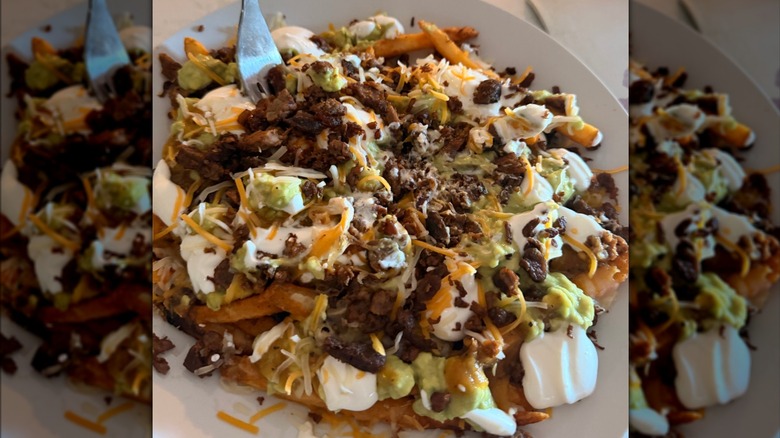
Few foods hit like carne asada fries. This San Diego classic is a relatively recent entry to the comfort food pantheon, but it's so effective at providing warmth to your soul that you'd think that it had been around forever. Carne asada fries were invented in the city towards the turn of the 21st century, with local restaurant Lolita's Mexican Food often claimed as being one of the earliest eateries to try them out, and potentially the first in the whole of San Diego to make them. Up until that point, fries were relatively unheard of in Mexican restaurants in the city, but once folks figured out how well carne asada and the various toppings worked with them, there was no going back.
Carne asada fries have everything you need in a comfort food dish. The fries offer a salty, carby bed for all of the other ingredients, while the carne asada delivers moisture, umami, and spice. Sour cream and guacamole give smoothness and creaminess, while the cheddar and cotija cheese sprinkled on top add a further pop of salt and fat. Sure, it's rich, but isn't that what comfort food's all about?
Marionberry pie
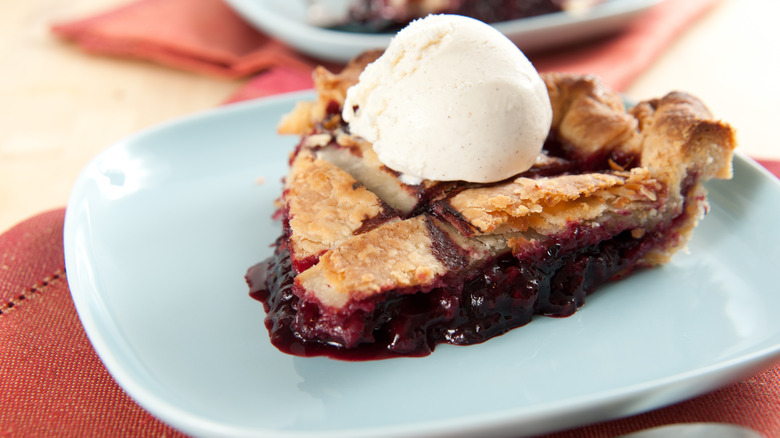
If you've never heard of marionberry pie, now's the time to get familiar with one of Oregon's most distinctive dishes. The marionberry is one of the Northwest's native berries, and is a blackberry variety with a slightly conical shape. Like regular blackberries, they have a tart note, but they're also juicier and have slightly more sweetness than their wild-grown sibling, and have less of a bitter edge.
All of these flavor notes make them ideal for throwing into a dish that, in 2017, became Oregon's official (and most iconic) state pie. To make marionberry pie, the berries are combined with sugar, a touch of salt, and some cornstarch, and then thrown into a simple pastry crust. The pie lid can be latticed for a rustic effect or scored on top with your favorite pattern. Then, it's baking time. As the pie bakes, the marionberries break down, creating a slightly jammy consistency that still has a nice bite to it. Serve the pie with some whipped cream or a scoop of vanilla ice cream, and enjoy the warming sensation it provides.
Smoked salmon chowder
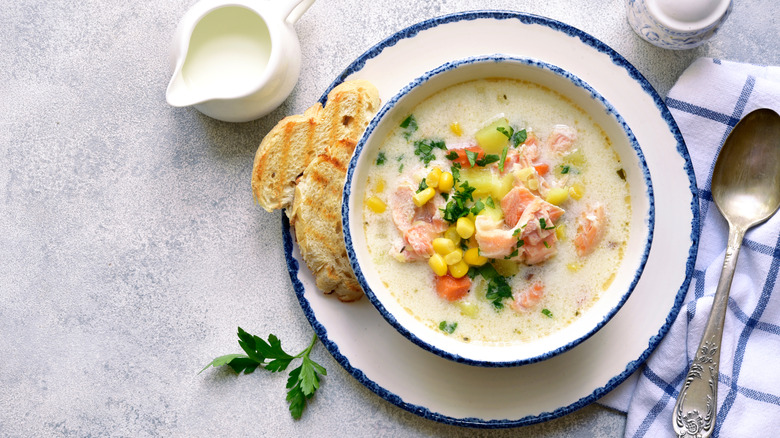
When you think of seafood chowder, where do you think it comes from? Probably from New England, right? Well, we're here to tell that region, and its clam chowder, isn't the only place that can produce a warming seafood stew. In the Pacific Northwest, smoked salmon chowder is the dominant form of this dish, and one which can deliver comfort on even the chilliest and darkest of days. As New England chowder uses the produce of the North Atlantic, Pacific Northwestern smoked salmon chowder is filled with fish that are abundant in the region.
Smoked salmon chowder is as salty and sprightly as you might expect it to be, with the salmon providing woody, sharp, and savory notes. Bacon is typically added, giving the broth even more intensity and creating more umami throughout. It's made even heartier with cubed potatoes and heavy cream, while corn can sometimes be thrown in to give it a slightly sweeter note. Oh, and don't forget to grab a hunk of bread to dip into the chowder, which provides even more comfort and bolstering sustenance.
Tri-tip sandwich
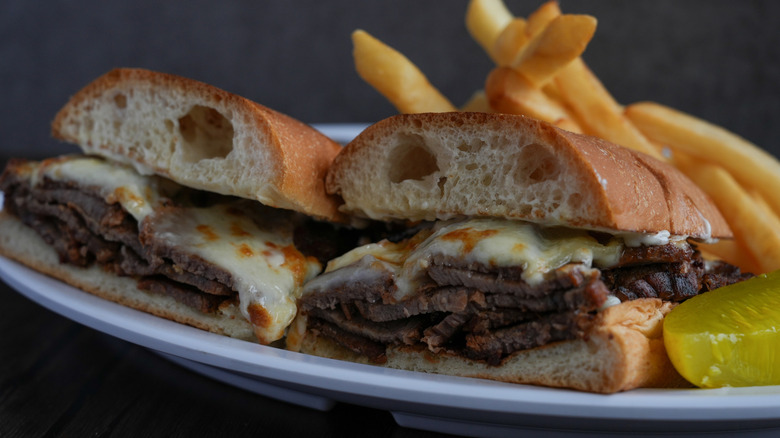
There are comforting sandwiches, and then there are tri-tip sandwiches. This sandwich was born in Santa Maria and is a direct result of the popularity of tri-tip in the city, a local favorite that began gaining traction as a desirable cut in the 1950s, and then went on to become beloved more widely. Cramming tri-tip into a sandwich became commonplace as a way to enjoy the meat, and also to turn it into a full meal, and pretty soon it became a style of its very own.
A Santa Maria tri-tip sandwich goes heavy on the meat, as you might expect. Slices of tri-tip that have been slow-cooked over hot, smoky coals are piled into a roll, which can be infused with garlic for extra flavor. On its own, the sandwich is meaty, carby, and deeply satisfying, but the sides it can come with make it even more so. Tri-tip sandwiches are frequently served with pinquito beans, a local specialty that's also an accompaniment more widely in Santa Maria barbecue. Tri-tip sandwiches also often come with salsa, and you can also grab it with a side of mashed potatoes.
Cioppino

Cioppino is a comfort food with a fascinating history. Upon first glance, you'd be forgiven for thinking that this seafood stew was brought to the U.S. after having been developed over thousands of years in Italy. In fact, it's thought to have been born in the late 1800s in San Francisco, created by Italian immigrants who would all contribute with leftover catch of the day to a shared pot. This is a dish designed to be eaten by folks who work hard and require sustenance at the end of a long day, and as a result, it's as hearty and nourishing as you might expect.
Because of the fairly rough-and-ready origins of cioppino, recipes can vary slightly. Shrimp, mussels, and crab all tend to make an appearance, and white fish like cod or halibut are also common. The broth is tomato-based, with a healthy glug of white wine and a bunch of aromatics. It's briny, sharp, and full of umami, and is filling without completely knocking you out for the rest of the day. For maximum comfort, folks like to eat their cioppino with crusty bread, dipping it into the stew and spooning the seafood on top.
Dutch Baby

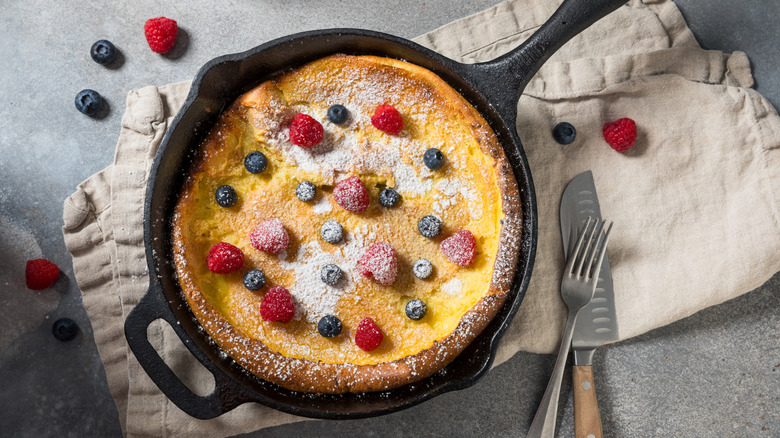
We love a comfort food that has, somehow, an equally comforting name. Such is the case with the Dutch Baby, a spin on a pancake that serves as an amped-up breakfast dish. Although you might think that the Dutch Baby was born in the Netherlands, this food is actually a Pacific Northwestern creation, and is said to be based on German Pfannkuchen. Some people trace Dutch Babies to Manca's Cafe, which is said to have invented them in the early 20th century, and it's said that they originated due to a spelling mistake on the menu, with "Deutsch" written as "Dutch." Its name was born, as was a classic.
The beauty of the Dutch Baby is in its grandness. It starts with a fairly standard pancake batter, but this batter is then poured into a hot skillet, which is then thrown into the oven. The Dutch Baby puffs up, turning into a bowl shape that looks almost like an enormous Yorkshire pudding. Once the Dutch Baby comes out of the oven, all of that soft, pillowy goodness is crowned with toppings, and whether you eat yours sweet or savory is up to you. Whatever you go for, you'll feel a warm glow for the rest of the day.
Sourdough bread bowls
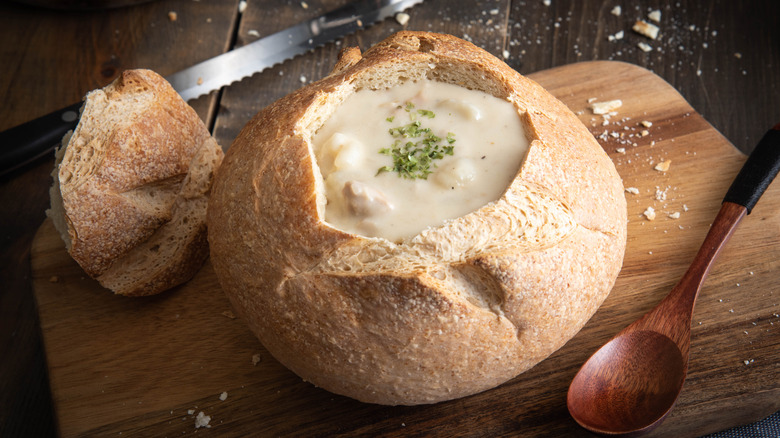
Think sourdough bread bowls are a gimmick? Tell that to folks in San Francisco. The sourdough bread bowl is a classic comfort food for people who grew up in the Bay Area, and is an evolution of the city's longstanding sourdough history and tradition, with the bread style first gaining prominence during the Gold Rush era and retaining a foothold ever since. Sourdough bread bowls were allegedly first created by Boudin, a sourdough bakery that was first established in 1849. Boudin sells its famous bread bowls to this day, ladling in hot spoonfuls of tomato, broccoli cheddar, and clam chowder soup, which are subsequently ladled out into people's mouths.
The beauty of a sourdough bread bowl is, of course, in its simplicity. Chefs take a fully-cooked loaf of sourdough bread and scoop out the middle, and you have a delicious vessel that can be eaten as you work your way through the soup. It's tangy, it's flavorful, and it'll provide all the carbs you need. As for the soup inside, San Francisco clam chowder is a common choice, with the briny notes contrasting wonderfully with the slight sourness of the bread. Ripping off hunks of the sourdough and dipping them in the chowder is, of course, a must.
California burrito

Burritos provide comfort to folks pretty much anywhere that they're eaten, but in San Diego, the California burrito reigns supreme. This spin on a burrito is anything but traditional: Invented in the city, but with somewhat murky origins, the California burrito is distinguished by the fries that are thrown into every wrap. Alongside the fries sit more traditional ingredients like carne asada, pico de gallo, guacamole, and sour cream, making this dish a Mexican-American fusion that definitely fills you up.
It must be said, of course, that the California burrito isn't the most elegant of foods – and people are well aware of its heavy, potentially unhealthy nature, with the fries making this thing into a hulking beast of a dish. However, that's not the point. Few things are more comforting than a combination of fries and meat flavored with condiments and wrapped in a soft tortilla. It's an all-in-one meal that's engineered to make you feel good, before you need to sleep it off afterwards.