

11 Things From '80s Kitchens You Rarely See Anymore

If you lived in the 1980s, you know there was much more to the decade than the stereotypical teased hair and neon leg warmers. While certainly hair metal, synth pop, shoulder pads, and teen movies contributed to the pop culture of the era and inspired the generations that followed, food culture of the decade also left us with a few classics we still eat today. But what was it actually like to stand over the stove and cook up a meal in an average 1980s home?
In the kitchen, earth tone-leftovers from the 1970s lingered heavily and granny chic and kitsch reigned supreme. Yet, the decade also saw its fair share of innovation. It was a time when kitchen gadgets were prevalent, so much so that many of the gadgets that were common during this time have fallen out of favor and the simpler, older tools have become the norm over their once-innovative electronic counterparts. Perhaps we can unlock a few memories by revisiting appliances, decorations, and kitchen tools you probably forgot about from the time period.
Woodgrained appliances
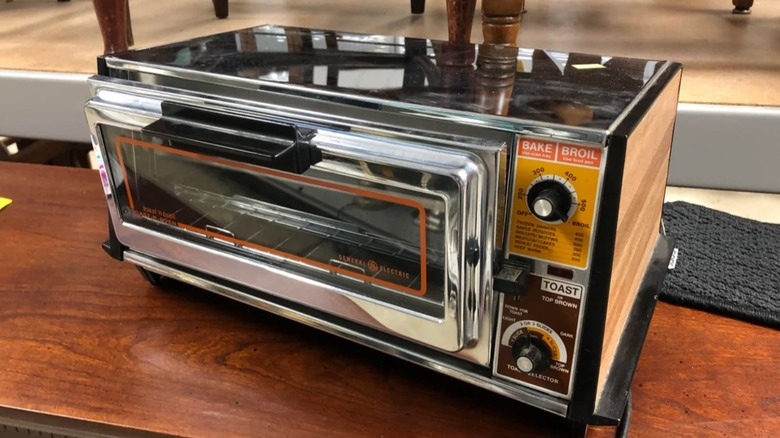
While it's often predominantly associated with mid-century design and the 1970s, wood-paneling was still a super popular design choice in the 1980s. It's now considered a rather dated look and is hardly seen in homes anymore despite the look being steeped in nostalgia and homeyness. Woodgrain provides a warmth and earthiness to a house that is difficult to achieve otherwise. But the trend arguably got out of hand when it extended into kitchen appliances.
It may be hard to imagine having ovens, microwaves, broilers, and refrigerators that mimicked the look of wood but flip through kitchen catalogues from the 1980s and you'll see plenty of examples. A countertop broiler from the 1986 Sears Wishbook is noted as having a "woodgrained-look metal body" and during this time, Kenmore offered vinyl inserts for its refrigerators with the options of a faux oak or hickory finish (per Sears). Nowadays, stainless steel is the standard choice for new appliances but there will always be a special place in our 20th century hearts for the woodgrain surroundings of decades past.
Accessories for Fresh Baked Bread
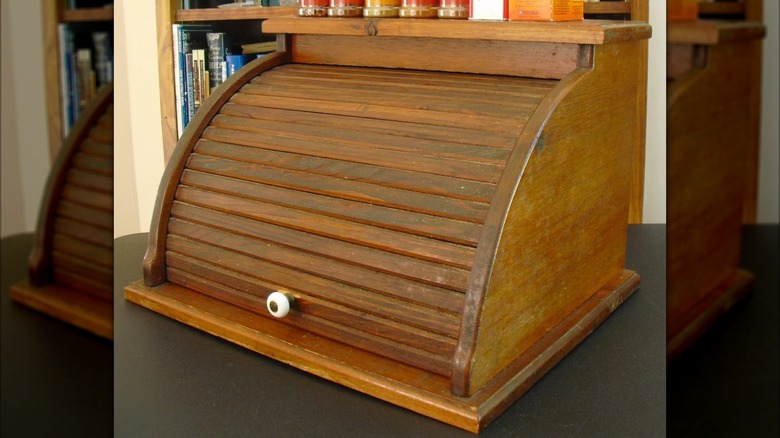
The 1980s saw a resurgence of at-home breadmaking after artisanal bread became a popular bread trend of the decade, largely as a counterculture reaction to the mid-century overindustrialization of the baked good. This renewed interest in traditional breadmaking led to the popularization of accessories and kitchen tools to aid in the at-home baking process. During this era, it was common for kitchen countertops to include bread boxes for storage and bread slicing boxes for cutting professional-level perfectly even slices.
Updated technology at the time also meant using new tools like the Hitachi bread machine. As shown in the 1989 Sears Christmas Wish Book, all you had to do was add in the ingredients into the device and the machine would mix, knead, rise, and bake a loaf of bread in 5 hours. Bread machines are still in existence today but like many of the out-of-fashion appliances on this list, the space they take up on the countertop isn't necessarily worth it for most modern home cooks. Especially when contemporary ovens are so advanced nowadays.
Some of these items may seem antiquated now, but many of these tools could still be useful to bakers and can be found in specialty culinary stores. For instance, bread boxes really are effective at keeping your loaves fresh and remain a valuable vintage kitchen item.
Potpourri Crocks
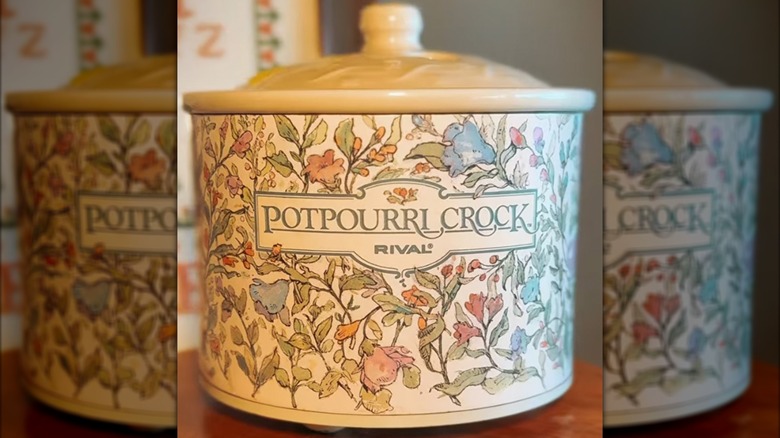
Before 1980, potpourri was not a word you would hear spoken very often in America, if ever. But those little bowls of sometimes-indistinguishable objects that smelled indescribably perfumey became all the rage in the 1980s. What originated as a simple mixture of dried flowers and fruits developed to include dyed woodchips and artificial scents. According to The New York Times, the craze of scenting the home in various ways became so intense that companies were consistently creating new ways to sell the concept to consumers. In 1986, this culminated in simmering potpourris for stovetop disbursement of scent.
With such rising popularity, it isn't surprising that companies like Rival (the company responsible for Crockpots) cashed in on the fad and created "potpourri crocks" for simmering potpourris, marketed to keep kitchens scented and smelling fragrant at all times. They were small, decorative ceramic plug-in devices that kept the potpourri simmering at a low and even temperature, per the 1989 Sears Christmas Wish Book. Nowadays potpourri is a rarity in households and scented candles have seemingly taken its place. Though perhaps we'll someday see a reemergence of devices for simmering scents with kitchen crafts like simmer pot kits trending on social media.
The Sears, Roebuck and Co. Merry Mushroom Canisters
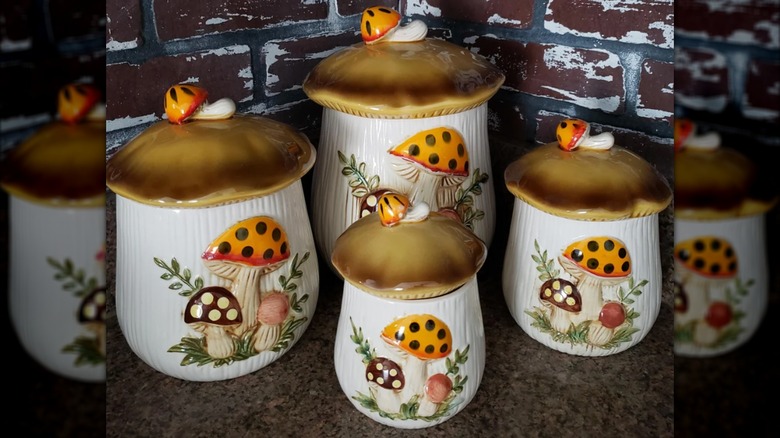
Items from the "Merry Mushrooms" kitchen accessory line by Sears, Roebuck and Co. were iconic kitchen staples in the 1970s and 1980s. The popularity of these kitschy kitchen must-haves lasted until Sears stopped producing the line in 1987, per A Collector's Guide to Merry Mushrooms. The 1982 Sears Christmas Wish Book displayed an impressive spread of countertop flair in the line including mugs, tea pots, cookware, trivets, butter dishes, paper towel racks, napkin holders, bread boxes, planters, clocks, and spice shakers. And that's just to name a few (the collection contained over 60 pieces).
The canisters, however, which were sold as a part of a 4 piece set, were the most popular item and definitely the one that has become the most memorable. With the emergence of aesthetics like cottagecore, the canisters are beginning to gain popularity again and are seriously sought after by devoted collectors. So if you ever see one of these storage jars in a thrift store, definitely grab it, as they maintain a strong resale value.
Electric knives
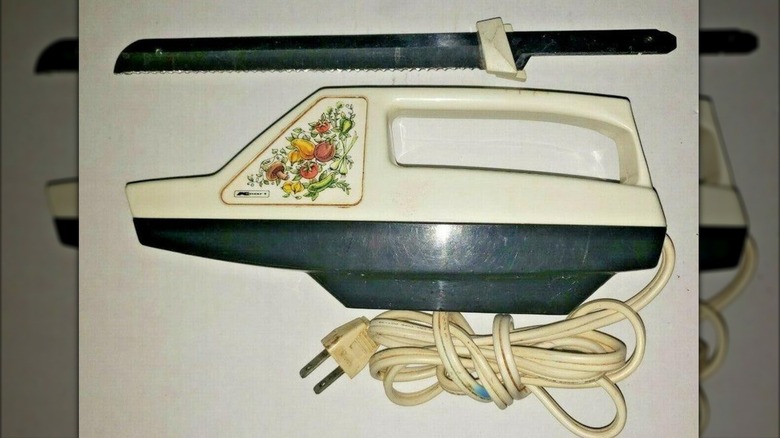
Electric knives were once considered an essential to complete any household kitchen but nowadays, they're far less common. When the high-tech tool first hit the market in the 1960s, they seemed to be the way of the future, especially when it came to cutting large roasts of meat. The way they worked is by two motorized blades moving back and forth in opposite directions. The K-Mart electric knife with a flower and vegetable design on the side is a particularly memorable product for '80s kids, as evidenced by nostalgic themed memes circulating on Instagram.
It's hard to pinpoint a definitive reason for why this device went out of style. It could be a change in how families gather and make meals and the fact that large weekly roast dinners are now rare in American households. A read through comments on sites like Quora also suggest electric knives were annoyingly loud, too difficult to clean, were bulky and cumbersome to store, and actually weren't that effective for carving meat. It seems once the novelty of the product wore off, the cons of owning one outweighed the benefits.
Dazey stripper vegetable peeler
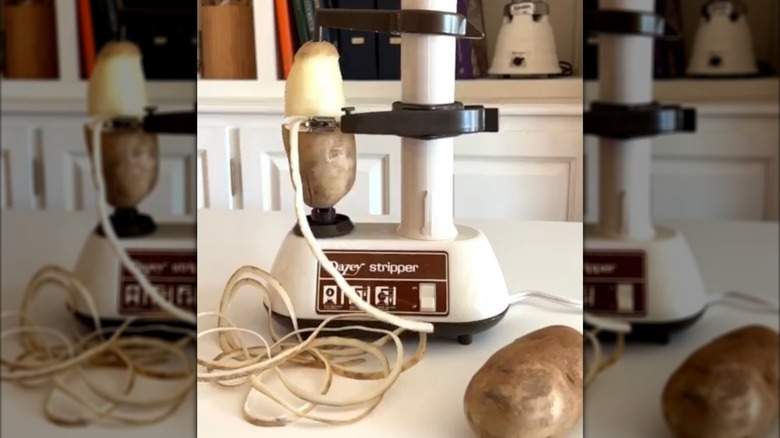
The Dazey Stripper is a great example of a vintage gadget from the 1980s that never really caught on. According to the 1989 Sears Wish Book, it worked by simply placing the fruit or vegetable in the holder, setting a blade atop, and pushing the button. Most commonly used for potatoes or apples, the device spun the fruit or veggie around while a blade stripped it of its peeling, leaving a long, continuous strand of peels as demonstrated on YouTube by emmymade. No doubt, it would come in handy for making large batches of food but clearly the device was not sought after for its day-to-day practicality, hence why you rarely see one anymore.
While the Dazey Stripper is no longer on the market, electronic vegetable peelers do still exist which is great for accessibility reasons. But it seems in the long run, most households decided they didn't need a special device for the simple task of peeling. Inevitably, handheld vegetable peelers remain more convenient to clean and store for the majority of home cooks which is why they remain a timeless kitchen essential and most have forgotten the Dazey Stripper.
Electric can openers
The fact that electric can openers were an apparent necessity in the 1980s begs the questions: how much canned food were people eating back then? In general, the uptick of canned goods began after World War II and played a heavy role in 1950s recipes, according to The National Museum of American History. Processed foods in general had a chokehold on the second half of the 20th century and it's only been in the past couple of decades that conversations around the benefits of limiting such foods have begun to be taken seriously. A generation who grew up eating recipes that incorporated canned goods were continuing this trend into the 1980s and often serving their own children similar meals to the ones they had growing up. Hence the usefulness of an electric can opener in 1980s kitchens.
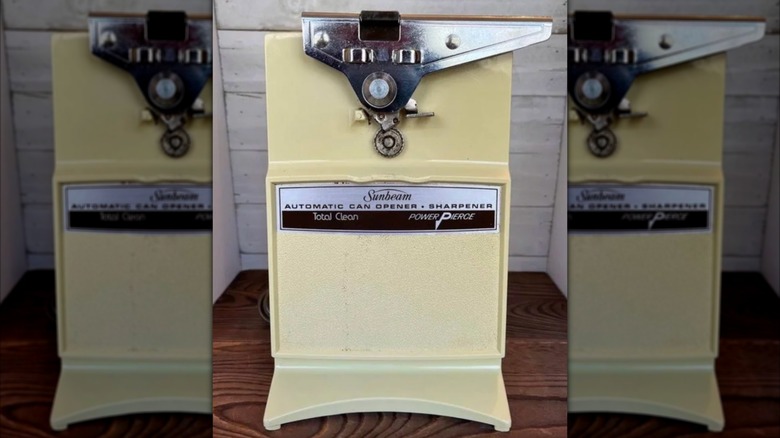
The Sunbeam electric can opener from the early 1980s was particularly popular model and users on Reddit reminisce on how distinctive the sound was and how crusty they often became. Ultimately, the popularity of electric can openers began to fade in the 21st century and manual can openers remain an old school kitchen tool that outlasted their electronic counterparts. After all, it's hard to beat the affordability, the durability, and the compactness of a traditional can opener.
Coffee percolators
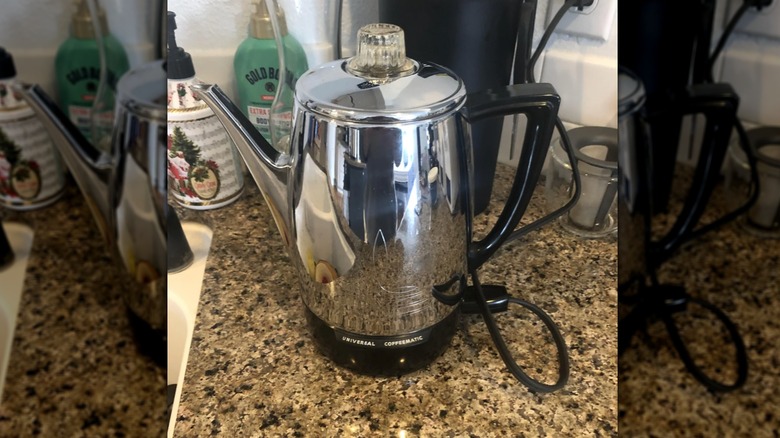
Though drip coffee machines like we're used to today were starting to become common in the 1980s, percolators were still a very prevalent way to make coffee at home well into the 1990s. These pitcher-shaped stove-top devices brew coffee with the force of boiling water which rises through a tube into a basket of grounds and then drips down and recirculates over and over again, according to Cavalcade of Food. Unlike drip coffee machines, the water runs through the same grounds several times. The result is a strong, robust cup of coffee.
However, with percolators, it's easy to burn the coffee and the more complex flavors of beans are going to be less apparent. This was all well and good when robusta beans (which are known for being cheaper and lower quality than their arabica counterparts) were the typical beans used in commercial brands, per Forbes. But as arabica beans, which have more complexity in flavor, grew in popularity at the turn of the 21st century, it makes sense that other brewing methods became the standard and percolators became known as the old school brewing method of decades past. While percolators still hold a nostalgic charm, they're now typically considered an inferior method for making a quality cup of joe, especially if you're using gourmet beans.
Tupperware
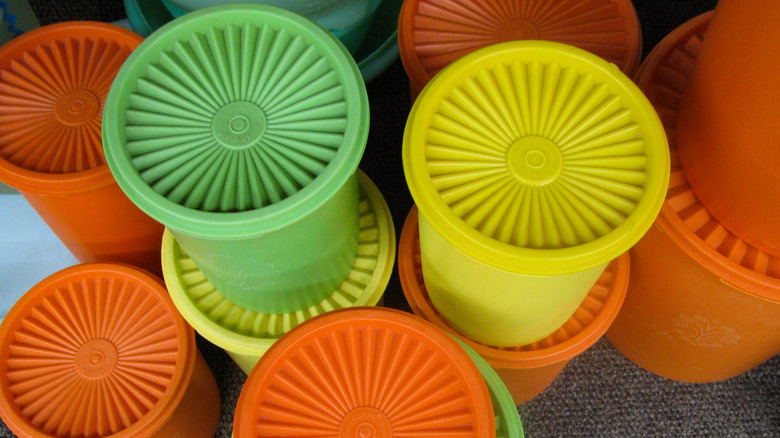
The history of Tupperware is one of American innovation. What began as a scientific experiment eventually became an effective method for storing food to make it last longer and a way for 1950s housewives to make an income from home through the unique sales model of "Tupperware parties." The popularity of Tupperware was undeniably prominent during the second half of the 20th century and the 1980s is no exception. If you could travel back in time and open the cabinet of a kitchen in the 1980s, you would probably see loads of the colorful storage containers, pitchers, and Jel-ring molds. A 1986 recipe book called "Quick and Easy Cooking with Tupperware" shows how the containers were still being used in the decade for everything from molding Jell-O salads to cooking soup in the microwave.
Of course today, we know the potential dangers of microwaving food in plastic containers and many have concerns for even storing anything edible in plastic containers, especially older ones that contain BPA. Unsurprisingly, Tupperware has fallen out of fashion in recent years, largely due to concerns around consuming microplastics. If you do happen to still have some of these plastic relics lying around, be wary of using vintage Tupperware due to its potential negative health effects.
Corn-shaped corn cob holders
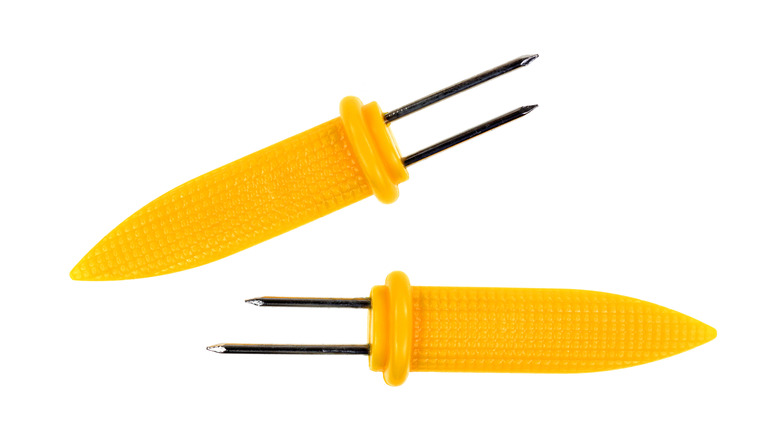
If you ate corn on the cob in the 1980s, you'd likely be using a not-so-revolutionary device to keep your fingers clean from the slippery butter-coated vegetable: corn-cob holders. And most likely those corn-cob holders were kitschily shaped like corn. As one Reddit user puts it, they're the "corn cob holders that your parents have been using since before you were born." The popularity of these cheap, plastic little yellow stakes is a great example of what made the time period so endearing. It was a time when day-to-day items had a little quirkiness to them.
Funnily enough the original idea for a corn holder that looked like corn dates back to a 1909 patent in which the inventor, Carl Bomeisler, includes a drawing and a description explaining, "The holder is shown comprising a handle portion representing an ear of corn." Clearly this design caught on and eventually morphed into the later versions that we know today.
Electric frypans
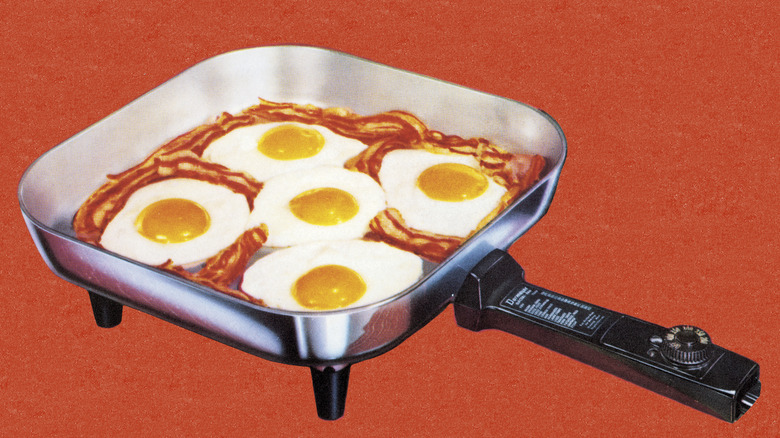
Long before air fryers became the trendy must-have kitchen appliance, electric frypans were the hit appliance. This vintage kitchen appliance was beloved by families throughout the second half of the 20th century for its ability to heat up quickly and cook evenly, particularly at a time when electric ovens and stoves were not as reliable as their contemporary counterparts. These devices were extremely versatile for a variety of different types of food and had easy temperature controls. Many models could detach from the heating element so they could be immersed in water for easy cleaning.
Electric frypans first gained popularity in the 1950s and their influence lasted well into the 1980s, appearing as a holiday essential and suggested gift in the Sears, Roebuck and Company Wishbook for every year of the decade. Nostalgic Reddit users often reminisce about the foods their moms would make on these devices including fried potatoes, bacon, pancakes, and chicken fried steak.
While electric frypans allowed families to save on electricity, these devices also took up a fair amount of counter space. By the start of the 2000s, as stoves and ovens continued to improve in quality and home cooking continued to shift in different directions, the hype of the appliance began to die down.