

This Forgotten '60s Steakhouse Was A Mall Staple
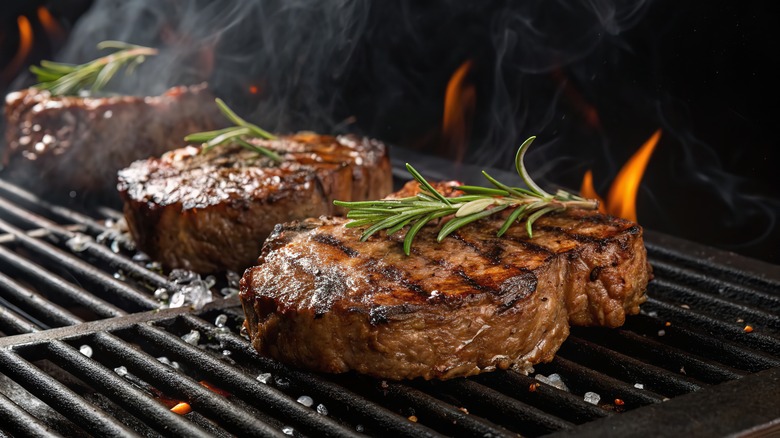
You may find it hard to believe, but shopping malls didn't always have food options, and York Steak House, a pioneer of contemporary mall food, has slipped into obscurity. Folks today may not know the name, but there was a time when York Steak House was one of the country's biggest chain restaurants.
In the 1960s, friends Ed Grayson and Bernie Gross were modestly successful franchisers of Burger Chef, a '50s burger chain that dominated the Midwest until the '90s. Inspired by a profitable Ponderosa in Springfield, Ohio, they chose Columbus for their first York Steak House, named for its Old English theming. The cafeteria-style restaurant was a hit, but their second location was the one that helped make history.
In 1971, Ed's brother Howard opened a York Steak House in Portland, Maine, as one of the first restaurants located inside of a mall. This enormously successful store raked in up to $400,000 a year in profits — just under $3.2 million when adjusted for inflation. In 1977, with 33 restaurants to their names, Grayson and Gross sold ownership of the business to General Mills for $17 million (over $94 million today) but stayed on staff to run the brand.
York Steak House's decade of expansion and collapse
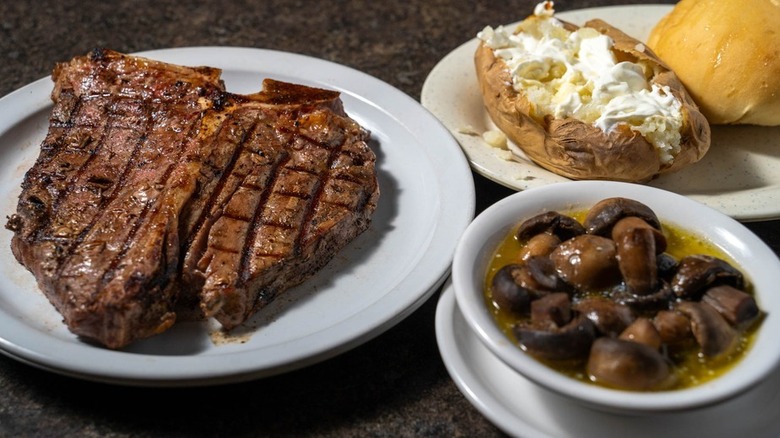
According to Ed Grayson, at first, "General Mills couldn't have been better. They'd come in, look at our figures, and never say a word, never do anything." Except for the pressure to open 25 new units per year, a difficult challenge that York Steak House met as it quickly spread to malls across the U.S.. Business was still booming in 1982, with almost 200 restaurants in 27 states. But one potential misstep may have foretold the chain's fate.
In the early 1980s, mall food courts became a cultural force not only for selling a variety of food in one convenient location, but also as a cool place to hang out. With his contract expiring, Ed Grayson wanted to gain a foothold in this market: "My last act was to say, 'Let's go into food courts. We
can do this in a food court as well as somewhere else in the mall.' But, and we opened two of them, and they were successful, but they [General Mills] never pursued it."
The Grayson brothers left shortly thereafter, and Gross stayed on as brand president for several more years until poor business decisions by General Mills convinced him to quit. In 1989, the food conglomerate sold the business to a large Bonanza franchisee for conversion. For most customers, this was the end of York Steak House, but it wasn't the end of the name.
The last York Steak House
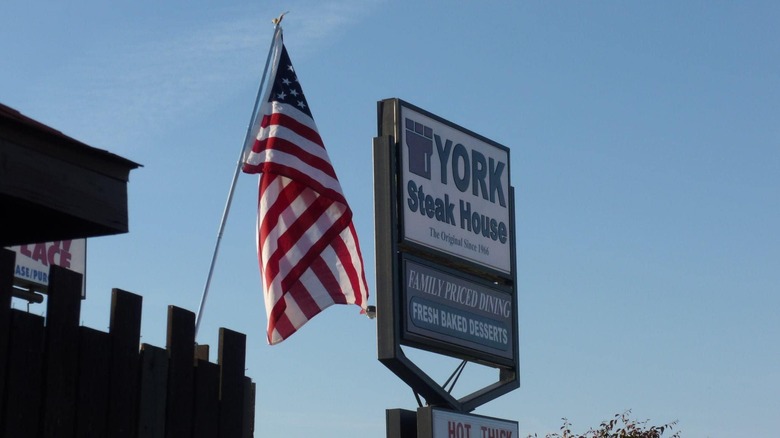
It's not uncommon for franchised restaurants to continue in operation after the core business closes. This was the case for the unusually-named Yogi Bear's Honey Fried Chicken in South Carolina, and for York Steak House. While an unknown number of them continued for several years, only one remains today, and it's in the historic chain's hometown.
The York Steak House in Columbus, Ohio, is a bit like a time capsule. It retains the vaguely Old English castle theme of the original business with wood-framed menu boards, Tudor-style exposed wood ceiling beams, and iron chandeliers. The cafeteria-style setup also remains, with hot and cold items (plus a salad bar) arranged at opposite ends of the restaurant.
Longtime customers are adamant that this last survivor not make too many changes. Historic chain restaurants can be a treasure for future generations, as shown by the last surviving Woolworth's luncheonette in California, cherished for its original decor and even kitchen equipment. The last York Steak House isn't this exceptionally preserved — the chandeliers were modernized, and there's now a salad bar — but anyone who remembers the original business will surely feel nostalgic walking in.