

Why Some Baked Goods Call For Buttermilk Instead Of Regular Milk
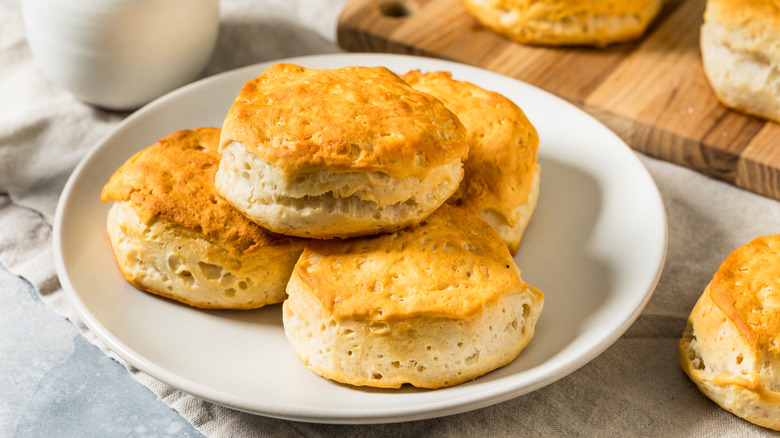
Most who have spent time in the kitchen are likely well aware of the many forms that dairy can take in a recipe. While the difference between using cheese and skim milk — which surprisingly can be used to make ice cream — in a recipe is self-explanatory, the discrepancies between different forms of cream and milk can lead to some understandable confusion. This is especially the case for buttermilk and regular milk, which each have their own specific set of uses that are necessary in the kitchen.
Buttermilk, named due to its origin as merely the leftover liquid from churning butter, is fermented milk that has gained a thicker texture and more sour taste. These days, buttermilk is made professionally by adding bacterial culture to milk and letting it ferment for 12 hours, resulting in a liquid that has more lactic acid in it than traditional milk. This lactic acid reacts uniquely to ingredients like baking soda, often causing doughs and batter to be much lighter and fluffier than if you were to use standard milk. Thus, while accomplishing many of the things that milk can in baking recipes, like adding moisture and flavor, buttermilk can also amplify dishes in ways that regular milk can't. Buttermilk is also commonly emulated at home by introducing some sort of acid, like white vinegar or lemon juice, to milk to ferment it, as the combination reacts in a similar way to the proper version of the dairy product.
The best times to use buttermilk over regular milk
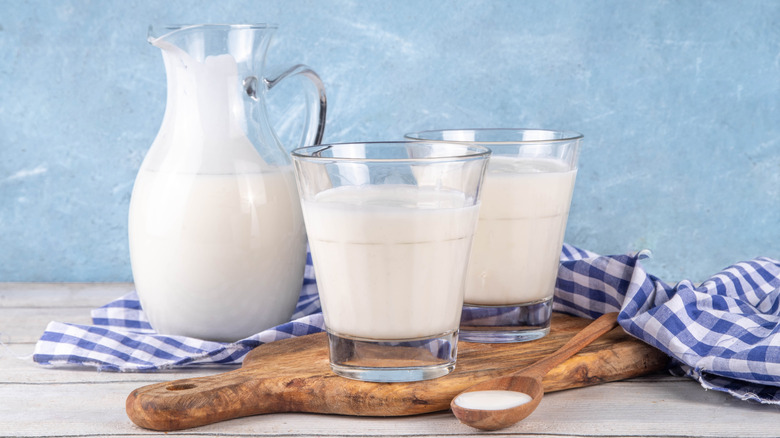
While it goes without saying that keeping some buttermilk on hand if you love to bake is a smart decision, its use even goes beyond just baking recipes that specifically call for the relatively uncommon ingredient. For the most part, replacing standard milk with buttermilk can be done in most recipes, as long as you're conscious of how much baking soda is also going into it. You'll want your recipe to have at least 1/2 teaspoon of baking soda for every cup of buttermilk you use, as this will allow the two ingredients to react to one another accordingly and result in your recipe benefiting from the dairy product's inclusion.
Buttermilk is also useful in other dairy-centric recipes, like ice cream, especially when its tanginess is paired with a fruity topping like strawberries or cherries. Furthermore, buttermilk is useful in several places where milk simply isn't, such as in marinades for meat. The popularity of buttermilk chicken in particular is a great example of its usefulness, as it is able to break down the meat's muscle fibers and proteins, making it infinitely more flavorful and tender as a result. And if you find yourself with some of the dependable ingredient left over and no recipe for you to use it in, don't worry – drinking buttermilk straight has a surprising amount of health benefits that go overlooked, meaning finishing it off yourself is a great way to avoid waste.