

Food Court Favorites From The '90s That Barely Exist Today
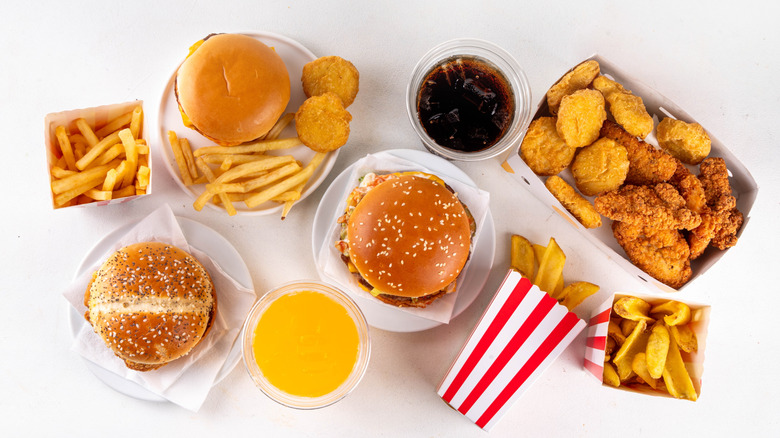
For people of a certain age, nothing evokes a feeling of nostalgia quite like a mall food court. These days, food courts are not quite a thing of the past, but they're definitely spaces that are seeing their last days. As consumer habits have changed and people spend less time in malls and more time shopping online, there's less of an emphasis on the kind of quick bites you'd formerly find in food courts, and more weight is given to full-service restaurant experiences. Back in the '90s, though, things were very different. That decade was the age of fast food, and there was nowhere better to find all of those greasy, sugary, salty delights than that corner of the mall where you'd meet your friends and hang out for hours. Ahh, heaven.
Amazingly, too, a lot of those old favorites that you thought might have died out are still with us today. Classic places like Mrs. Fields, Arthur Treacher's, Boardwalk Fries, and Corn Dog 7, which used to keep people fed in large numbers with their diverse cuisines, can still be found if you look hard enough. Sadly, though, much like food courts themselves, these restaurants now seem to be in their dying days. Ready to take a trip down memory lane? Grab your favorite food court-based snack, and let's go.
Mrs. Fields cookies
If your visit to the food court had to include a cookie, then there's a fair chance that you got yours from Mrs. Fields. This chain was the place to go for chocolate chip cookies back in the '90s, with workers and visitors alike trying to grab discounted treats at the end of the day when the stores had to sell up. Starting life in 1977 in Palo Alto, California, Mrs. Fields soon became a food court staple, enticing customers in with the smell of freshly baked cookies. People still remember its food fondly to this day. "I've always known Mrs. Fields cookies to be the best I've ever eaten," said a former customer of the chain on Reddit. "What happened?"
Unfortunately, the brand eventually took a downward turn, and the 2008 financial crisis seemed to be the last straw for the cookie company's dominance. Mrs. Fields filed for bankruptcy in 2008 following months of customers tightening their belts and avoiding too much discretionary spending. A further bankruptcy claim came in 2018, with the company announcing that it had plans to restructure. Mrs. Fields is still around today, and while it has locations in several states, they're far between.
Corn Dog 7's corn dogs
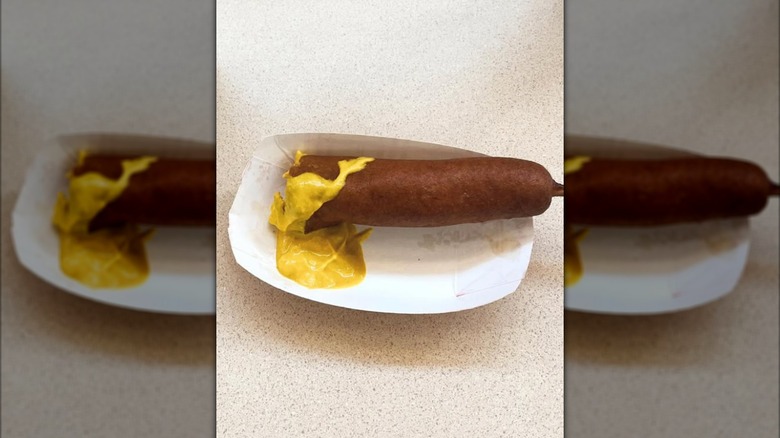
These days, corn dogs are a food that you'd mostly find at a county fair — but back in the '90s, they were a staple of mall food courts. People used to go wild for these corn-covered hot dogs, and companies like Hot Dog on a Stick used to do a roaring trade. Corn Dog 7 was a slightly lesser-known rival to that brand, but that doesn't mean that it was any less beloved. Its corn dogs and other menu items were craved by folks who needed something hot, salty, and convenient, and its cheese on a stick was a particular favorite. "I don't know if any Corn Dog 7s still exist," said one Redditor, "but their cheese on a stick got me through many a sesh of TMNT at the arcade." That last abbreviation stands for "Teenage Mutant Ninja Turtles," just FYI.
Well, we're pleased to tell that person that Corn Dog 7 does still exist — you just might have to look a little harder to find it. The family-owned business, which started back in 1978, now only operates three branches, with two in Mississippi and one in Los Angeles. If you're willing to travel, though, you may just get to relive that nostalgia once more. Alternatively, you could make yourself some cheese on a stick at home by coating some Cheddar cheese in a cornmeal batter and then deep-frying the whole thing.
Blimpie subs
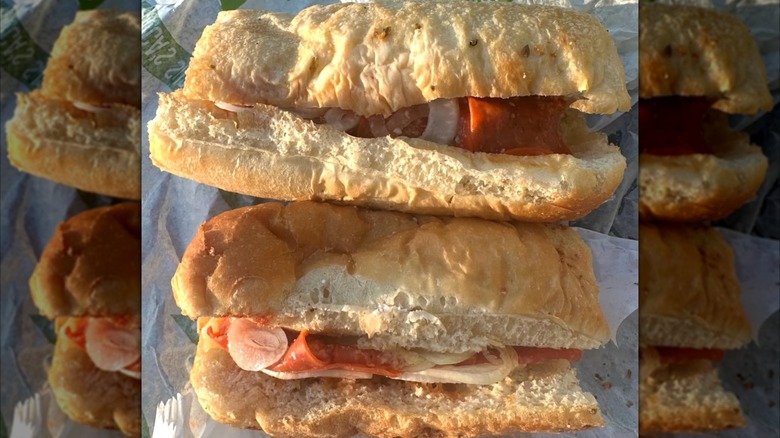
Spare a thought for Blimpie, folks. Back in the '90s, it looked as though it could have been a serious competitor to the likes of Subway and Jersey Mike's. This restaurant was first founded in the 1960s, and by 1983, it had reached 150 locations. In the 1990s, it set its sights on growing even larger, and food courts were a big focus of its operations. Blimpie seemed to realize that where it would thrive best was in transit locations, where people just needed a quick bite to eat before carrying on with their main activity. As well as mall food courts, it also focused on college food courts, airports, convenience stores, and gas stations.
It's those mall memories that stick the most, though, and people still hold fast to grabbing one of its subs between purchases at their favorite stores. Somewhat amazingly, Blimpie still exists today, but you'd be lucky if you manage to come across one in the wild. Its branches are mostly located in colleges or gas stations, so you're more likely to stumble across one by accident.
The Great Steak & Potato Company's Philly cheesesteaks
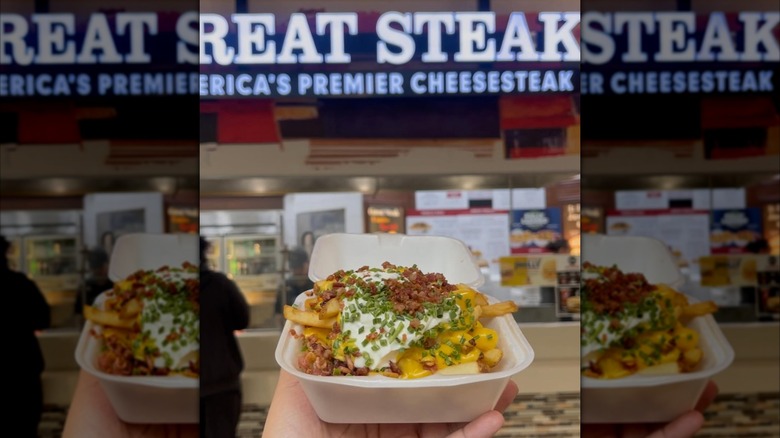
There are a lot of places to get a good Philly cheesesteak, but if you were heading to a mall in the '90s, there was only one restaurant you wanted to go to in the food court. That restaurant was The Great Steak & Potato Company. Post on any online messaging board about which place people liked to get their food from at courts in the '90s, and you'll immediately be flooded with responses stating that The Great Steak & Potato Company's grub was the best. "My favorite place to eat in the mall when I was a kid," said one Reddit user, with another calling it "immediate nap time food."
The fact that The Great Steak & Potato Company managed to dominate so much in the '90s is all the more impressive given that it had only started operating in 1982. The Ohio-based company quickly expanded thanks to its winning combination of hot meat, cheese, and fries, and thanks to a franchising pivot in 1985. The '90s were definitely its heyday, though, and now The Great Steak & Potato Company is way less prominent than it used to be. There are just 63 restaurants remaining in the United States, and 14 more internationally.
Arthur Treacher's fish and chips
If you had a hankering for some fried fish and potatoes a couple of decades back, there was only one place for it: Arthur Treacher's. The fish and chip shop was a mall food court staple back in the '90s, and it was a go-to for its signature offering of deep-fried cornmeal balls, which some people remember as a core part of their youth. "I LIVED off Arthur Treacher's!" said one particularly enthusiastic Reddit commenter, detailing what they used to eat when they frequented the food hall. "No one knows what I'm talking about. I'd get the fish and chips with hush puppies and live."
We're willing to bet that a fair few other folks did this, too. At its peak, Arthur Treacher's was enormous: The fish and chips chain had 826 locations when it was at its largest, and managed to corner a market that hadn't yet been dominated by one business in the United States. However, while Arthur Treacher's was still a big deal back in the '90s, it had actually started to decline before then. The business faced a slow but steady decline from the 1970s onwards, and now it's a shadow of its former self, with single-digit units remaining. Kinda sad, huh?
Manchu Wok orange chicken
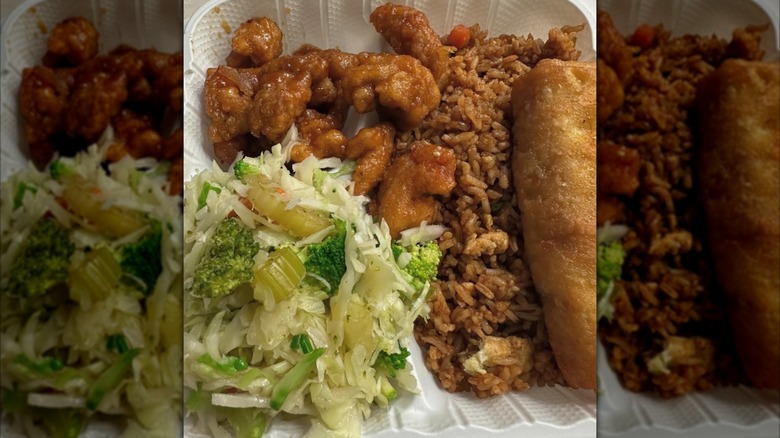
Back in the '90s, there were a few places you could go to in the mall if you wanted American-Chinese food. One of them, of course, was Panda Express, the ultra-famous chain that still does a roaring trade to this day. Another was Manchu Wok, its lesser-known friend that now exists mainly in Canada. Manchu Wok started in 1989, and in just three years, it had accrued hundreds of locations across the United States and beyond, with many of them located in mall food courts. Although its food court locations weren't as successful as branches located in other places, like office towers, they were still a cornerstone of the company's business, and people fondly remember snacking on its orange chicken.
However, over time, Manchu Wok's fortunes gradually reversed, and it slowly receded from view. Perhaps that was due to Panda Express and its dominance; the chain now boasts over 2,300 stores, after all. Manchu Wok, on the other hand, now has just a handful in the U.S., and a few more north of the border.
Surf City Squeeze smoothies
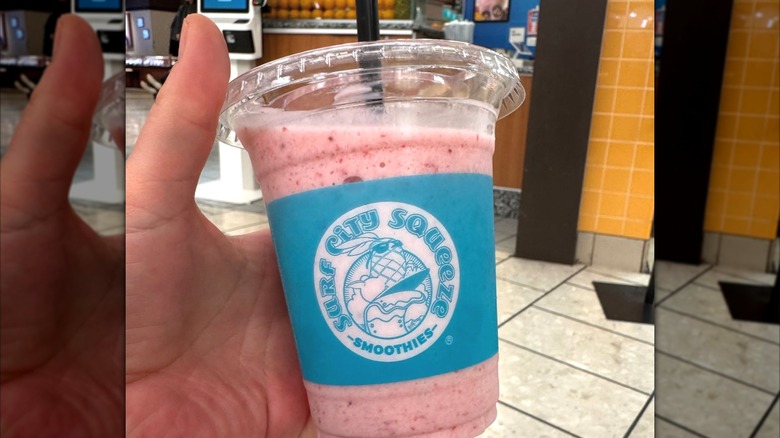
Smoothies were big in the '90s. Although they had been around before then, this decade was when they truly started to take off as a hangover of the fitness craze of the 1980s, with chains like Orange Julius, Jamba Juice, Tropical Smoothie Cafe, and Planet Smoothie all making a brisk trade during this time (despite the questionable nutrition of their drinks). Surf City Squeeze was one such chain, and it's one that gives people misty eyes, thanks to its delicious flavor combos. "Back in the day, I worked at the mall and used to be obsessed with the pineapple orange coconut smoothie at Surf City Squeeze," said one person on Reddit.
Surf City Squeeze has managed to remain in business to this day. It's fair to say, though, that it's a pale imitation of what it used to be. Nowadays, Surf City Squeeze has just 63 units in operation, a number that's down from previous years. Now that everyone can get a smoothie maker or blender in their own homes, there's just less need to head down to the food court to grab one.
Boardwalk Fries' boardwalk fries
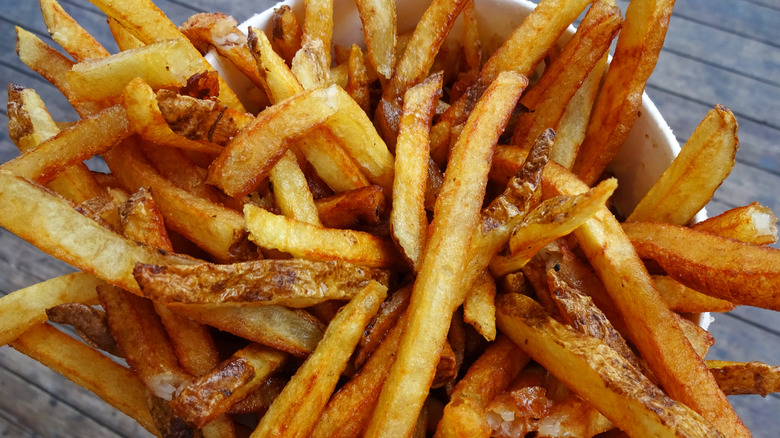
The '90s were the decade that fries got fancy. It was no longer enough to chop them up and cook them once: The 1990s demanded that things be bigger, better, and cooked with more. As a result, double-cooked boardwalk-style fries became a thing, and the place to go was, of course, Boardwalk Fries. This chain served its fries by the cupful to hungry mallgoers, and it was known for offering one thing, and one thing only: Potatoes.
This gave it a super-strong brand identity, but the business (which started its life in White Marsh Mall in 1981) was perhaps a little stuck by the limited nature of its own output. While other chains were expanding and offering all kinds of new menu items, Boardwalk Fries stayed dishing out potatoes and nothing else. Eventually, it started to change its ways and offer burgers and loaded fries, but it didn't move quickly enough to stay on top. Over time, Boardwalk Fries began to fade into obscurity, and while there are a few locations around today, it's far from the bustling fast food business it used to be.
Miami Subs sandwiches
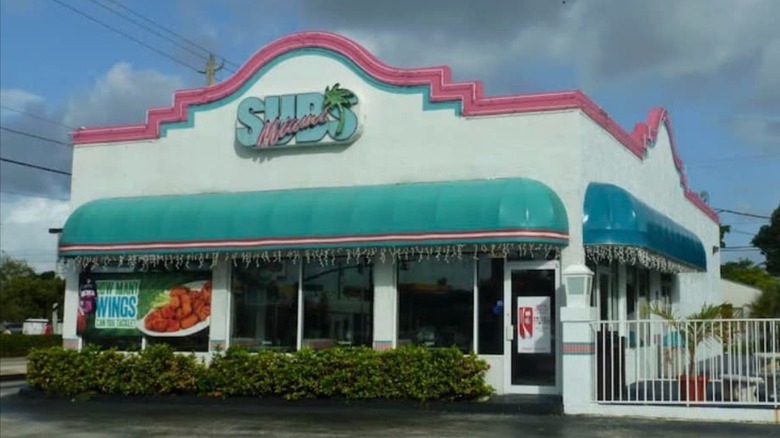
Sub sandwiches weren't hard to come by in the '90s, but if you wanted one with a Floridian flair, then Miami Subs was the place to go. As its name suggests, this restaurant started life in Florida before expanding nationally. By 1997, there were 185 Miami Subs units across the country, with food courts being a key target for the brand, alongside airports, convenience stores, and office building complexes. With a little bit more luck, this sub chain could have taken over the world.
However, Miami Subs' fortunes went south in a stunning reversal and especially violent circumstances. Its founder, Konstantinos Boulis, sold the brand in 1999 to Nathan's Famous and continued to invest time in his casino venture. After a falsified wire transfer to buy the casino business from conman Jack Abramoff, however, Boulis was killed in a mob hit. Sadly, the Miami Subs image then took a downturn, and despite investment from none other than singer and rapper Pitbull in 2012, it never quite recovered. The chain's now called Miami Grill, and it has locations throughout Florida, South Carolina, and Nevada.
Flamers burgers
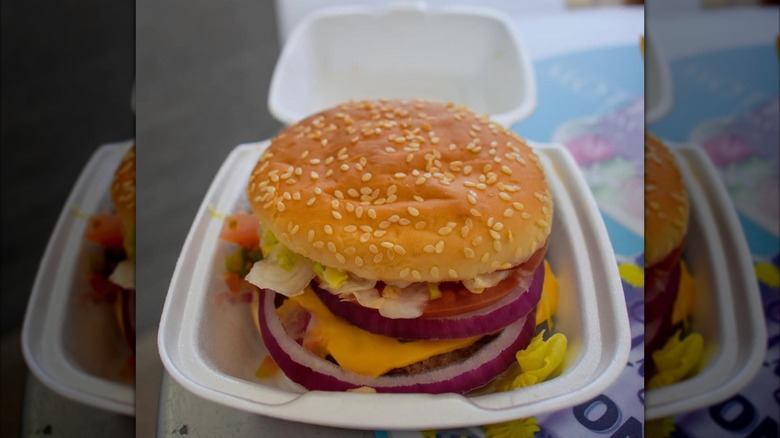
Burger King wasn't the only restaurant chain that could do flame-broiled burgers back in the 1990s. There was also the aptly named Flamers, a burger joint that was first born in 1987 in Jacksonville, Florida, and subsequently was rolled out across the country. We're not quite sure what it was putting in its burgers, but it's clear that they were good enough to create memories that lasted a lifetime. "Flamer's had awesome hamburgers that they grilled right in front of you," said one person on Reddit, recalling their memories of their favorite food court grub. "Big round ones and then you pick the toppings right there like at a sub shop. Nice serving of fries as well. Damn, I can still taste their delicious food."
It's not entirely clear where it all went downhill for Flamers, but over time, it appears that it lost its shine. Perhaps there was only room for one flame-broiled hamburger chain after all, and Burger King swallowed up the competition — or perhaps it couldn't survive once mall food courts began to disappear. Regardless, Flamers began to shrink in size, and today it's only got about 50 locations, mostly in malls that are dying themselves.