

Classic '80s Fast Food Spots We Wish Would Come Back
We don't want to scare you, but the '80s were roughly 40 years ago now. We know, it unsettled us too. As such, it's fair to say that the world feels like it was kind of an alien planet back then. A different time when Rubik's Cubes and power suits ruled the roost, and life was all about living it to the max. That kind of lifestyle, of course, included a healthy amount of fast food. Alongside the other popular foods in the '80s, fast food restaurants were really reaching their peak during the decade. It's therefore no surprise that fast food chains were absolutely everywhere: As well as the usual huge suspects like McDonald's, Burger King, KFC, and Taco Bell, there were also a ton of regional and smaller-scale outfits that kept people fed across different sections of the country.
Some of America's fast food chains have a long history, and with so many of them out there, it's little wonder that not all former staples from the '80s are still around today. What is surprising, though, is how many of them are gone for good after reaching such massive numbers during the decade. Fast food joints like Rax Roast Beef, Naugles, and Pup 'N' Taco, serving 1980s foods, were heavy hitters before virtually disappearing without a trace. Others, like D'Lites, tried something a little new during the 1980s, and unfortunately didn't quite stick the landing. Whatever the reason for their disappearance, these fast food spots are ones that we want to see again.
Rax Roast Beef
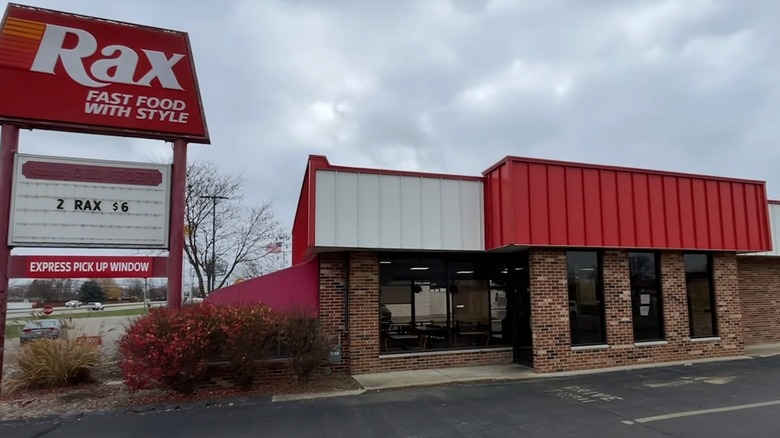
Did you know that Rax Roast Beef once had hundreds of locations across the country during the 1980s? We wouldn't blame you if you didn't; in the 2020s, most people have never heard of it. However, there was a time when this chain was a serious player in the fast food game. Rax first opened its doors in 1967, when it was known as Jax. A decade later, and its name shifted slightly into its more well-known form, and it seems like the change did the chain good. It soon started adding restaurants quicker than anyone could count, and by the mid-1980s, it was absolutely enormous, with locations also spilling over into Canada and Guatemala.
Rax specialized in roast beef sandwiches, but it was also an innovator in its field. It pioneered the concept of a salad bar, which it filled with interesting items, and it even had a dessert bar at one point. It also introduced the concept of serving baked potatoes in fast food restaurants. Rax was spending heavily on its marketing during this period, but it was also starting to struggle financially. Then, in 1992, an ill-fated ad campaign featuring a highly unpopular character sealed its fate. Rax fell out of favor and had to file for bankruptcy. Its stores began closing, and Rax never recovered. We wish it would make a comeback, though; we think that chains like Arby's, offering roast beef sandwiches, deserve a worthy competitor.
Showbiz Pizza
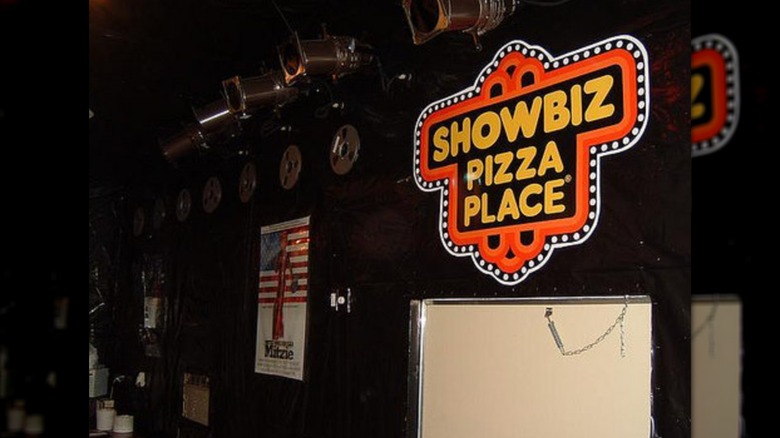
There are plenty of pizza chains in America, and who doesn't like theirs with a little pizzazz? That was the concept that Showbiz Pizza was bringing to the table way back in 1980, when it first opened its doors in Kansas City. The fast food restaurant was a fairly contentious offshoot of Chuck E. Cheese (formerly known as Chuck E. Cheese's Pizza Time Theatre), and expanded on many of the high-concept ideas that the chain brought to the table. Diners at Showbiz Pizza would be treated to a live show while eating their pies — there were various stages dotted around the dining room, and themed rooms would keep people entertained as they chowed down. It all sounds very '80s, right?
Just as Chuck E. Cheese was about to go totally under in 1984, Showbiz Pizza bought it out, incorporating the brand under its wing. However, over time, it seems that Chuck E. Cheese's name recognition eclipsed Showbiz Pizza's. The latter's restaurants gradually began to undergo refits to take on Chuck E. Cheese theming, and in 1998, ShowBiz Pizza Time Inc. was renamed Chuck E. Cheese Entertainment Inc. We think that the world could benefit from Showbiz Pizza's razzmatazz a little more these days, though.
D'Lites
D'Lites was a fast food chain with a difference. At a time when you couldn't move for greasy burgers and heavy fried chicken, D'Lites founder Doug Sheley thought he spotted a gap in the market: A fast food restaurant that offered a healthy spin on the classics. After consulting with Wendy's founder Dave Thomas, Sheley followed his instinct and created his chain in 1981, opening the first D'Lites restaurant in Atlanta. The restaurant would focus on reduced-fat, reduced-calorie, and nutritionally-dense meals without compromising on items that you knew and loved, by using lean beef, light cheese, and high-fiber burger buns.
It all sounds pretty smart, right? No wonder D'Lites grew as quickly as it did. After a slow couple of years, D'Lites exploded in size, and by 1985, it had 100 restaurants operating across 19 states, and plans to create more than 1,000 additional locations. Sadly, however, D'Lites started to struggle when locations were built in blue-collar areas that didn't quite take to the concept. Ultimately, the chain was bought out, and D'Lites closed for good. We think that it was an idea that came before its time, though: We dig the idea of having a fast food restaurant that puts nutrition at its core, and we'd love to see how it fares in a landscape that understands better than ever before how to make healthy food taste amazing.
Sisters Chicken and Biscuits
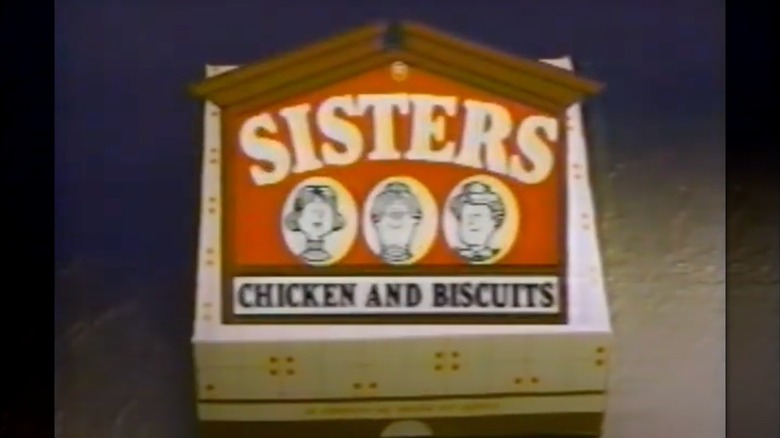
Buttermilk biscuits are a southern staple, but if you've never heard of the chain, Sisters Chicken and Biscuits, we wouldn't blame you. The fast food franchise lasted just nine years, and while that's pretty impressive in the competitive landscape of quick-service eating, the fact that it was run by fast food giant Wendy's made us think that it might have stuck around for a little longer. In fact, though, when Sisters Chicken and Biscuits was founded in 1978, it was intended to be an expansion vehicle for Wendy's. Created by Wendy's franchisee James W. Near, it soon became a subsidiary of the burger restaurant.
The vibe of Sisters Chicken and Biscuits was homely, rustic, and warm, with restaurants surrounded by white picket fences and adorned with lanterns. Inside, the prices were pretty good: You could get a 10-piece box of chicken with four biscuits and a liter of Coke (yep, a liter) for just $7.99. We personally think that this chain should have been bigger than it was, but sadly, it wasn't meant to be. In 1987, Sisters Chicken and Biscuits was sold to its largest franchise owner, and promptly disappeared.
Pup 'N' Taco
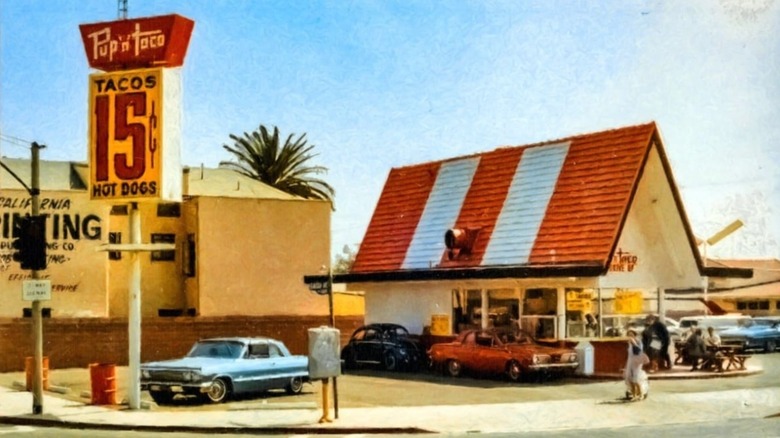
If at any point in the 1980s you wanted a chili dog, a taco, a tostada, a burrito, and a pastrami sandwich all at once, then there was one place you could get them: Pup 'N' Taco. This versatile fast food chain first opened its doors in 1965, but it took a little while to gather momentum. By the 80s, however, it was on a roll, operating approximately 100 locations. Although it was mainly spread across California, it also expanded into Colorado and New Mexico, and for a while, it looked as though it was set to take off.
However, it wasn't to be. Pup 'N' Taco just couldn't keep up with the rapid growth of its competitors, and it faced a particular threat from Taco Bell, which was churning out tacos at a mind-blowing pace. Sadly, Taco Bell smelled blood in the water: When Pup 'N' Taco's founder Russell Wendell started to focus on new projects, Taco Bell snapped up nearly all of the chain's locations. Pup 'N' Taco was left with just three restaurants in Albuquerque, with Wendell having to change their names to "Pop 'N' Taco," due to Taco Bell owning the rights to the Pup 'N' Taco brand. Now, sadly, the restaurant is no more — but we think that a fast food chain that serves almost everything you could care to order has a place in today's world, and we're begging for it to make a comeback.
Burger Chef
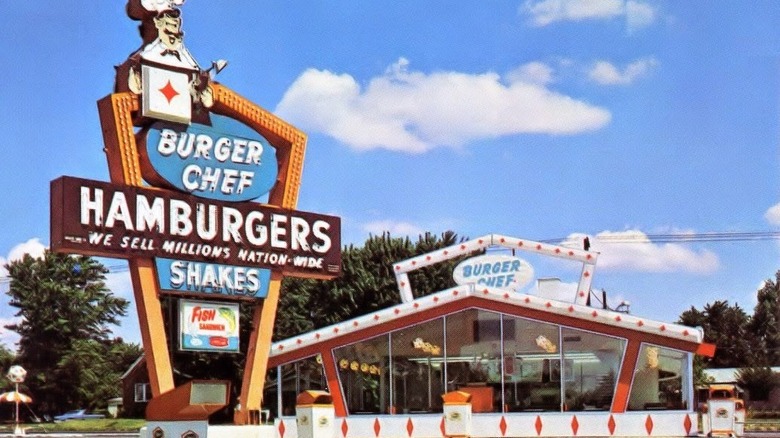
The rise and fall of Burger Chef has to be seen to be believed. There was a time when this burger chain was the second-largest fast food business in the country, and at the peak of its power, it had more than 1,200 individual restaurants. Not bad for a fast food joint that started as a single location back in 1957 in Indianapolis.
Burger Chef's success was propelled both by a sale to General Foods Corporation in 1968, and by its iconic menu items, including the Big Shef burger and its Fun Meals (which incidentally came before the Happy Meal). Sadly, in the 1970s, it began to struggle, but in the early 1980s, it still had a strong presence in the market. Then, at the end of 1981, it seemed that it was time for Burger Chef to hang things up for good. An offer came in from Hardee's to buy the brand, and with that, Burger Chefs began transforming. The number of Hardee's locations duly skyrocketed, and with that, the Burger Chef name was no more. We think it all ended too soon, and we're frankly devastated that we didn't get to try the Big Shef.
Naugles
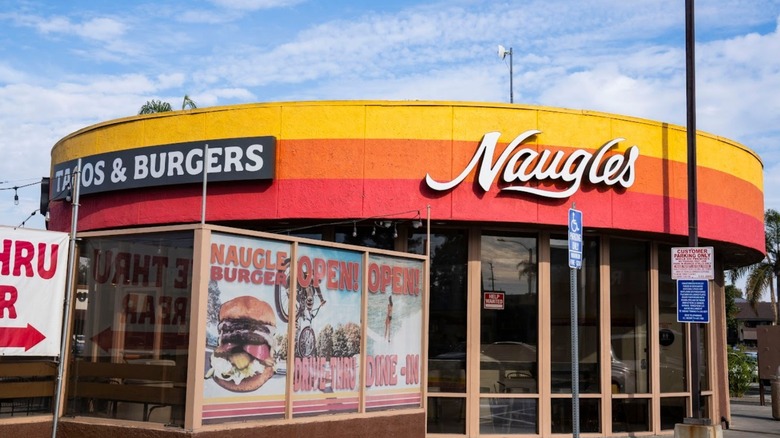
Although Naugles isn't around anymore, its story is one that all aspiring entrepreneurs should hear. Founded by Dick Naugle in 1970, when he was nearing his 60th birthday, the American-Mexican food chain began life as a single location in front of a cemetery in Riverside, California. It's not exactly the kind of spot that promises instant success, but within a year, Naugle was pulling in $40,000 a week in sales, all driven by a combination of his sheer grit and the promise of tasty tacos and burgers.
Naugles grew at a rapid rate, and throughout the 1980s, it was a permanent fixture in the American-Mexican food space. By 1986, it had reached 214 units, but it had also started to struggle with depleted cash reserves. A couple of years later, Naugles was acquired by Del Taco, which greatly increased the footprint of the latter restaurant and depleted the presence of the former one. It looked like it was all over for Naugles. However, there was a twist in the tale in 2015, when food blogger Christian Ziebarth won a trademark battle against Del Taco that revived the Naugles brand. Now, two Naugles restaurants are in operation in California, but it hasn't achieved anywhere near the national prominence that it once had, and most people don't know it exists. We think it's time for that to change.
Druther's
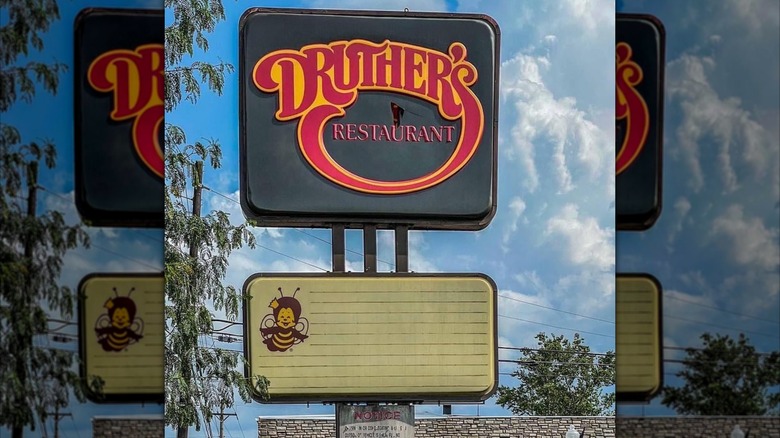
Druther's was one of those quintessential '80s fast food restaurants, but those folks with a longer memory will know that it existed long before that. Druther's was originally known as Burger Queen, which first opened in Winter Haven, Florida, way back in 1956. Burger Queen spread across the state before popping up in other parts of the country and abroad, but by the 1970s, it was becoming apparent that its name was a problem: When it tried to open stores abroad, it clashed too much with Burger King, leading to confusion and legal troubles between the two. It was time for a rebrand, and in 1980, Burger Queen became Druther's.
By 1985, Druther's was operating 158 restaurants across eight different states, and stores in places as far-flung as the United Arab Emirates and Taiwan. Eventually, though, times changed for the brand, and in 1990 it was bought out by the (also similarly-named) Dairy Queen. There's one single Druther's left in Kentucky, but it has no presence nationwide. It's a shame it's not still a big operation, as Druther's hugely diverse menu made it a winner: You could get everything from fish and chips, to burgers, to potato wedges, to fresh salads. Combine that with an all-American image, and it was a winner.
Chicken George
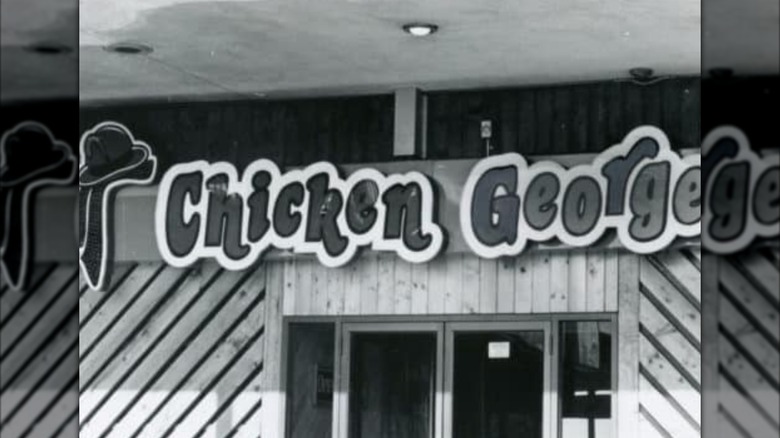
Chicken George was a fast food chain that did things its own way. Founded by Theodore N. Holmes in 1979, the chain was named after a character in Alex Haley's "Roots: The Saga of an American Family," and the business specialized in serving southern and soul food to the African American community around Baltimore. Instead of churning out burgers or tacos like loads of other fast food chains at the time, Chicken George instead had dishes like spicy greens, Louisiana gumbo, and fish with homemade biscuits on its menu. It was an immediate hit when it opened, and by 1983, it had eight different units operating in both Baltimore and Philadelphia.
Sadly, though, its success couldn't last forever. In 1988, it was forced to file for bankruptcy, being unable to pay its creditors back. Chicken George couldn't make up the difference needed with its assets, and it shut down for good. It's a shame, too: This was a chain that had not just a distinctive menu in a pretty boring fast food landscape, but was also beloved by its community.