

Slow Cooker Vs Oven: Which Is Best For Tender Beef Short Ribs?
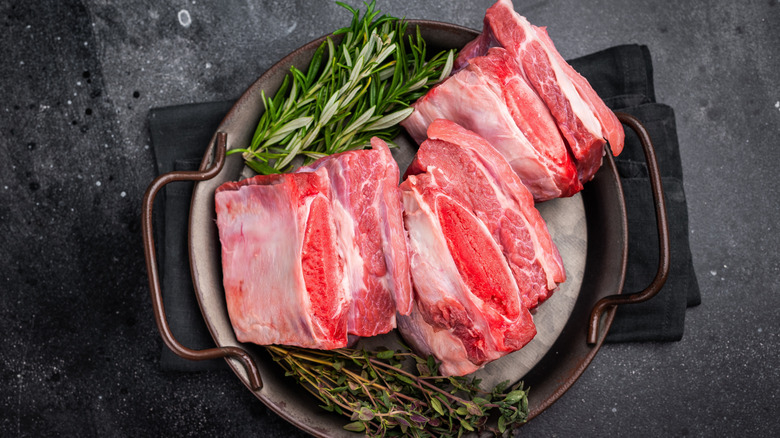
Short ribs are a fatty beef cut found along the upper portion of the cow's rib cage, or (for those who know their beef cuts), they're usually from either the chuck, plate, rib, or brisket. The high fat content renders while cooking to create an extra tender bite, but you have to treat the fat right to get there: You need a longer cooking time and a lower temperature.
As you can tell from the appliance's name, it's hard to beat a slow cooker for things that need to be cooked slowly, including short ribs. It's a nearly foolproof way to make them as tender as possible, but a standard oven also has potential — that is, if you don't just toss a bare rack of ribs in for an hour. For an oven to match a slow cooker's ability to yield extra-tender meat, look no further than braising. Braising in an oven is nearly as easy as slow cooking, and if done right, means equally tender short ribs.
A slow cooker may be ideal for convenience and texture, but cooking short ribs in an oven — while slightly more challenging — can have the same, if not better, results. Each method has its own advantages and disadvantages beyond tenderness, which must be considered alongside how much meat falls off the bone at the end.
Oven-braised short ribs
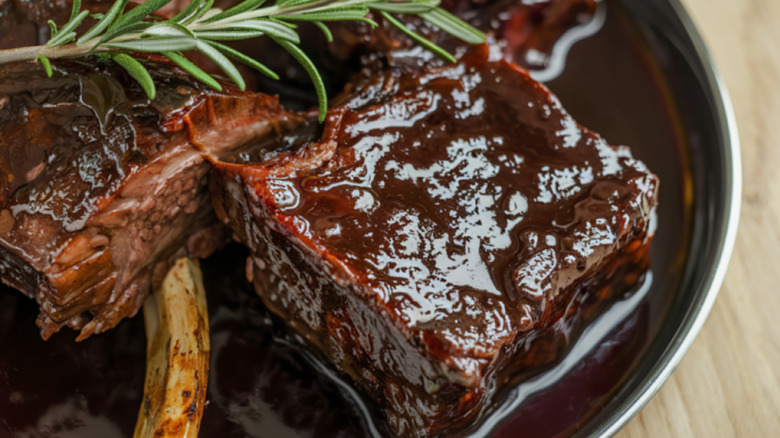
Braising is a two-step process where the short ribs are seared on the stovetop and then roasted in the oven while covered and submerged in a flavorful liquid, like beef stock with diced onions. Braising is done at lower temperatures than most oven recipes, often around 325 degrees Fahrenheit or lower, which allows the intramuscular fat to melt into tender meat and a flavorful broth.
Minus the searing, a well-executed braise is conceptually similar to a sped-up slow cooker. It takes slightly more work, but produces similar tenderness faster. How much faster varies — the ribs are done when they're done — but they will need at least 2 or 3 hours in the oven. And that's in addition to prep work, including time spent searing.
Braising is appreciated for its excellent development of flavors, especially the searing step's Maillard reaction for tasty browned edges. But the braising liquid matters too — restaurants often braise short ribs with beef stock and red wine, using a whole bottle for a braising liquid that's about half wine and half stock. As delicious and chef-approved as oven braising is though, don't count out a slow cooker.
Slow cooker short ribs
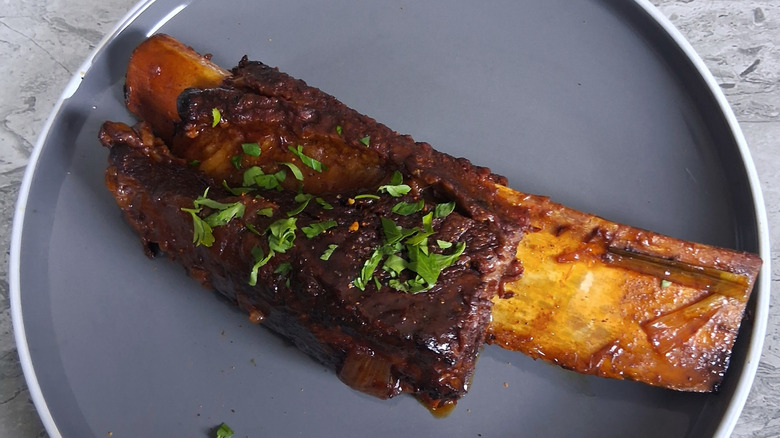
Perhaps a slow cooker's main attraction is convenience. Simply preheat, toss everything in, and come back in a few hours. It's essentially an extended version of the liquid part of braising. And though it isn't necessary, you can also sear short ribs before they go in a slow cooker for better, braised-like flavor at the cost of having an extra pan to wash.
Slow cookers take so long because of their limited temperature range. A slow cooker's high and low settings represent big temperature swings; it varies by make and model, but low (where you should cook short ribs) can mean around 170 degrees Fahrenheit, and high is almost double that. They can't get as hot as an oven, so they take longer too. But there's a limit to how tender short ribs can get; remember that braising produces similar results in half the time.
This method has another drawback in the flavor development. Unlike braising, you should avoid cooking with too much alcohol in a slow cooker. If cooking with red wine, the alcohol content won't begin to cook off until it reaches 173 degrees Fahrenheit. That takes longer in a slow cooker on low than an oven set to 325. Without reducing the red wine content — and weakening the flavor — your broth could wind up unpleasantly boozy. But the short ribs will be incredibly tender.