

Gordon Ramsay's Tip For A Picture-Perfect Beef Wellington

Preparing a classic beef Wellington is a true test of culinary skill and timing. You've got to prepare the filling, sear the beef perfectly, and assemble it all together in a puff pastry crust before crossing your fingers and hoping the tenderloin doesn't overcook while the pastry browns in the oven. As if that weren't enough, it also needs to look uniform and inviting when sliced into rounds at the table. Luckily, Gordon Ramsay has a tip for making a picture-perfect beef Wellington: Use several layers of plastic wrap to make a seamless log that keeps its shape once baked.
The British chef employs cling wrap at two key points during the assembly stage. First, he lays it down on the worktop (using two sheets in case one of them splits) and spreads a mushroom mixture over the top in an even layer. Known as duxelles, this element of the dish completely encases the beef before it's wrapped in pastry, giving the dish an additional burst of umami. However, the texture of the sauteed mushrooms makes it tricky to coat the tenderloin without it all falling away. Placing the duxelles on the plastic before putting the beef on top means the wrap can be lifted up at the edge and laid over the meat more easily. From there, it's rolled into a tight cylinder and refrigerated until it's ready for the next step.
A uniform beef Wellington encourages an even cook
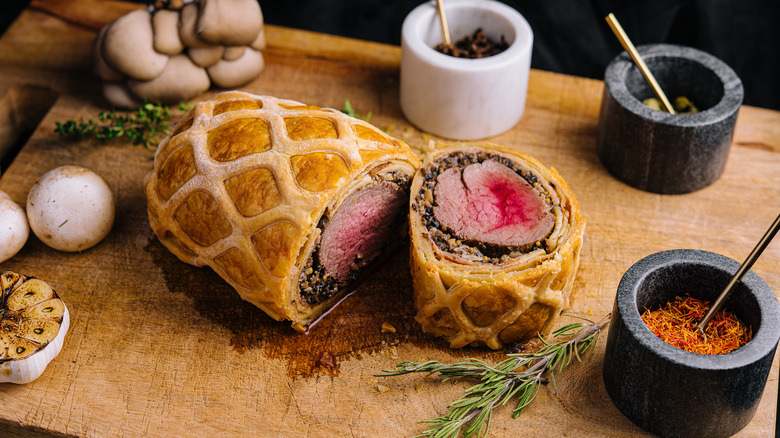
Once the mushroom-coated beef is chilled, Ramsay places more layers of plastic wrap beneath his puff pastry. He then unwraps and places the beef on the dough and uses the same technique to lift up the edge of the plastic to completely encase the meat. The key here is to be firm without disturbing the delicate surface of the puff. While you could try to complete this step without the plastic wrap, you might end up making holes in the pastry or make it trickier to work with as the warmth of your hand softens the fat inside. The plastic creates a barrier between your hands and the pastry which allows you to roll the Wellington into a tight tube with an even thickness that looks perfect when served. Moreover, a Wellington that's uniform across its entire length — with no areas thicker or thinner than others — will cook more evenly, guaranteeing that the beef remains succulent in the center and isn't over- or undercooked in parts.
One of the common mistakes that can ruin beef Wellington is failing to place it seam-side down in the oven after brushing it with an egg wash. However, if you use Ramsay's technique and roll the finished Wellington properly, you should be able to massage the seam and smooth it out to limit the risk of leaks. Any beef Wellington leftovers can be reheated in the oven covered with a sheet of foil.