

Make Bakery-Worthy Bread Every Time By Following This Math Rule
If bread baking is your love language, then you know precision is the key to getting the perfect loaf, whether sourdough or marble rye. You also know that it's not achieved by simply breaking out the measuring cups and leveling off ingredients. For bread bakers, consistency lies in using baker's math or baker's percentages. This is when ingredients are measured in percentages relative to the weight of the flour used, with the flour's weight always equaling 100%. Why is flour the constant? Because it provides bread's structure, and everything you add to it changes that.
You may find this to be confusing at first, as it doesn't follow the typical rules of math, but it is the not-so-secret method to getting a consistent taste and texture whether you bake two loaves of bread or 20. Think of it this way: If you were building a house with Legos or Lincoln Logs, and you always keep the same base, you can make it taller or shorter, but it will always have the same basic shape. That's the same principle as baking bread using baker's math.
Memorize the formula
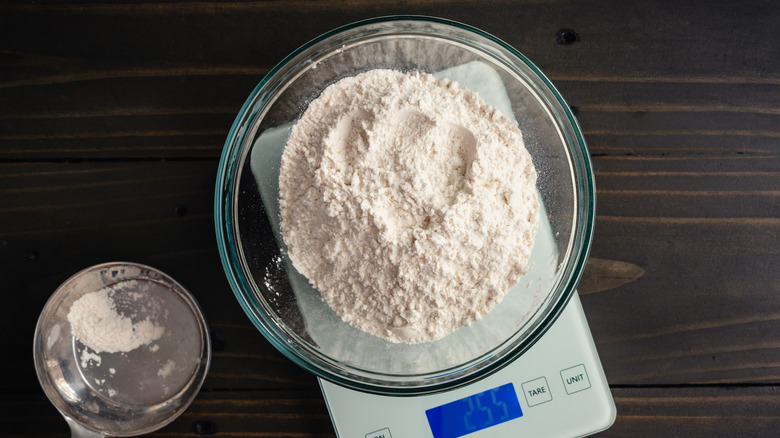
How does it work in practice? First, imagine that your classic challah bread recipe calls for 1,000 grams of flour and 700 grams of water. This means that the dough's hydration is 70%. If you were to increase the water-to-flour ratio, it would become wet and sticky, producing a softer bread. If you decrease it, the bread will be drier and more crumbly.
Additionally, if you add in 15 grams of salt, which would be equal to 1.5%, and 10 grams of yeast, which is 1%, the recipe's total percentage would be 172.5%. It's weird, we know — but it allows you to scale the percentages of certain ingredients up or down. If you want to add or remove ingredients like butter, sugar, or oil, this ratio helps you do that without changing the entire recipe. The most important thing to remember is that everything revolves around the amount of flour you choose to use.
If you like formulas, the baker's percentage for any individual ingredient is calculated by taking the total weight of said ingredient and dividing it by the total weight of flour, and then multiplying that number by 100. Memorize this, and you can use it for whatever pizza dough or bread recipe you are making. The real lesson here: Start using a scale for baking to weigh your ingredients to avoid making common mistakes that can happen with bread making.