

This Old-Fashioned Appliance Could Be Found In Most Kitchens – Now, It's A Thing Of The Past
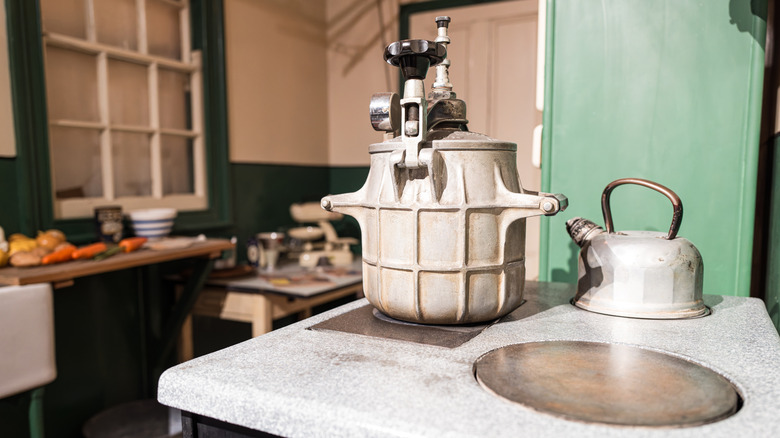
Modern kitchens are packed with nifty electrical gadgets and appliances like Instant Pots, coffee machines, and even dehydrators. However, once upon a time, culinary appliances ran on nothing but elbow grease, which meant everything took a little more time and energy. One such old-fashioned appliance that could be found in most kitchens (but is now a thing of the past) was the butter churn.
Along with nut grinders, the cookie press, and percolators, the butter churn is one of the retro appliances that time forgot. Often set in the corner of the kitchen, the butter churns of old were usually large and unwieldy, but they provided homesteaders with a way to make butter from the milk collected from their cows once the cream had risen to the top. They were shaped like barrels and had a pole sticking out from the top of the lid known as a dasher. This long handle was plunged into or stirred around the bottom of the barrel to agitate the cream inside. Later in the 1940s, butter churns became compact and easier to use — they looked like glass mason jars with a paddle inside and a crank on the lid that was perfect for turning by hand. These gadgets could be placed on a tabletop to make smaller measures of butter and didn't take up heaps of space.
How is butter made?
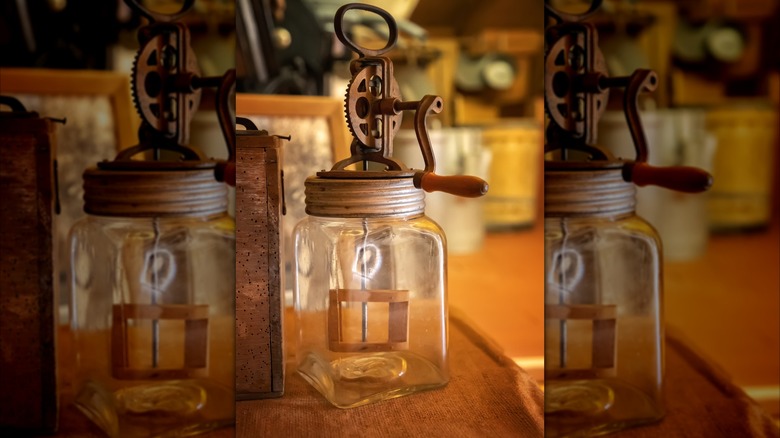
Interested in the science behind how cream actually becomes butter? It's the tiny particles of fat inside the cream that start to cling together in a clump when they're bashed against each other. This leaves behind a ball of butter and a measure of liquid known as buttermilk. Therefore when cooks made their butter by hand, they created two separate ingredients that could be used in their dishes: butter for sautéing and making pastries, and buttermilk for preparing tender biscuits and pancakes.
Nowadays, large old-fashioned butter churns have completely disappeared from kitchens because commercially made butter is so easily accessible and affordable at the supermarket. That said, there are modern tabletop versions around that use a similar hand-crank technology but boast a prettier aesthetic for cooks who like to make everything from scratch. It can take around 8-10 minutes of churning by hand for yellowish clumps of butter to appear within the cream, so it does require some manual labor. Once a lump has formed, it has to be rinsed in water and squeezed so any residual buttermilk can be removed. Then it's ready to shape into a log or be mixed with additional flavorings, like salt, herbs, garlic, or chili to create homemade compound butter. While this process is time-consuming, there's something satisfying about making it from the ground up without using any preservatives or colors.